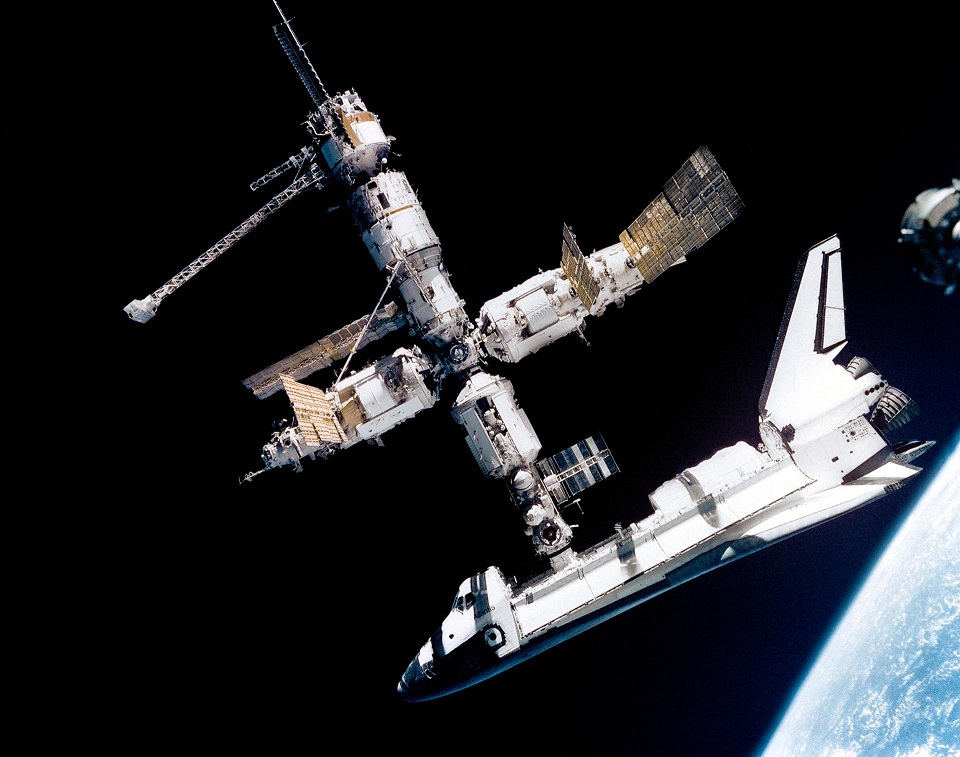
Space colonies ancestors from the last century
To fully enjoy reading this post, listen to Spacelab by Kraftwerk
Spacelab… Spacelab… An electronically distorted voice echoed in the room when many years ago I was dreaming about living and doing weird experiments among the stars. The dream has finally come true! Let’s see how.
By space colony is usually meant a large, self-contained, artificial environment in space that is self-sufficient and permanently inhabited. This concept has been featured in many sci-fi novels and movies since Edward Hale wrote his short story “The Brick Moon” in 1869 (yes, more than 130 years ago, yes a sphere made of bricks in space!).
From fiction to theorization the step is very short and so at the beginning of the XXth century space travel and colonies started to appear in works by visionary geniuses like Konstantin Tsiolkovsky, one of the founding fathers of modern rocketry and astronautics. It took more than fifty years since his most important work, Exploration of Outer Space by Means of Rocket Devices (1903) to see a human in space. April 12, 1961: one of the most significant dates in the history of humanity, the day that Yuri Alekseyevich Gagarin reached outer space, laying the first stone to become Spacepolitans!
After that day and in the middle of their Space Race, Russia and USA started to send several manned missions to space, increasing step by step the duration of the space flights, since establishing the first permanent space station.
The very first one was the Russian Salyut-1 in 1971, followed by the American Skylab, launched in 1973. In the following years a series of other experimental stations of the Salyut program were launched, trying to increase the duration of their presence in orbit: Salyut-1 remained in orbit 175 days before crashing back to Earth, Salyut-7 as many as 3216.
It was still a Russian station to break any record, MIR: launched in February 1986 it remained in orbit for 5511 days until March 2001, it was occupied by astronauts for 4594 days and hosted 125 human beings. But MIR broke another record: it was the first “international” station, with many countries cooperating to run experiments on it and sharing costs, including the USA. Thanks to the glasnost process, in June 1992 American President George H. W. Bush and Russian President Boris Yeltsin agreed to cooperate on space exploration initiating the Shuttle–Mir Program. For the first time, historical “enemies” like the USA and Russia were collaborating for something bigger than the interest of a single country: the future of humanity in space! Looking at a US Space Shuttle docked to the Russian MIR was extraordinary and this great experience paved the way to another great international collaboration…
Also China has developed the technology to remain in space thanks to the Tiangong Program, with the launch of two experimental stations named Tiangong-1, lifted-off in 2011 and re-entered in 2018, after 2377 days in orbit, but inhabited only for 25 days, and Tiangong-2 with a similar curriculum (2016-2019, 1037 days in orbit, inhabited only for 26 days).
Despite not being a stand-alone station, let me cite the realization of my childhood fantasies, the Europe’s Spacelab! It was made by different modules. Their configuration could be changed from mission to mission and it was designed to fit in the Space Shuttle cargo bay. So it was re-entering the atmosphere without damage after each mission (22 in total from 1983 to 1998), thanks to its wonderful steed. I discovered lately that the song I was enjoying so much years ago was actually a tribute to this technological jewel! The circle closes…
Ok, ok, I know, this is what has been done so far and you want to know what is going on today. But, as the title says, this is part 1, dedicated to the past century pioneers. Next time I will tell you more about the present engineering miracle that orbits at 400 Km over our heads and what it is likely to happen in the next few years, on our way to become Spacepolitans!
 Becoming Spacepolitans
6 thoughts on “Humans in Space (1/2)”