Space colonies today and in the coming years
To fully enjoy reading this post, listen to I.S.S. (Is Somebody Singing) by Chris Hadfield
December 6, 1998, the Russian module Zarya and the US module Unity were mated in orbit by the STS-88 crew, starting the assembly of the most complex and incredible human work: the International Space Station…
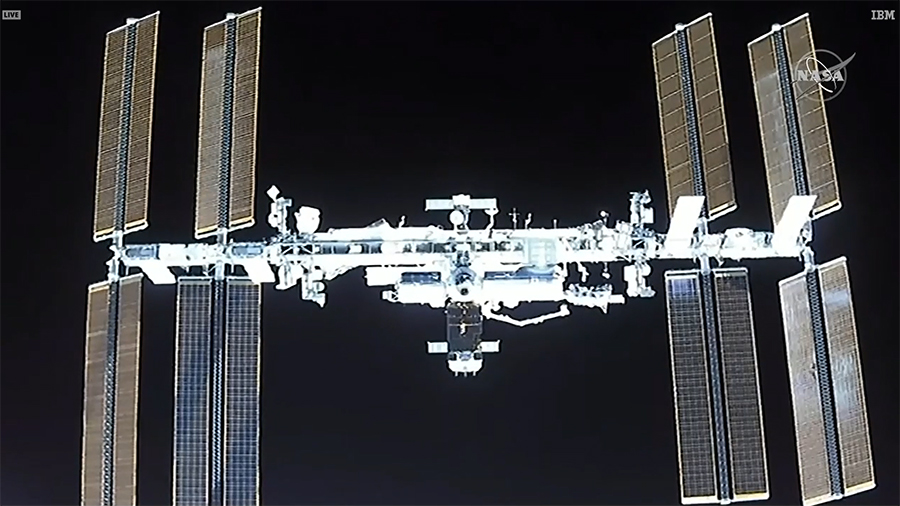
In the last blog entry, Humans in space (1/2), I showed you what has been achieved almost entirely in the last century regarding living in space. All those initiatives have ended already. So this second part begins with describing our current home among the stars, the International Space Station (or ISS).
Using the legacy left by the MIR experience, Russia and the USA partnered together to build a common and long-lasting space station, with the participation of other important countries like Canada, Japan and the European Union. That’s why the first word of its name, International, is so well-fitting, that’s why this human work is so important: space is able to unite people from every part of the world, overcoming selfish national objectives!
But let’s leave politics to the politicians, let’s have a close look at ISS and its numbers. After the matching of the first two modules, many modules were added during the following years and the actual configuration was reached in June 2011, counting 15 pressurised modules.
The first long-term residents arrived on the 2nd of November 2000, starting the so called Expedition 1 mission. At the moment I’m writing the station is occupied by Expedition 63, having hosted more than 240 humans so far. It has been inhabited for 19 years and a half. Obviously, these numbers are continuously increasing and its decommissioning should happen somewhat around 2030, but it’s not yet decided and NASA is also considering to open it up to commercial partners, especially now that the first commercial capsule with astronauts, the SpaceX Dragon, reached the station.
Ok, the ISS is a technological jewel and a great exercise in international cooperation, point taken. But what is it for? Well, the ISS is a micro-gravity research laboratory in space (yes, a Spacelab!), specifically in Low Earth Orbit, on which astronauts are testing tons of technologies and scientific experiments, with the aim of learning how to live in space and how working in space can be beneficial for the entire humanity. In a few words, the ISS is a bridge between the Earth and outer space!
If you want to know more about the ISS in simple words, I suggest this infographic from space.com website.
If you want to visit virtually the ISS, I suggest two ways:
1) the Guided Tour with astronauts Luca Parmitano (Italian pride!) and Drew Morgan;
2) the dedicated section in Google Earth, which allows you to visit it in a Streetview-like way.
If you want to see the ISS with your naked eye, you can learn from a special website, Spot The Station, when the station will be over your head at night time, so that you can observe the third brightest object in the sky passing by.
The present is impressive, what about the near future?
There are two projects that are actually in the pipeline and that will see the light in a few years: a new Tiangong station and a lunar ISS little brother.
The new Tiangong is going to be assembled starting in 2021, when the first module, Thiane, will be launched into orbit. Actually the China’s plan is to complete the new station by 2023 and it should stay in orbit for at least 10 years, hosting 3 astronauts on 6-months shifts continuously, acting like the ISS as a micro-gravity laboratory.
The Lunar Gateway is a project in the plans of US, Europe, Russia, Japan and Canada, like the ISS, but its objective is not only to allow to make science in micro-gravity, but it will be used also as a orbiting base for the robotic and human exploration of the Moon. Its first two modules should be sent into Moon’s orbit by November 2023 and it should be in the final configuration by the end of 2028.
I know, you feel like reading a sci-fi novel, but it is not: this is what we will see in this decade! Be prepared…
If you miss some sci-fi stuff, let’s have a look at the most interesting (at least for me) theoretical projects, the ones that aim to be self-sustaining, as the space colony definition states.
The Gateway Foundation is a very young initiative that aims to build the first spaceport in low Earth orbit. Based on the concepts developed by that genius of Wernher von Braun in 1952, the Gateway is a modern attempt to bring to reality the first space station provided with artificial gravity, thanks to the centrifugal force of its external rotating structure. Want to see a realistic anticipation? Look back at the movie 2001: A Space Odyssey, in which Stanley Kubrik had fun in playing with cameras to reproduce the centrifugal artificial gravity effect of such rotating structure.
Last but not least, I want to introduce you the so called O’Neill Cylinder, a very futuristic hypothetical structure in space, self-sustaining, allowing life as similar as possible to life on Earth, theorized by Gerard K. O’Neill in 1978. In his book The High Frontier, the American physicist proposed the construction of a structure in space made by two counter-rotating cylinders, using materials coming from Moon and asteroid mining, able to provide artificial gravity and allowing to host a breathable atmosphere and breathtaking landscapes. In short, something truly sci-fi. Why then citing it as a sign to become spacepolitans today if these structures are so far away from reality? Well, in 2019, during the Blue Moon lunar lander presentation event, Mr. Jeff Bezos pondered the plan of building such off-worlds instead of colonizing other planets. And when Jeff Bezos starts to plan something, results arrive sooner or later…
Fascinating topic? Yes, artificial space structures are fascinating, partly because they are so sci-fi and partly because they are already part of our reality! Next topic will be equally fascinating for the same reason… Just wait a few days and you will find another sign of how we are becoming Spacepolitans!
 Becoming Spacepolitans
3 thoughts on “Humans in Space (2/2)”