How first humans reached space and more…
To fully enjoy reading this post, listen to Ballata by Litfiba.
Space, last frontier… But where is this frontier? How much farther from Earth can we say the Space starts? And then, how do we get there? How can we reach it? Let’s see…
Well, we are lucky! The UN Outer Space Treaty, come into force on October 1967, legally states that space starts 100 km from the sea-level, following the Kármán Line, named after Theodore von Kármán, a Hungarian American engineer and physicist. He was the first to calculate the altitude at which the atmosphere becomes too thin to support an aeronautical flight, 83,6 km, just below the 100 km threshold chosen in the treaty as the space boundary.
100 km seems not so distant from the Earth’s surface, especially today, but it seems quite a lot in height, more than 12 times Mount Everest. So how to get there and how to go beyond?
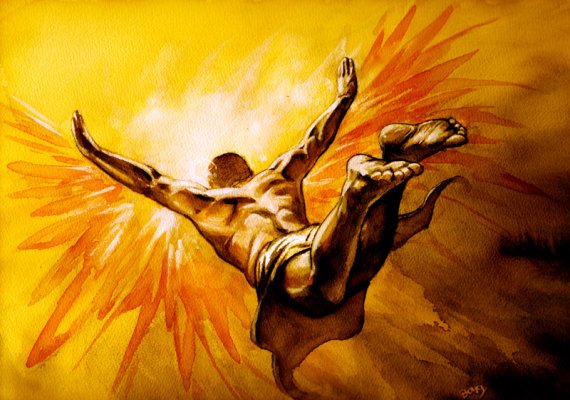
Mythology provides the first known tentative with the incredible flight of Icarus. Using special wings, he tried to get higher and higher, in the quest of reaching the Sun. Thanks to Kármán studies, we know now that it wasn’t the Sun, heating up his wings, which made him fall to the ground, but the less romantic rarefaction of the atmosphere. Unfortunately, he was not the first human to reach Space, but his attempt was remarkable.
Another interesting idea was proposed many years later, in 1865, by my beloved Jules Verne in his great novel From the Earth to the Moon: A Direct Route in 97 Hours, 20 Minutes. Supported by very interesting calculations, Verne thought that a very big cannon could be able to accelerate a crewed bullet to escape velocity, thus allowing to leave the Earth, travel in Space and reach the Moon. Physically possible, unfortunately in reality it would end in sending into space just a human smoothie, since the acceleration would be too big for the bullet’s occupants to survive.
Verne’s idea was not so bad and even quite similar to the technology that proves to be the right one: rocketry.
Even if the word rocket comes from the Italian word rocchetto (meaning bobbin or little spindle, after its similar shape), the first rockets appeared in China during the 13th century. They were powered by gun-power and used both in military and as fireworks. Their usage remained the same for centuries until Mr. William Leitch, a Scottish astronomer, suggested to use rockets to enable human spaceflight in 1861. Some years later, at the beginning of the twentieth century, great minds Konstantin Tsiolkovsky (already cited in Humans in Space 1/2), Robert Esnault-Pelterie, Hermann Oberth and Robert H. Goddard started to apply in practice rocketry to spaceflight. They were real pioneers and their theories and experiments led the way to the Russian-American Space Race of the 50s and 60s.
The Russian started in pole position, thanks to the incredible work led by Sergei Pavlovich Korolev, He was the Chief Engineer behind all the Russian “firsts” of that period:
- the first artificial satellite in orbit, the Sputnik, launched the 4th of October 1957 on one of Korolev’s marvels, the R-7 rocket
- the first animal to orbit Earth, Laika, launched the 3rd of November 1957 in a modified Sputnik, always on top of a R-7 rocket
- first man to orbit Earth, Yuri Gagarin, launched the 12th of April 1961 in the Vostok spacecraft, always on top of a R-7 rocket
- first woman to orbit Earth, Valentina Tereshkova, launched the 16th of June 1963 in the sixth and last Vostok spacecraft, again on top of a R-7 rocket
- first man to perform a space walk, Alexei Leonov, launched the 18th of March 1965 in the Voskhod-2, again on top of a R-7 rocket.
An impressive list of records: the combination rocket-spacecraft finally allowed men to pass the cosmic Pillars of… Kármán!
The story didn’t end there, obviously.
The Americans were desperately trying to catch up with the Russians after the Sputnik launch, finally playing their trump card, the controversial genius of Wernher Von Braun.
Student of Hermann Oberth first, then father of the terrific nazi rocket bomb V2, he was deported in the US after WWII with his team of engineers. He took up the baton of Robert Goddard, when he was moved to the American space program at the end of the 50s, joining the newly formed NASA.
His first contribution was to the Mercury Project: one of the Redstone missiles designed by Von Braun launched for the first time the American astronaut Alan Shepard in space, aboard the Mercury spacecraft, around one month after Gagarin’s flight.
However, his masterpiece was the Saturn V rocket, the biggest and most powerful ever created so far! Thanks to this gigantic missile, NASA successfully implemented its Apollo Program, sending the first man to the Moon, Neil Armstrong on the 20th of July 1969, and then another eleven astronauts and even three lunar rovers, for a total of 6 successful missions.
If the Space Race almost ended there, rocketry proved to be a successful transport to send payloads and humans in space, opening the new space era.
Eager to see what happened next? Yes? If so, there is a lot to discover about space transportation! The Apollo Program was a great milestone, but just a milestone on the way to become Spacepolitans!
 Becoming Spacepolitans
3 thoughts on “Travel to Space (1/3)”