Mastering transportation to Low Earth Orbit
To fully enjoy reading this post, listen to Planet Caravan by Black Sabbath.
Low Earth Orbit is actually our new Space frontier, since only pioneering Apollo crewed missions have been able to go further. In the following entry you will find out how we were and are able to reach it consistently.
Once you reach the Space passing the famous Kármán line, you enter an area extending up to 2000 km of altitude and called Low Earth Orbit (or LEO). This is the region of Space most visited by humans in the last 50 years, since Gagarin’s flight. In fact the next step after reaching the Moon was to start having a human presence in space and trying to get benefits from this unique environment. LEO was the obvious choice due to its proximity to the surface of the Earth and to the natural protection from solar and cosmic dangerous radiations (Earth’s magnetic field offers shelter up to 1000 km from the surface of the planet). So in the early Seventies both Russia and the USA started to launch special infrastructures with their rockets to LEO, the so called space stations (see my blog posts Humans in Space 1/2 and Humans in Space 2/2 for references to the following space stations), designed to host astronauts and make scientific and technological experiments.
The Russian Proton was the first one to launch in LEO the Salyut-1, in April 1971. Astronauts were sent separately after two months, using one of the earliest Soyuz rocket-spacecraft systems, during the triumphal-tragic Soyuz 11 mission: triumphal because it was the first successful mission to bring astronauts to a space station, tragic because they lost their lives during the re-entry for a technical problem. Modern heroes, no doubt, like all the others who lost their lives at work, especially when working for all humankind.
Two years later, the Americans were also able to perform a similar activity, with astronauts reaching the Skylab station on board of modified Apollo spacecrafts, launched by modified Saturn rockets..
If the Soyuz missions in LEO continued for years, allowing astronauts to get on the MIR station and then the International Space Station (ISS), the Apollo-Saturn system was dismissed during the second half of the Seventies. It was replaced some years later by an authentic monster machine, the Space Transportation System (or STS).
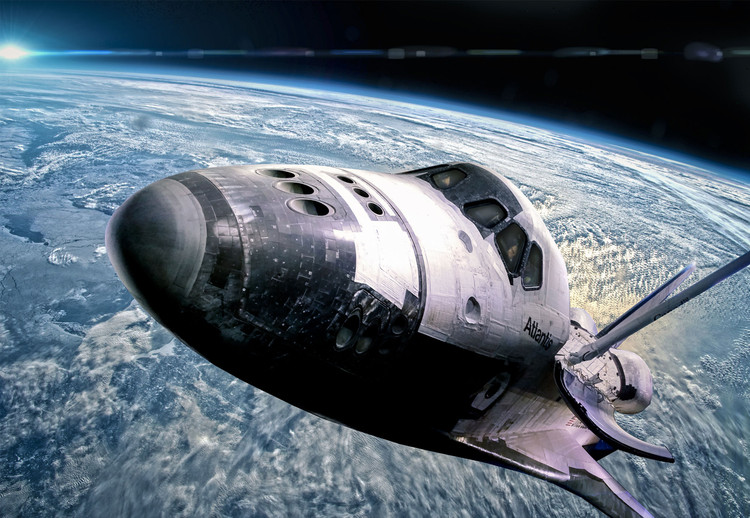
The core of this incredible technological work of art was its reusable orbiter spacecraft, the well-known Space Shuttle. It was capable of sending into orbit from five to seven astronauts per flight and to carry tons of various equipment, landing smoothly and safely after each mission (accidents excluded). In its 135 missions from 1981 to 2011, the Space Shuttle accomplished several goals:
- it transported astronauts to the Russian MIR
- it allowed the deployment of devices like the Hubble Space Telescope, the Chandra X-ray Observatory and the Galileo Jupiter probe, just to cite a few
- it was the space steed of the European Spacelab
- it was the key mean of transport for the building of the International Space Station
- it deployed several satellites and experiments, and so on and on…
To cut a long story short, the Space Shuttle was the king of transport in LEO, allowing to use space as a new field of human operations. After its retirement, only the Soyuz continued to bring astronauts to space, specifically to the ISS and this situation remained as such for almost 9 years, Except for China which had also been able to send astronauts to space. In 2012 it actually managed to send astronauts on a space station. The Shenzhou Program is still currently running and has already planned future missions. It is based on Long March rockets and Shenzhou spacecrafts, vehicle derived from the Russian Soyuz.
If I had written this post before the end of May 2020, I would have stopped here. But today I can finally add a new paragraph about travelling to LEO: the first commercial flight for astronauts in Space. SpaceX, the company founded and led by Elon Musk (his name speaks for itself), showed its capability to reach LEO in September 2008 with the fourth launch of Falcon 1. After that event, NASA awarded SpaceX a millionaire contract to send payloads to the ISS first, and then astronauts too, allowing the USA to become again self-sufficient in this strategic activity. It took almost twelve years after the successful launch of Falcon 1, for SpaceX to become the first commercial company to send humans in Space. But they did it! It was the 30th of May 2020, astronauts Robert Behnken and Douglas Hurley lifted off at 3:22 p.m. EDT on top of a brand new Falcon 9 rocket, hosted on the Crew Dragon spacecraft, christened Endeavour. The goal of the mission was (well still is at the moment of writing) to bring the two astronauts to the ISS and then back to Earth. The Endeavour safely docked to the ISS after around nineteen hours of space travel and actually it is currently still docked there. The plan is to travel back to Earth in July or August, depending on how much the current testing will last.
Now you must be convinced, rockets are the best choice to reach space, at least until now. But they are not the only way to reach Space. Surprised? Curious? I will talk about this additional technology and about the future of human Space travel in my next post, offering you one more clue on our path towards Becoming Spacepolitans!
 Becoming Spacepolitans
2 thoughts on “Travel to Space (2/3)”