A Planetary Time Machine Full of Questions… and Answers!
To fully enjoy reading this post, listen to Mars, the Bringer of War by Gustav Holst.
The red planet is the body of the Solar System most similar to the Earth. Should we colonize and exploit it to make humans a multi-planetary species? Or should we preserve its status of pristine celestial fossil, barely sampling it by robotic probes? Let’s try to find a possible answer to this new intriguing conundrum.
Humans have always been fascinated by Mars, this shining red dot in the night sky, a symbol of the gods of war for many ancient civilizations. Thanks to the very first telescopic observations by Galileo Galilei in 1610, the scientific interest on Mars started to raise. In 1877, the first detailed map of the Italian astronomer Giovanni Schiaparelli ended up strongly impacting not only the scientific community, but also the collective imagination. Indeed, thanks to an incorrect translation of the Italian word “canali”, Schiaparelli’s work was interpreted abroad as if he had observed artificial “canals” on Mars’s surface, instead of natural “channels”. The incredible Suez Canal had been completed just a few years earlier and it was rather easy to guess that there were intelligent inhabitants of Mars, capable of engineering works like the ones just made by the Earthlings. Then, even if the following observations disavowed the canals interpretation, the Martians myth was already becoming so popular that first tales, then movies were dedicated to it, celebrating the various forms of our cosmic neighbours. The idea of having company in the solar system was so bewitching that scientific discoveries against it were initially just ignored by the general public. In the following decades, the existence of Martians was widely accepted and, in 1938, the historical radio transposition of the novel The War of the Worlds by the great H. G. Wells allegedly caused public panic among listeners who believed that aliens from the red planet had invaded the Earth. It is impossible to establish whether the cause of such mass hysteria was the masterful direction and interpretation by Orson Welles or the tension that preceded World War II, or the widespread Martian myth. Nevertheless, that broadcasting showed how the public was willing to accept such an eventuality.
Today we know that there are no green humanoid conquerors living on Mars’s surface, nevertheless, the Bowiean question “is there life on Mars” (or at least was) is far to be definitively answered, it remains a great scientific question mark. And it is not the only one, Mars is indeed full of mysteries!
Its atmosphere is actually very thin and scientific evidence has demonstrated that it was not like this in the very past. How did Mars loose almost its entire gaseous cover?
In addition, Mars’ mass is less than it should be considering its actual position and assuming it formed from the primordial planetary cloud of our Solar System. Why didn’t it grow like the other planets did?
And again, its surface is clearly divided into three different zones, each of them formed in the three main Martian ages: Noachian, Hesperian and Amazonian. Why didn’t the surface change homogeneously and at the same pace?
In order to find the most likeable answers to these and other intriguing questions, many robotic exploration missions were launched and they brought back invaluable insights to explain what could have been the history of the planet. For example, we solved the mystery about the presence of water, since the first probes found water ice in its pole caps and even in the terrain, in the form of permafrost. It had been found that in its ancient past the conditions of the Martian atmosphere were allowing liquid water presence, allowing the possible development and growth of life forms. And so on…
However, all the experiments run so far were not conclusive about the presence of life and some other enigmas. So, more and more national space agencies are operating probes and sending new spacecrafts toward the red planet, with the common intent of finding answers and clues about the origin of life in our solar system and so on. This is why we are witnessing a record breaking number of active Martian missions these days.
Let’s take a deeper look to understand what they specifically aim for.
[Detailed section alert: jump to the end if not interested in technical stuff]
In orbit there are already six spacecrafts:
- Mars Odyssey, the most long-lived, in orbit since 2001; this NASA orbiter main objective was to produce the first global map of the amount and distribution of many chemical elements and minerals that make up the Martian surface; nowadays, it is still active and providing relay communication services between the Earth and NASA probes on the surface.
- Mars Express, a veteran ESA spacecraft, in orbit since 2003; its primary mission objectives were to take high resolution pictures of the surface combined with altitude data and spectroscopic information of the atmosphere; thanks to its radar instrument, it allowed the discovery of salty liquid water lakes under the surface. Unfortunately, its lander, Beagle 2, never answered back after its tentative to survive the landing phase. Still taking great pictures, today the orbiter is playing an important role in communication services for other missions.
- Mars Reconnaissance Orbiter, another NASA old friend orbiting since 2006; its main objective was to get insights on water history on the surface, taking very high resolution close-up (it can get to the dimension of a table); as other orbiters, it is now working as a communication bridge between the Earth ground systems and other robotic probes on the surface.
- Mars Orbiter Mission, or Mangalyaan-1 (“Mars-Craft”), arrived in 2014, it was the first mission from ISRO, the Indian space agency; its primary objective is to look for methane traces in the atmosphere, an important possible footprint for the presence of life; there is even a movie about it, due to the daring development of this amazing enterprise (Mission Mangal).
- MAVEN, NASA mission in orbit since 2014, with the main tasks to study the upper atmosphere and to understand why Mars did lose and is still losing gas molecules towards outer space; the spacecraft changed orbits over time to provide different insights; as all other orbiters, it is involved in the Martian communication relay framework for ground missions.
- ExoMars Trace Gas Orbiter, a joint mission with ESA and Roscosmos, orbiting Mars since 2016, its main goals are to monitor seasonal changes on the surface looking for methane presence and to search for hydrogen concentrations, indicating the presence of water under the surface. Unfortunately, as for the Mars Express mission, its lander Schiaparelli didn’t touch the surface as expected, crashing quite fiercely; part of the ground mission communication relay, it will play a major role in supporting the next ESA mission to the red planet, ExoMars 2022, aiming finally to a successful landing of a European probe on the surface, this time a rover named Rosalind Franklin.
In addition to these six technological jewels, two orbiters have just been added to the Martian fleet in the first days of February 2021:
- Emirates Mars Mission – Al-Amal (Hope) Probe, the very first United Arab Emirates mission to the red planet; it will help put together many pieces of the atmospheric puzzle, adding more insights on the lower part of Mars’ volatile shell and looking for additional data about oxygen and hydrogen escape into outer space.
- Tianwen-1 (“Heavenly Questions-1”) , again a a very first mission to Mars, this time operated by the China National Space Agency; it is made of two devices, an orbiter and a small rover, which will try to land later in May 2021. In addition to many technological first demonstrations (reaching Mars and entering its orbit as the very firsts), its main scientific goal is to find the additional water presence under the surface, thanks to a special ground-penetrating radar, mounted on the rover.
On the ground there are two active missions arrived in the past years, both from NASA:
- Mars Science Laboratory, better known as Curiosity Rover. It is an incredible six wheel robotic vehicle, the size of a big car, full of instruments,capable of drilling little holes, collecting material and analysing it with a real onboard laboratory; the main goal was to find evidence about Mars habitability for microbes somewhere in its past. Wandering the Gale Crates since August 2012, it collected a huge amount of precious information, enabling scientists to find chemical and mineral evidence of past habitable environments on the surface; after more than three thousand sols (Martian days) of operations, it is now heading to Mount Sharp, looking for more and more clues of the planet’s history.
- Insight Mars Lander, successfully landed in 2019, it plays two main roles, providing information about Mars’ interior thanks to a special seismograph and acting as a complete weather station, to register every variation of temperature, atmospheric pressure, wind speed and so on. Unfortunately, its heat probe, which was supposed to provide information about the inner soil temperature, didn’t work out due to the unexpected poor consistency of the terrain, on which the probe landed.
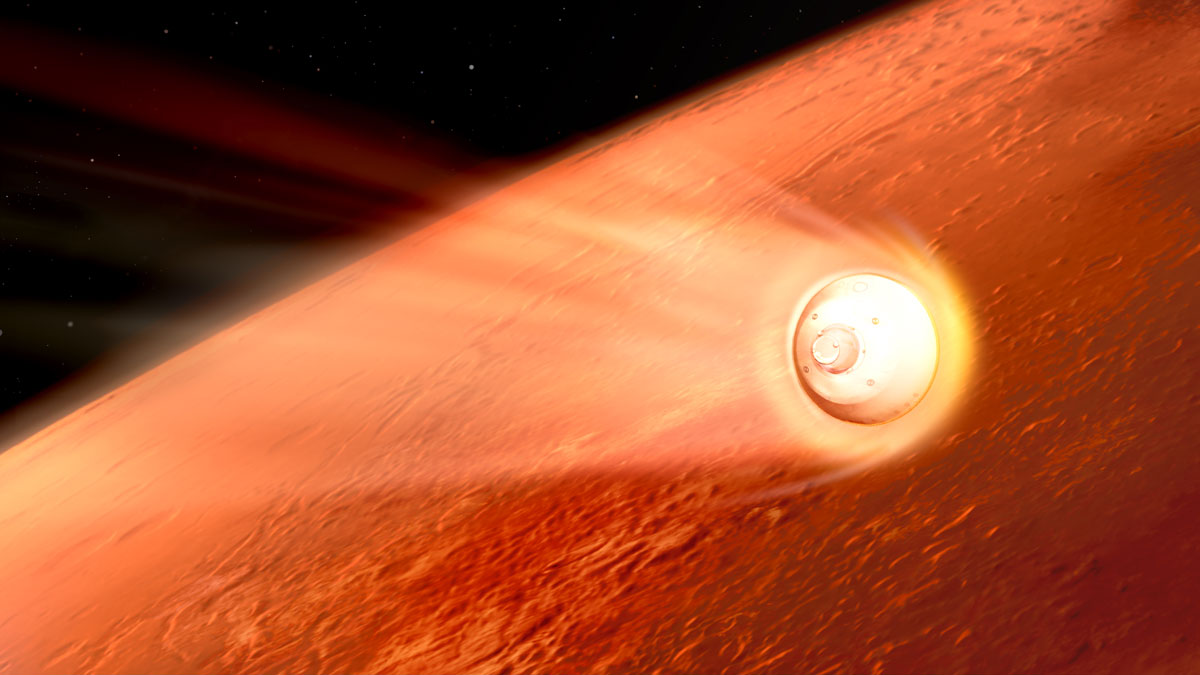
Another American mission is set to land in the next days, precisely the 18th of February 2021 (less then two days since the publication of this article, stay tuned to the news!): the Mars 2020 Mission and its rover Perseverance. Its main scientific goal is to directly search for ancient microbial life, landing on one of the most interesting places on Mars’ surface, Jezero Crater. Scientists are confident that it was an ancient river delta and, if there had been life on Mars, Jezero Crater would have been a very crowded place! So, it seems to be the ideal site even for a sample return mission, right? In fact, this is exactly one of the rover’s tasks: collect terrain samples and seal them in special containers for a future flight back to Earth. Perseverance will carry also a couple of very promising demonstration technologies: MOXIE, an experiment to produce oxygen out of the Martian atmosphere, almost made of carbon dioxide (could you guess why?), and Ingenuity, the first helicopter to fly over another world, introducing a new generation of probes for planetary exploration. What an amazing mission to follow!
What about the future? At least four projects are already in development phase:
- ESA ExoMars 2022, will land the rover Rosalind Franklin, already cited above, on the surface. The clue is in the name, it should be launched in 2022.
- Mars Therahertz Explorer, consisting of an orbiter and a lander, it should leave the Earth in 2022. If successful, it will be first Japanese mission to orbit around Mars, since another spacecraft, called Nozomi, did just a flyby due to a technical failure.
- Martian Moons Exploration, or MMX, developed by JAXA, will be a first mission aimed to visit the moons of the red planet, Deimos and Phobos; the launch should happen in 2024.
- Mars Orbiter Mission 2 (MOM 2), also called Mangalyaan-2, will be the second Indian mission to Mars and it will also bring a lander and/or a rover, details are still to be defined; the launch should occur in 2024, however it could easily be delayed until 2026, since it is still in the early stages.
[Detailed section alert end]
Incredible, isn’t it? All these robotic spacecrafts are the maximum expression of the human intellect, involving every aspect of our knowledge and capabilities. We are putting all these efforts in the hunt for evidence about the past of the Solar System and the development of life. This is something that only the exceptional Martian environment could allow to uncover, due to its blocked planetary evolution. Looking at a spot on Mars’ surface is like looking at a site like Pompeii: it shows the signs of what happened during the Martian age, in which it was formed, billions of years ago. Digging into the underground we could find the traces of past biological activity and, why not, we could even find still alive microbes! What a unique planetary time machine!
However, there is an eventual high risk to alter this pristine fossil world, the risk of introducing biological contamination from the Earth. Although all the robotic probes are assembled in clean rooms and kept always aseptic to avoid any kind of undesirable passenger, the presence of humans on the red planet surface would definitely raise the possibility that microbial life from Earth could be transferred unwillingly. Should this very unfortunate event happen, there would be a very high chance to bias the future scientific research, losing the chance to solve the most important scientific questions mentioned so far.
This is why we should consider very carefully any human presence on Mars’ surface. We could start building an orbiting station first, leveraging from the experience accumulated with the International Space Station and with the next Lunar Gateway. We could use this orbiting laboratory to pilot rovers and robots from above, in real time, being able to perform quicker and deeper research. Then we could establish bases on the surface of Phobos and on Deimos, the Martian moons, which are without atmosphere and couldn’t have hosted life in the past. Then, we could consider building a first little scientific base, like the ones in Antarctica, but only when the technology will allow us to live there with almost zero risk of contamination and when the benefits of human presence on the surface will be worth that minimum risk.
I know, this approach doesn’t seem to be that Spacepolitan, does it? Many people would like to conquer very soon the red planet, SpaceX’s plan to colonize Mars is so fascinating! Nevertheless, even if it could seem too cautious, the proposal above is exactly in line with the Spacepolitans’ mission of preserving life in its natural environment. It is not easy to apply it to our planet, however, it must be applied also to all the other worlds, not to repeat again and again the same fatal mistake we are making here! So, in answer to the initial dilemma of this post, we should continue with our excellent robotic missions, getting closer and closer to the red planet, without rushing there only for the sake of being the first humans to press the Martian soil. We could be a multi-planetary species also colonizing inanimate worlds, like moons or dwarf planets without any chance to host or have hosted life. We should become Spacepolitans without risking to compromise life on other worlds!
 Becoming Spacepolitans