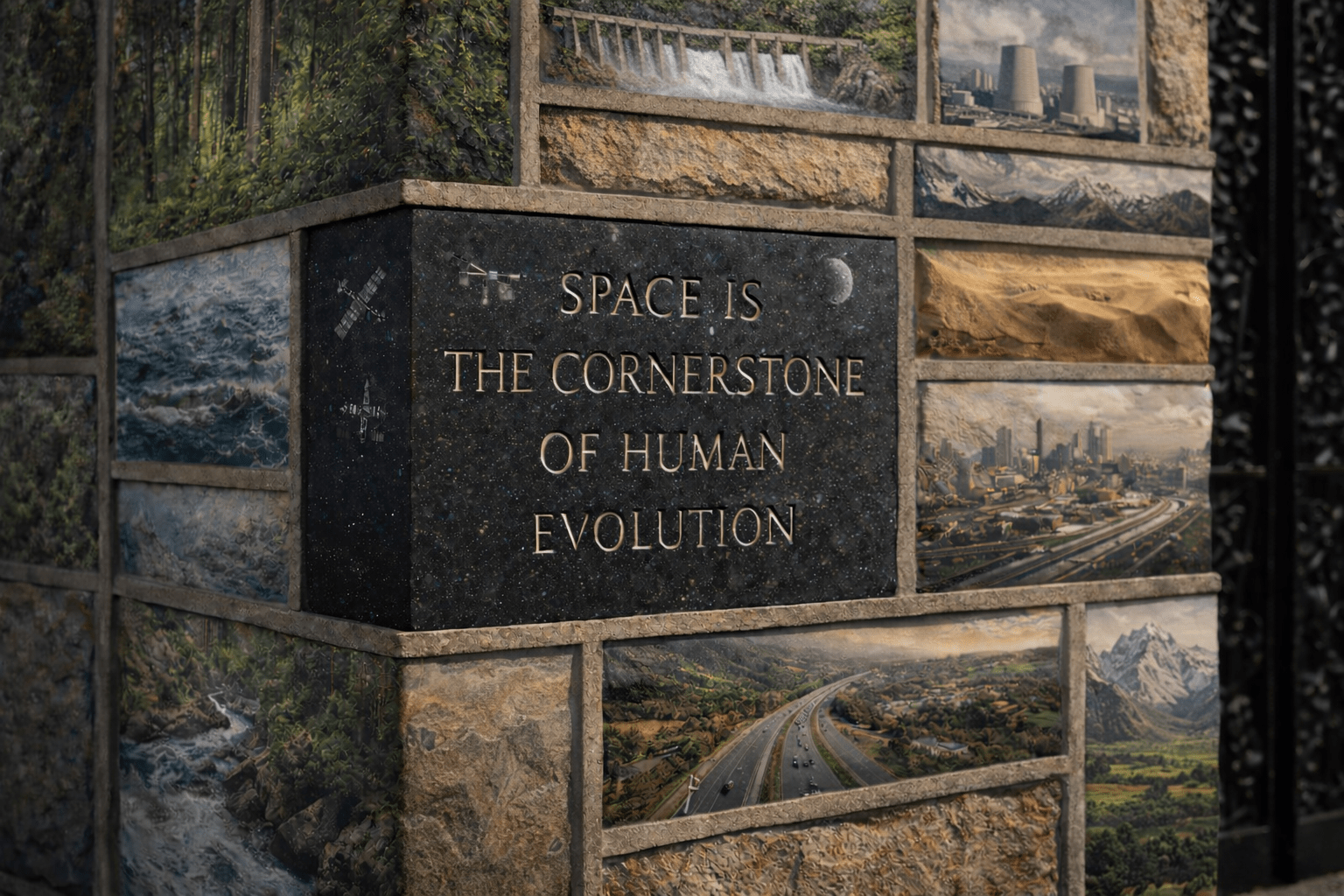
Space is the cornerstone of human evolution. Credits: created with Assistance from OpenAI’s DALL·E
If space is the cornerstone of human evolution, then understanding this shift is no longer optional. It is part of becoming aware of where we are heading.
Listen to The World is not Enough by Garbage to enjoy reading this post.
There comes a moment in every architecture when the cornerstone is placed. The element that aligns the structure, defines its geometry, and gives coherence to everything that follows.
Today, Space for Earth becomes that cornerstone within Becoming Spacepolitans.
This page is not another thematic essay. It is the programmatic bridge between the Manifesto and the entire portfolio of topics that explore how humanity is already extending beyond the planet.
The Manifesto defines the planetary problem: a civilization designed to expand operating inside a finite biosphere. The Sustainable Development Goals represent humanity’s first coordinated attempt to address that structural tension. But coordination alone does not change geometry.
Space does.
Space is not an escape from Earth. It is the structural layer that enables sustainable human evolution beyond planetary limits. It enlarges the system within which sustainability can operate. It transforms scarcity into an engineering challenge. It allows energy, materials, computation, and industry to progressively extend beyond the biosphere that must be preserved.
The renewed Space for Earth page maps this shift clearly. From planetary observation to resource expansion, from in-space manufacturing to orbital intelligence infrastructure, it shows how the movement toward space is no longer speculative. It is operational.
If space is the cornerstone of human evolution, this page is the cornerstone of the blog’s evolution.
Read the updated page here: Space For Earth.
Space for All, all for Space!
 Becoming Spacepolitans