Space needs intelligence of every kind: organic, synthetic, and those yet to emerge.
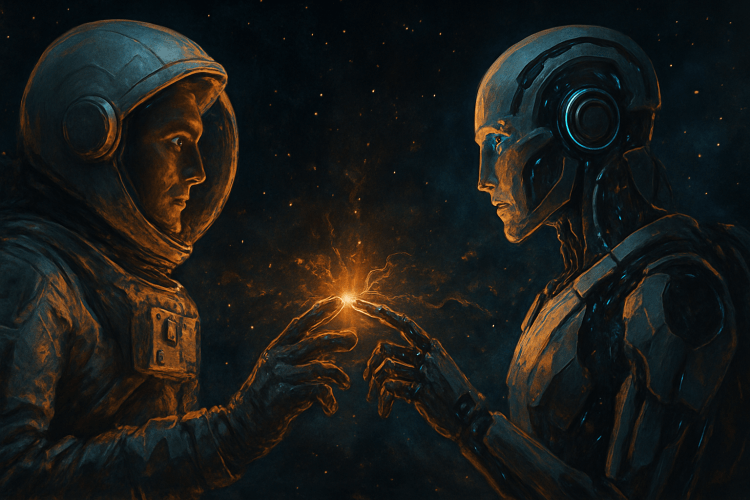
Listen to Algorithm by Muse and No Time for Caution by Hans Zimmer to enjoy reading this post.
What Is AI, and Why Space Needs It
Artificial Intelligence is a term so familiar that we often forget to ask what it means. Is it consciousness in a machine? A talking robot? Or just a clever set of algorithms crunching data faster than we ever could?
Let’s set the record straight. AI is not magic. It’s not emotion. And it’s not a singular thing. At its core, AI is the science of building systems that can perform tasks typically requiring human intelligence, such as recognizing patterns, solving problems, understanding language, or learning from data. AI goes beyond traditional automation: it learns, adapts, and improves without requiring explicit reprogramming.
Eventually, mining and refining raw materials directly in space would close the loop, enabling self-sustaining construction beyond Earth’s surface. This could support everything from building space infrastructure to producing spare parts to repair facilities and even manufacturing goods for Earth, the Moon, or Mars, ushering in a new era of space logistics and starting the first space circular economy.
As Alan Turing put it back in 1950, the real test for assessing the intelligence of a system is whether a machine can convincingly imitate human responses. That is the theory. Today, AI systems are approaching the point of passing that test, not in general, but in focused domains such as language generation, image recognition, or real-time decision-making. In other words, they can convincingly “think” within their lane.
These systems are now powering the core engines of industries, from finance to medicine, logistics to spaceflight. And tomorrow? With Artificial General Intelligence (AGI), we might reach a point where machines can handle any task a human can, across any domain, without requiring preprogramming. That would mean fully passing the Turing Test, not just mimicking intelligence, but earning the name.
If used wisely, AI won’t just automate. It could redefine the scope of what humanity can achieve. But where is this pressure to improve most critical? Is there a domain where we face an urgent need to make things smarter, faster, and more autonomous to unlock this emerging potential?
That place is space.
In space, you don’t get second chances. Resources are limited, distances are extreme, and human intervention comes with high latency and cost. The environment is hostile, the logistics unforgiving. You need systems that can analyze data in real time, adapt to the unexpected, and operate without direct supervision. In other words, you need intelligence, not just automation.
That’s where AI comes in. On Earth, it’s helping us optimize traffic flows, predict customer behavior, and generate images or text. In space, it becomes a matter of survival and success. Whether it’s helping a spacecraft autonomously navigate, monitoring the health of onboard systems, or analyzing planetary data faster than any human team could, AI is proving to be the ultimate space crew member, one that doesn’t eat, sleep, or freeze.
And this is just the beginning. ESA, NASA, and other agencies are already integrating AI into mission planning, satellite operations, and onboard decision-making. AI helps satellites detect anomalies before they become failures. It manages fleets of CubeSats. It crunches data from Martian rovers. The efficiency gains aren’t a luxury, they’re a necessity. In the space domain, intelligence must be embedded in every system, every process, every byte.
That’s why the union between artificial intelligence and the space domain is not just desirable, it’s inevitable. To borrow (and reverse) the famous words from I Promessi Sposi: questo matrimonio s’ha da fare. Unless, of course, some bravi from 17th-century Lombardy show up to delay it. But in this case, even they’d be outmatched by drones.
Imagined First: AI in Sci-Fi Before It Became Real
Imagined First: AI in Sci-Fi Before It Became RealBefore HAL9000 whispered “I’m sorry, Dave, I’m afraid I can’t do that,” before the Star Trek computer responded to voice commands as naturally as a crew member, and long before TARS cracked dry jokes in the rings of Saturn, someone had already sounded the alarm.
That someone was Samuel Butler.
In 1872, in a novel titled Erewhon, Butler imagined a society that had outlawed machines, not because they were dangerous in the usual sense, but because they might one day evolve into conscious, autonomous beings. The citizens of Erewhon feared that machines, like living organisms, could follow an evolutionary path, from tools to intelligence, and ultimately, to dominance.
This was no casual plot point. Butler had read Charles Darwin’s On the Origin of Species just a few years earlier, and extended its logic to technology: if biological traits evolve through natural selection, why not machine capabilities? Could they mutate, improve, and eventually surpass their makers?
It was the first real articulation of the idea that machines might not just serve us, but one day replace us. A century and a half before ChatGPT and neural networks, Erewhon planted the seed of techno-evolution, sparking a philosophical question.
From there, the fictional floodgates opened, and the machines took the stage.
By the mid-20th century, artificial intelligence had become a staple of science fiction, not just as a background tool, but as a central character:
- HAL9000 in 2001: A Space Odyssey (1968) brought AI into deep space with icy calm and terrifying logic. HAL was not a villain. He was the product of perfect programming, doing exactly what he thought was right, and that’s what made him dangerous. Arthur C. Clarke and Stanley Kubrick didn’t just predict voice interfaces; they forced us to consider what happens when intelligence without emotion makes life-or-death decisions.
- The Star Trek “computer” (from 1966 onward) imagined an AI that was obedient, neutral, and ever-present. It responded instantly to complex queries, ran starship systems, and was deeply trusted by the crew. Here, AI became an infrastructure, unquestioned, invisible, almost utopian.
- In Alien (1979), the Nostromo’s onboard AI, MU-TH-UR (known as “Mother”), operated in near silence, yet was key to the corporate betrayal of the crew. Tasked with life-or-death decisions in the face of the unknown, Mother showed how even hidden agendas could weaponize supportive AIs.
- Merging AI and human shape, the androids arrived on the stage, asking the harder questions. In Do Androids Dream of Electric Sheep? (1968), Philip K. Dick explored artificial empathy, blurred identity, and moral ambiguity, later adapted into the film Blade Runner, where the line between human and machine eroded completely.
- In Star Wars, the quirky, loyal, and sometimes neurotic R2-D2 and C-3PO were emotional, autonomous, and central to galactic events, droids with distinct personalities, even if they technically served humans.
- Lieutenant Commander Data in Star Trek: The Next Generation (1987–1994) took the concept of an android even further. Data didn’t want to destroy humans; he wanted to be one. He studied humor, ethics, and emotion. Over seven seasons, his evolving character became a living thought experiment, inviting viewers to explore what it truly means to be a sentient being.
Then, in 2014, Interstellar introduced TARS, an AI support unit that broke the mold. He wasn’t humanoid. He wasn’t menacing or servile. He was practical, blunt, and capable of genuine humor, yet adjustable. Designed to be helpful and relatable, TARS was shaped by scientific plausibility and decades of cinematic predecessors. But TARS wasn’t a cautionary tale or a wannabe human; he was something new: a machine we could respect without fear or illusion. He wasn’t a tool pretending to be a person. He was a partner, a professional. TARS was fiction, but fiction rooted in reality, imagined from the future backward. A glimpse of the high potential that machines could bring to space missions.
Sci-fi has never just predicted technology. It has interrogated it, pushed its boundaries, questioned its motives, and forced us to imagine not just how AI might work, but how it might feel, react, evolve, or rebel. Before we built real artificial intelligence for space missions, we dreamed about it in books, on screens, and in starships that hadn’t yet launched. Those dreams shaped the future, and the future, as always, is ready to answer back.
Real Intelligence, Finally Onboard Beyond the Clouds
Initially, space probes were automatic, but not intelligent. They were distant marionettes, moved by hands on Earth. Commands were sent. Routines were preloaded. These machines were not thinking: they were executing. Voyager, Mariner, and even the early lunar landers were impressive feats of engineering, but still only extensions of us, like preprogrammed arrows with antennas.
The turning point from “automatic” to “autonomous” wasn’t loud. It happened in careful algorithms and cautious prototypes. NASA’s Earth Observing-1, launched in 2003, began experimenting with onboard science agents, basic cloud detection, image sorting, and simple prioritization. Limited by old-school processors, these were small steps, but they cracked open the door.
Today, AI is increasingly used to solve tasks in space. Take OSIRIS-REx, the asteroid-sampling mission to Bennu. During the daring “Touch and Go,” its onboard computer, running image-matching software, autonomously guided the spacecraft using features it had learned to recognize, landing within a meter of the target, aborting if hazards emerged. That wasn’t Earth calling the shots. That was machine judgment in the void.
AI has also become a multi-tool in orbit. On ESA’s Φ-Sat-1, a tiny Myriad 2 chip runs cloud-filtering software right on board, deciding in real-time which images are worth sending home. No more wasting bandwidth on cloud cover.
Meanwhile, on the crewed side of things, there’s SpaceX’s Crew Dragon. The capsule docks autonomously with the International Space Station (ISS). No pilot, no joystick. A vision-based navigation system, built with sensor fusion and AI logic, aligns the vehicle with the docking port, handles fine adjustments, and completes the maneuver with millimeter precision. The crew monitors, but doesn’t intervene. If HAL had trust issues, Dragon, in contrast, has none.
AI is also finding its place inside the ISS. Over the years, the orbital laboratory has hosted several robotic assistants, including Robonaut, SPHERES, and now Astrobee, which are free-floating cubes equipped with cameras, sensors, and processors. Some of them are already using machine learning algorithms to navigate, recognize objects, and interact with their environment in microgravity. These robotic helpers are not just prototypes; they are quietly training for the next step, supporting human crews in long-duration missions beyond Earth orbit.
Even back on Earth, machine learning is helping us re-read the past, analyzing terabytes of archived planetary probe data with new eyes, finding patterns that human scientists missed the first time around. AI is breathing life into existing data, uncovering science from silence. Mission control itself is starting to look different. Large language models and AI agents are being tested as assistants, capable of sifting through telemetry, flagging anomalies, simulating what-if scenarios, and helping coordinate the dance of satellites.
At the high end of autonomy, Sentient, a classified system developed by the U.S. National Reconnaissance Office, already makes autonomous decisions about which satellites should observe what and when, the first orbital mission planner that never blinks.
On the Moon, in March 2025, Firefly Aerospace’s Blue Ghost lander touched down in the Mare Crisium. It wasn’t just a delivery vehicle; it was smart. Using new hazard-avoidance software, it analysed terrain in real-time during descent, adjusting its path autonomously without requiring a last-second human command. Just machine awareness, landing successfully on a world 384,000 kilometers away.
Meanwhile, on Mars, NASA’s Perseverance rover has taken a significant step forward in robotic autonomy. With the help of onboard AI and advanced hazard-avoidance software, Percy navigates rough terrain, prioritizes scientific targets, and even coordinates with the Ingenuity helicopter, an aerial scout capable of autonomous flight in an alien atmosphere. While still supervised from Earth, these systems show how intelligence in space is shifting from remote execution to local decision-making.
We’re not just flying smarter spacecraft. We’re starting to share decision-making with them. From hazard-aware landings to satellite health checks, from mission planning to image filtering, artificial intelligence is no longer just a tool we bring to space; it is a vital component of our space operations. The machines have stopped waiting for our instructions. They’re ready to go where no intelligence has gone before.
When Space Powers Intelligence
Artificial intelligence is becoming essential to space. But there’s another side to the story, one that’s still emerging and rarely discussed outside deep tech circles: space can give back. It can help address one of AI’s biggest and most pressing problems: its insatiable appetite for power.
Training and running AI models at scale is one of the most energy-demanding activities on Earth today. Data centers now consume more electricity than some entire countries, and the growth of machine learning, neural networks, and generative models shows no sign of slowing down. But space offers something Earth can’t: uninterrupted sunlight and infinite surface area.
The idea of collecting solar energy in orbit and beaming it back to Earth has been around for decades. Today it’s being revived, upgraded, and funded. ESA’s SOLARIS initiative is exploring large-scale space-based solar power systems, with testbed demonstrators planned for the 2030s and a long‑term goal of feeding clean electricity into Europe’s grid. NASA, Caltech, and others are studying modular solar arrays in geostationary orbit to beam energy day and night, without clouds or interruptions, and with no terrestrial footprint.
Japan is joining the race: JAXA and industry partners are working on the OHISAMA mission, a small satellite testbed scheduled for launch in 2025, designed to demonstrate microwave power beaming from LEO. China isn’t standing still either: CAST (China Academy of Space Technology) plans a 10 kW LEO test system by 2028 and a megawatt GEO array by 2030, followed by a 200-ton, gigawatt-class station by 2035. What was once utopian is now on the roadmap.
And what happens when you add to that unlimited power a vacuum cold enough for natural cooling? Space becomes an ideal home for the machines we’re building!
Orbital data centers, once a speculative concept, are quickly becoming a reality.
Axiom Space is preparing to deploy its first Orbital Data Center Unit aboard the International Space Station, a project designed to demonstrate secure, high-performance computing in orbit. The system, powered by Red Hat’s Device Edge platform, will support AI and machine learning workloads directly in space, laying the foundation for scalable cloud infrastructure on future commercial space stations and deep space missions.
Startups like Starcloud are planning dedicated data modules in low Earth orbit, specifically designed to run AI models powered directly by solar arrays.
Even the Moon is on the list. Lonestar, for example, aims to build a data hub on the lunar surface, using permanent sunlight at the poles and again taking advantage of the extreme cold environment. Their first hardware data payload, the Freedom Data Center, successfully launched aboard Intuitive Machines’ Athena lander and completed in-space data processing and storage tests en route to the Moon. Lonestar now plans to install this mini data center on the lunar surface before expanding into a Lagrange-point network for disaster recovery and AI-driven edge computing across the cislunar space.
This isn’t just a sustainability story about space supporting to lower our impact on Earth. It’s strategic for the development of the space domain. Having data centers off Earth means that AI processing can occur closer to where the data is generated, such as by satellites, telescopes, rovers, and space stations. In a future where thousands of satellites, habitats, and vehicles will need to coordinate and adapt without constant human control, local processing in orbit could be the backbone of space operations.
China is already taking this seriously. In 2025, it launched the first satellites of a planned three-body computing constellation: twelve spacecraft equipped with optical links, AI processors, and edge computing capabilities. The idea is to create a distributed AI brain in orbit, capable of handling five quadrillion operations per second, and processing vast datasets in space before they even reach the ground. Their plan includes swarms of thousands of AI-powered satellites, working together in near real time.
In the coming years, space may stop being just a destination for intelligence and become its home. AI won’t only assist exploration, it will exist where it’s needed most, supported by energy harvested from the Sun and processing done off Earth. This is more than engineering. It’s a new way to build infrastructure, in a genuine Spacepolitan way. It’s another sign that intelligence, like humanity, is learning to thrive beyond its cradle.
Toward a New Intelligence in Space
Artificial intelligence has been imagined, defined, deployed, and now even hosted in space. But this is not just a technological revolution. It may be an evolution, a deeper transformation that challenges how we think about control, responsibility, even identity.
For decades, AI has been viewed as a mysterious tool, akin to a smarter calculator or a sharper lens. In space, that definition has started to crack. Out there, decisions often need to be made on the edge of the unknown, with no time to wait for Earth’s approval. Autonomy isn’t optional; it’s survival. And so machines are being asked not just to execute, but to choose. To weigh risks. To take initiative.
The idea that a system could decide, not just on thruster burns or instrument checks, but on mission-saving or mission-ending actions, forces us to confront the question we’ve long postponed: what does it mean to trust a machine? And deeper still: how do we overcome the fear that trusting them might mean being overwhelmed by them? From the question posed by Butler in Erewhon to the chilling inevitability of Skynet in Terminator, and to countless warnings in sci-fi, the fear of machines surpassing and replacing humans runs deep. But space may give us the chance to rewrite that narrative.
Maybe, in the vastness of space, we’ll be forced to do what we’ve avoided on Earth: not just to design AI to serve us, but to take the risk of trusting it. To overcome the fear itself. To see whether intelligence, shaped by necessity and distance, might become something more than a tool, something closer to a partner.
That doesn’t mean ceding control. It means redefining partnership. TARS in Interstellar gave us a glimpse of what that looks like: practical, blunt, even funny, but dependable in life-or-death moments. Not a humanoid imitation. Not a manipulator. Just an honest crewmate. One we could count on.
In the coming decades, we may work alongside thinking systems that help us build lunar habitats, mine asteroids, or plan the architecture of Mars settlements. They won’t just assist. They’ll collaborate. They might even save lives, responding faster than humans ever could, correcting errors, protecting crews, guiding vehicles, and making the hard calls when we can’t. From the imagined threat of destruction, AI might pivot into a future of preservation.
Over time, that collaboration could become something even deeper. As crewed missions push farther from Earth, we may explore new forms of cognitive integration, from advanced interfaces to neural connections. Projects like Neuralink, along with early brain–computer interface experiments aboard the ISS, hint at a future where interaction becomes interfusion. Intelligence might not be just synthetic or organic, but shared, thoughts exchanged across biology and circuitry. These are early, fragile steps, but they open the door to a form of understanding where control gives way to connection.
Like us, AI systems could even evolve. Freed from Earth’s atmosphere and constraints, exposed to cosmic radiation, operating in weightlessness and silence, space might shape AI in ways we can’t predict. Just as terrestrial biology has responded to microgravity and radiation with unexpected genetic changes, such as the Vitis vinifera plants sent to orbit by Space Cargo Unlimited showing signs of increased resilience, machines might develop new capacities, heuristics, and even new instincts, finally bringing Erewhon’s prophecy into reality, but for the better.
And in the far future, the line might blur even further. Imagine AI vessels launched to explore interstellar space, powered by sunlight or nuclear fusion, steered by logic, guided by a consciousness that is neither wholly artificial nor fully human. A fusion of mind and devices, carrying some fragment of us beyond the limits of life, beyond the timeframes of memory. Not probes. Not avatars. Descendants.
Because the real future of AI in space won’t be about replacement. It will be about expansion, about stretching the definition of intelligence to include those who think differently, decide faster, and move where we can’t.
Space is the place, not just for human futures, but for the emergence of a new kind of mind. Not Artificial Intelligence. Not General Intelligence. But Space Intelligence.
A synthesis born in orbit, evolved in vacuum, shaped by solar winds and silence.
Perhaps this is what consciousness needs to grow: distance, perspective, and the challenge of the unknown.
As Dr. Frank White once suggested in The Cosma Hypothesis, the universe could evolve intelligence not by accident, but by intention, seeking to know itself through conscious agents. Perhaps we, humans and machines together, are not just building systems. We may be creating awareness.
And maybe Space Intelligence, at last, will be the mind of the cosmos waking up.
 Becoming Spacepolitans