Real-world Ragnarök or the foundations of a spacefaring civilization: the space rock dilemma.
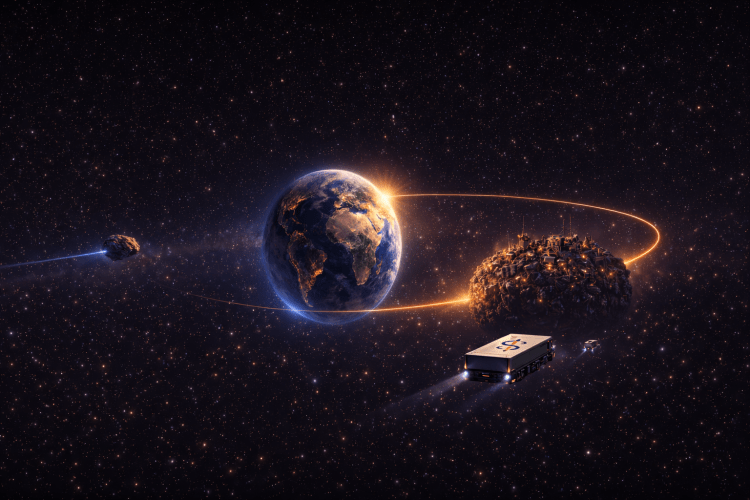
Listen to The Golden Age by The Asteroids Galaxy Tour, Space Rock by Rockets, Space Rock by Trip Rexx, andLucy in the Sky with Diamonds by The Beatles to fully enjoy reading this post.
The Leftovers of Creation
Asteroids are not debris drifting aimlessly in space. They are the raw materials left over from the construction of the Solar System.
Around 4.6 billion years ago, a cloud of gas and dust collapsed under gravity, beginning to assemble planets around a young Sun. Not all the material merged into full-sized worlds. Some fragments remained scattered, orbiting as silent witnesses of that primordial building phase.
Think of a LEGO construction. You follow the instructions and complete the model. When you are done, a handful of pieces remain on the table. The structure is finished, but the extra bricks remain. Not useless. Just unused.
Asteroids are those extra bricks. They preserve the original ingredients of planetary formation, metals, silicates, carbon compounds, and even water locked inside minerals. They are leftovers of creation. And leftovers, in the right context, are an opportunity.
What Are They Really Made Of?
If asteroids are raw materials, the obvious question follows: raw materials of what?
Astronomers classify them mainly by composition, and three major families dominate the population.
C-type, carbonaceous asteroids, are the most common. They are dark, primitive bodies rich in carbon compounds, clay minerals, and often water bound inside hydrated minerals or ice. These objects are chemical time capsules, preserving some of the earliest material from the young Solar System.
S-type, silicaceous asteroids, are made mostly of silicate rocks mixed with iron and magnesium. They are stony bodies, closer in composition to many meteorites that fall to Earth, and represent fragments of partially processed planetary material.
M-type, metallic asteroids, are rarer and particularly intriguing. Composed largely of nickel and iron, sometimes enriched with platinum group metals, they may be remnants of the metallic cores of ancient proto-planets that were shattered long ago.
Beyond these three broad classes, smaller subgroups exist, some defined by a single peculiar object. But the essential message remains simple: asteroids are not all the same. They are chemically diverse reservoirs of rock, metal, carbon, and water.
In other words, they are not just stones. They are a distributed inventory of planetary ingredients.
Where They Live
Asteroids are also classified by where they orbit. Their position in the Solar System tells us a lot about their history and their potential future role.
Near-Earth Asteroids, or NEAs, are objects whose orbits bring them close to Earth’s path around the Sun. They are grouped into families such as Amor, Apollo, and Aten, depending on how their trajectories intersect or approach Earth’s orbit. These are the bodies most relevant for both planetary defense and future resource missions.
Main Belt asteroids form the largest population. They orbit between Mars and Jupiter in a vast region known as the asteroid belt. Rather than being fragments of an exploded planet, current models suggest that Jupiter’s strong gravity prevented this material from ever accreting into a full-sized world. What we see today is a population that never completed the planetary formation process.
Trojans occupy special gravitational positions called Lagrange points, leading or following a planet along its orbit. The most numerous are Jupiter’s Trojans, but other planets host them as well. These objects are gravitationally parked, sharing a stable dynamical balance with their companion planet.
Centaurs orbit between Jupiter and Neptune. They are hybrid bodies, often containing significant amounts of ice mixed with rock, and can display characteristics of both asteroids and comets. In many ways, they are transitional objects, shaped by gravitational interactions that slowly move them inward or outward over time.
Beyond Neptune lies the Kuiper Belt, populated by icy bodies and dwarf planets such as Pluto. Even farther away, at the edge of our Solar System, is the hypothesized Oort Cloud, a distant spherical reservoir from which long-period comets occasionally travel toward the inner Solar System.
This is where the distinction between asteroids and comets becomes less rigid. Traditionally, comets are volatile-rich bodies that, when approaching the Sun, heat up and develop a glowing coma and tails, while asteroids remain inactive and rocky. Yet the boundary is not absolute. Some objects evolve from active comets into dormant, asteroid-like bodies. Others, like Centaurs, sit naturally between the two categories.
One remarkable visitor from that distant reservoir is Bernardinelli–Bernstein, discovered in 2014 and currently on its long journey toward perihelion in 2031. With an estimated diameter of more than one hundred kilometers, it is one of the largest known Oort Cloud objects ever observed. It reminds us that the outer suburbs of the Solar System are not empty. They are vast storage rooms of primordial material, occasionally sending ambassadors inward.
They are not separate worlds. They are variations of the same cosmic fragments, shaped differently by composition, distance, and thermal history.
Learning to Know Them
Our relationship with asteroids did not begin with mining plans or defense strategies. It began with curiosity.
On January 1, 1801, the Italian astronomer Giuseppe Piazzi discovered Ceres, the first object identified in what we now call the asteroid belt. What initially seemed like a missing planet between Mars and Jupiter turned out to be the first member of an entirely new population.
Since then, the catalog has grown dramatically. Today, more than a million asteroids have been identified and tracked, and estimates suggest that hundreds of millions of smaller bodies populate the Solar System. Most of them remain invisible to the naked eye, yet their orbits are carefully recorded and continuously refined.
Observation soon evolved into exploration.
In 1991, NASA’s Galileo spacecraft performed the first close flyby of an asteroid, imaging 951 Gaspra on its way to Jupiter. A few years later, NEAR Shoemaker became the first mission dedicated entirely to an asteroid, orbiting and eventually landing on 433 Eros.
Other missions expanded our understanding further. The European Rosetta mission orbited and deployed a lander on comet 67P/Churyumov–Gerasimenko, while Japan’s Hayabusa and Hayabusa2 returned samples from near-Earth asteroids 25143 Itokawa and 162173 Ryugu. In 2023, NASA’s OSIRIS-REx delivered material from 101955 Bennu back to Earth.
Meanwhile, new missions continue to broaden the picture. Lucy is traveling toward Jupiter’s Trojan asteroids, and Psyche is heading for 16 Psyche, one of the most intriguing metallic bodies in the Solar System.
From distant points of light to touched surfaces and returned samples, asteroids have shifted from abstract celestial objects to tangible scientific targets. We are no longer just observing them. We are beginning to understand them.
Cross: The Dark Side of Space Rocks
Asteroids are raw materials and scientific treasures. But they are also potential impactors.
Earth’s history carries the evidence. About 66 million years ago, a large asteroid struck what is now the Yucatán Peninsula, leaving behind the Chicxulub crater and triggering global environmental changes that contributed to the extinction of the dinosaurs. It was a rare event, but not impossible.
Impacts do not need to be global to be destructive. In 1908, an object exploded over the Siberian forest near Tunguska, flattening thousands of square kilometers of trees. No crater was left, but the atmospheric blast demonstrated the power of even a mid-sized object.
More recently, in 2013, a roughly twenty-meter body disintegrated in the atmosphere above Chelyabinsk, generating a shockwave that injured more than a thousand people and damaged thousands of buildings. The object had not been detected before it entered the atmosphere.
Events like Tunguska and Chelyabinsk reinforced the need for global coordination. In 2016, the United Nations officially recognized International Asteroid Day, observed each year on June 30, the anniversary of the Tunguska event. Asteroid Day promotes education, research, and international cooperation on impact risk and planetary defense.
Awareness, however, is only the first layer of protection. Effective defense requires continuous observation, data sharing, and precise orbital calculation.
Today, newly discovered objects are continuously tracked and analyzed by the Minor Planet Center, the international clearing house for positional measurements of minor planets and comets. When an object is found, its orbit is calculated and refined through repeated observations.
At the international level, the International Asteroid Warning Network coordinates global efforts to share data and assess potential impact threats. At the same time, NASA’s Planetary Defense Coordination Office oversees detection programs and develops response strategies. Planetary defense is no longer theoretical. It is institutional.
To communicate potential danger, scientists use the Torino Scale, a scale from 0 to 10 that combines impact probability and potential damage. Most objects are rated 0, meaning no unusual level of risk. Occasionally, an asteroid briefly rises above that level until further data clarify its trajectory.
One notable case was 99942 Apophis, which in 2004 reached level 4 on the Torino Scale due to early uncertainty about a possible 2029 impact. Additional measurements later ruled out that threat, demonstrating how improved data transforms concern into clarity.
Although no collision is expected, Apophis will make an exceptionally close approach to Earth in April 2029, passing well within the orbit of geostationary satellites. This rare event has turned a former threat into a scientific target. NASA has redirected the OSIRIS-APEX spacecraft, formerly OSIRIS REx, to study Apophis after its encounter with Earth. Meanwhile, the European Space Agency will launch RAMSES, the Rapid Apophis Mission for Space Safety, to observe the asteroid before and during its close flyby.
A potential impactor has become an object of coordinated international study. The same rock that once generated fear is now generating data.
If detection and tracking are the first line of defense, preparation is the next step.
In 2022, NASA’s DART spacecraft intentionally impacted Dimorphos, the small moon of the asteroid Didymos, to test whether a kinetic strike could alter its orbit. The collision successfully shortened the moon’s orbital period, proving that controlled deflection is possible.
The European mission Hera, launched in 2024, is on its way to study the aftermath in detail, measuring precisely how the impact changed the system and refining models for future defense strategies.
Planetary defense is not about dramatizing the sky. It is about reaching civilizational maturity. For the first time in Earth’s history, a species is learning not only to detect a cosmic threat but also to prevent it potentially.
Asteroids can be our cross. But understanding them transforms fear into capability.
Delight: The Potential End of Scarcity
If asteroids can be a threat, they can also be a solution.
For most of human history, resources have been limited by geography. Metals, rare elements, water, and energy sources are unevenly distributed across Earth’s surface. Scarcity has shaped economies, politics, and conflicts. Asteroids introduce a radically different perspective: resources are not confined to a single planet.
Many asteroids contain iron, nickel, cobalt, platinum group metals, silicates, carbon compounds, and water. Water alone changes the equation. In space, water is not just for drinking. It can be split into hydrogen and oxygen to produce rocket propellant, used for life support systems, or shield habitats from radiation. A carbonaceous asteroid rich in hydrated minerals is not a rock. It is a reservoir.
This is the conceptual foundation of asteroid mining. The idea is simple in principle: extract materials directly in space instead of launching everything from Earth’s deep gravity well. The practical challenges are enormous, but the physics is favorable. Small bodies have low gravity, making material extraction and transport far less energy-intensive than lifting the same mass from Earth’s surface.
Several companies are already exploring technical pathways. TransAstra is developing a method known as Optical Mining, using concentrated sunlight to fracture and extract material from small asteroids. The concept includes enclosing a target body and heating it to release volatiles that can then be collected.
Another startup, AstroForge, is working toward refining platinum group metals in space, aiming to demonstrate that high-value materials could be processed beyond Earth before ever reaching terrestrial markets.
Beyond mechanical extraction, biological approaches are also being tested. The BioRock experiment aboard the International Space Station studied how microbes can extract useful elements from rock in microgravity. Biomining, already used on Earth, may one day assist in processing asteroid material or supporting in situ resource utilization on the Moon and Mars.
Asteroids are not treasure chests waiting to be opened. They are distributed resource depots orbiting the Sun. If accessed responsibly, they could reduce pressure on Earth’s ecosystems and support the development of infrastructure beyond our planet.
Scarcity has always been a defining constraint of civilization. Asteroids suggest that, at a planetary scale, that constraint may not be absolute.
From Mining to Manufacturing
Extracting resources is only the first step. The real transformation begins when those materials are used where they are found.
This is the principle of In Situ Resource Utilization (ISRU). Instead of transporting everything from Earth, future missions could rely on local materials for fuel, construction, radiation shielding, and life support. On the Moon and Mars, ISRU focuses on regolith and ice. In the asteroid belt, it could focus on metals, volatiles, and structural material.
Asteroid mining without space manufacturing would simply relocate extraction. Combined with orbital production, however, it changes the architecture of exploration.
In collaboration with NASA, Redwire has demonstrated in space manufacturing technologies aboard the International Space Station, including 3D printing systems and the production of high-quality optical fibers in microgravity. Experiments have shown that certain materials can be produced with fewer structural defects than their Earth-made counterparts.
These are early steps, but they prove a fundamental point: manufacturing need not remain bound to planetary surfaces.
The broader evolution of orbital production, from additive manufacturing to large-scale assembly, is explored in detail in our page The Rise of In-Space Manufacturing. What matters here is the systemic link: asteroids provide raw inputs, manufacturing transforms them into infrastructure.
Metal from a small body could be used as structural beams. Water could become propellant depots. Carbon compounds could support life support systems. Instead of launching complete spacecraft from Earth, we could assemble and refuel them in orbit.
Mining supplies the matter. Manufacturing gives it form.
Together, they redefine the economics of expansion beyond Earth.
From Threat to Infrastructure
For most of human history, asteroids were distant lights or imagined omens. In the last two centuries, they became scientific objects. In the last few decades, they became risks to calculate and potentially deflect.
What they become next is not guaranteed.
The same bodies that once symbolized extinction could serve as stepping stones. The same rocks that forced us to develop planetary defense could one day supply materials for propulsion depots, orbital shipyards, and deep space habitats.
An asteroid does not have to remain a drifting fragment. It has the potential to become a station. A warehouse. A shield. A hub.
We are still far from hollowed rotating habitats carved into ancient stone. Yet the physics allows it. The materials exist. The engineering principles are understood in outline. What remains uncertain is not the possibility, but the priority.
In visions such as Hestia Asterobase, an asteroid is imagined as inhabited architecture, a protected interior carved inside primordial rock, slowly rotating in the dark. It is not a prediction. It is a scenario. A demonstration of what these objects could become if attention, resources, and long-term thinking align.
Asteroids are not destiny. They are potential. They can remain hazards in our sky. Or they can become part of the infrastructure of a spacefaring civilization. Between those two possibilities stretches a long arc of decisions, priorities, and imagination.
 Becoming Spacepolitans