A new kind of space travel takes shape among the planets. On an asteroidal carousel, three individuals learn to stand together as a crew with rules and laughter. Trust begins where gravity holds.
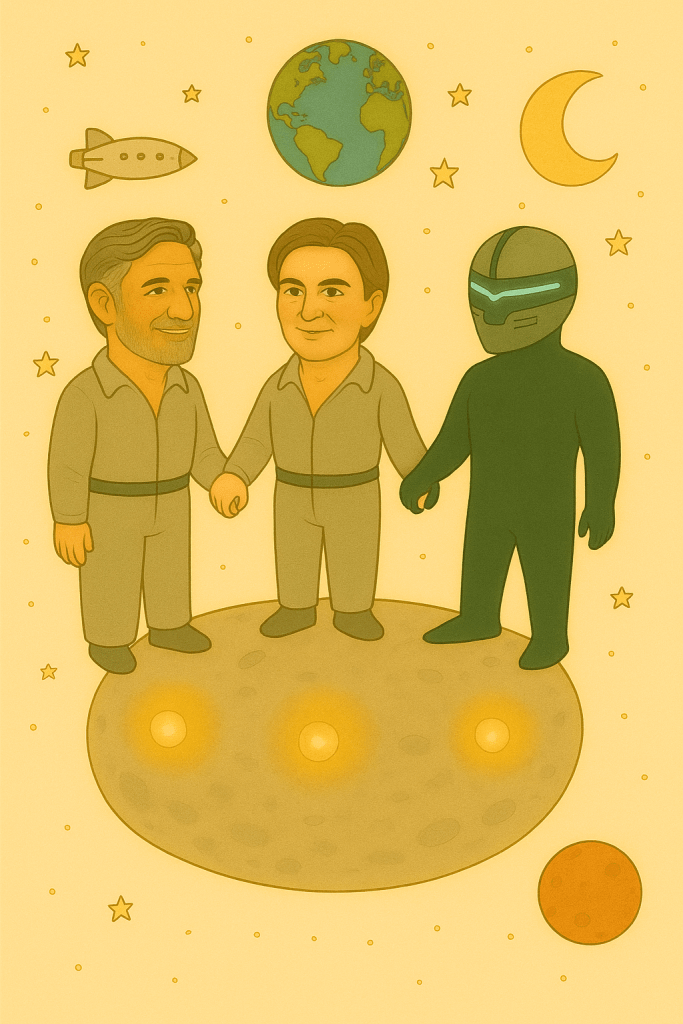
For the full vibe, listen to Bring Us Together by The Asteroids Galaxy Tour; this story was freely inspired by its sound and spirit.
A Voice From A Million Years
The training atrium holds a kind of quiet, although silence in space is never true silence. Beneath the soft blue lighting from recessed strips, there is always the low, layered hum of life support, the steady breath of conditioned air through hidden vents, and the faint hiss of the immersive videowall’s circuits.
The floor is a muted composite, textured with a fine, sandpaper-like grip that holds his boots steady. Firm, practical, made to balance uncertain steps.
Alethon stands near the Training Screen, shifting his stance in small tests, heel to toe, side to side, as he reads how his body absorbs the pull. The calves speak first, then the lower back, a persistent reminder that these are the first real minutes in gravity after a long journey in microgravity. Not unpleasant. Not yet familiar.
Monty is opposite him, leaning casually against the wall near the far door, the set of her shoulders suggesting a comfort Alethon hasn’t yet found, as if the room already belongs to her.
That door, the one to the rest of the base, glows green for a moment. Alethon feels a faint echo of Hestia’s words from before, and the glow strikes him as a promise kept: green means clear, green means trust. Then, with a whisper, the door slides open; the reassuring color washes across its surface, fading as the seal parts to reveal a faint bluish light beyond. Trust has opened the way, but the unknown still lies ahead.
From the darkness, a silhouette drifts into view. First, a line of light at mid-height. Then the full body.
Analog AI Spacedroid, Class Prometheus, Serial No. 001, call-sign Hermes.
The first of its kind.
Inside its chest, behind reinforced composite plating, rests the computational core, not silicon, not digital. Hermes is analog. Its ‘thinking’ unfolds in layered magnetic states and vector fields, a design built to mimic intuition rather than calculation; a brain placed in the chest, as if built to feel patterns rather than compute them.
Low in the abdomen, a power-heart pulses, inaudible but warm if you stand close. From here, energy radiates through its frame, feeding every system: sensors, processors, and the synthetic muscles that give the limbs their human-like motion.
The same source supplies the discreet micro-thrusters in the palms and soles: in pressurized spaces, they draw station air through hidden torso intakes, compressing it before release; when the air thins, the system seamlessly switches to compact cold-gas tanks. As the door releases the body into the room, that system carries it forward.
Hermes enters at a forward angle, head leading, feet trailing by thirty degrees, like a diver slipping into water. The faint hiss of compressed air whispers from the vents in its palms and soles, steady, controlled bursts. It is a movement made for enclosed spaces: efficient, safe, impossibly smooth.
The spacedroid closes the distance in a slow, deliberate glide, covering seven meters without a wasted vector. Each microburst brakes a fraction of a second before the next; the approach feels less like crossing air than being carried by it.
As it draws nearer, the visor becomes more evident: a seamless 360-degree band curving around its head from temple to temple, a darkened glass catching and bending the atrium’s light. Even at rest, it carries a faint glow, the quiet signature of an active mind. This is the optical-auditory interface, a panoramic braid of lidar, acoustic tomography, and thermal overlays, with phased-array comms sewn into the rim.
A black central line traces from the visor’s midpoint over the crown and down the back, housing environmental sensing arrays in a modular spine. On each cheek, three diagonal slits, matte black when idle, angled parallel to the visor’s edge. When the droid speaks, they pulse in rhythm with the sound, a visual echo made light.
The visor’s dark surface remains angled toward Alethon throughout the glide, an unwavering line of attention that makes the air between them feel thinner. Its movement is unhurried, revealing no effort against gravity’s steady pull.
Hestia announces:
“Doctor Alethon Kouros’s boarding is complete, Commander. The Training Screen is powered and fully operational, ready for the session.”
Hermes’s head turns slightly toward the nearest audio emitter. The lines on the cheeks glow softly, their rhythm pulsing in sync with the voice, a visual heartbeat in the dim light.
“Acknowledged, Hestia.”
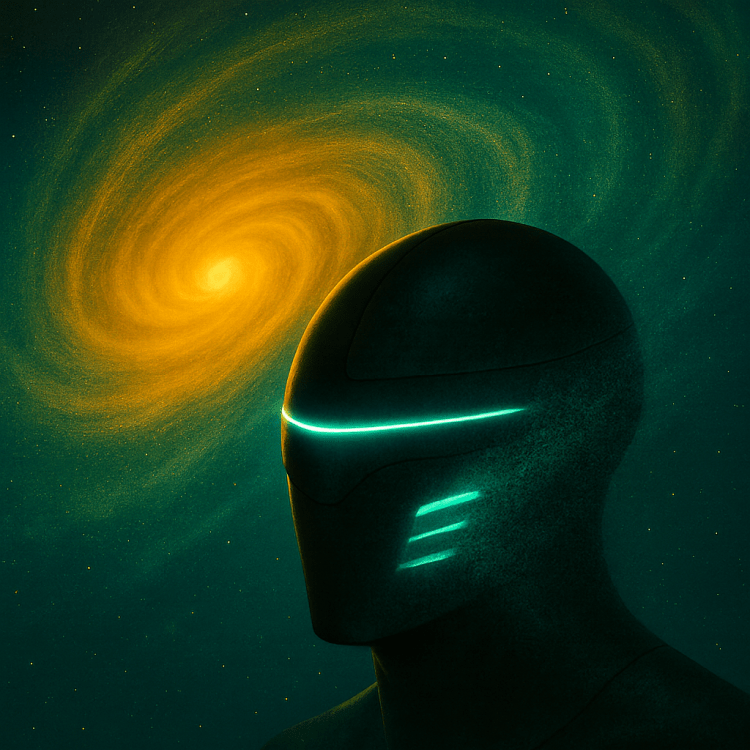
The sound stops Alethon before he can blink. It isn’t just a tone; it is resonance itself, a timbre that seems to have carried through stone and vacuum for eons before shaping words. The resonance appears to carry weight, a light pressure across his sternum, as if the acoustic wave arrives with its own gravity. In that instant, a drop of song surfaces in his mind: “the travelling sounds from an ancient past, drawn together in one unifying voice.”
Hermes touches down lightly, its boots meeting the floor as the air vents sigh one last time, stirring the doctor’s hair. The visor inclines toward him.
The voice comes again, still carrying that undertone of stone and distance, yet now softened into something soothing:
“Impressive. You’re already on your feet. Faster than most after weeks in microgravity. You are more Selenite than a standard Earthling.”
Alethon’s mouth curls into a small, private smile. The familiar sound carries his thoughts to Moon-g: easier, lighter on the bones, softer on the tendons than on Earth. Though numerically identical to the lunar pull, Hestia’s gravity feels heavier, deliberate, as if the base wants its guests to remember they stand on something solid.
Monty cuts in from the side, grin in place:
“And I didn’t help him, I swear.”
The visor dips in a faint nod, the droid’s version of a smirk, before focus returns to Alethon.
From the far corner, a helmet‑sized drone emerges from its recess, HSA3, gliding silently until its jets give a brief pfft, holding position just above the commander’s shoulder line. A soft chime, then:
“Mission 1 accomplished, Commander.”
The reply comes with the same professional precision, though gentler at the edges, almost paternal:
“Logged, Three. Resume passive mode during the training session.”
The drone’s indicator light dims, drifting quietly toward the wall opposite the Training Screen.
“Was Three a good voyage companion?” Hermes asks as it closes the gap to arm’s length, extending its right hand.
Graphene-laminate haptic skin sheathes its titanium–boron-carbide lattice, protecting the alloyed frame and the precision mechanisms beneath. Green to distinguish its artificial nature and engineered for contact, it can sense pressure, texture, even warmth, micro-exchanges of energy to mimic the human touch.
To cover the unique external layer, it wears a sleek, skin-tight utility suit, matte black and functional, that covers the torso and limbs but leaves the head, hands, and feet exposed. The garment is unnecessary for operation, perhaps symbolic, serving as a nod to modesty, identity, or some echo of human norms.
In the atrium light, the celadon green of its exposed hand shifts in muted tones, catching reflections like stone beneath water.
“Yes, silent but always there, a companion all the same… and ‘Three’ feels right. I like it, it sounds familiar,” Alethon says, taking Hermes’ hand in greeting.
Touch. Or the illusion of it. As their hands meet, his mind slips to a lesson from his early studies: touch, the most intimate act between two beings, is never truly contact at all, just electrons refusing to merge. Yet in the engineered warmth of Hermes’ graphene skin, his senses read the opposite: closeness, connection.
“Your graphene skin feels… warm. Unexpected. How do you…”
For a moment, the doubt presses in. Was this construct too human, or not human enough? Could it ever be trusted as genuine, or would it always carry the shadow of the artificial?
Monty’s voice slices neatly through: “Gentlemen, the romance can wait. You can walk hand-in-hand during the base tour. Now, let’s move on with the training.”
Hermes doesn’t flinch.
“You’re right, Monty. Training comes first.”
Then, gently drawing its hand back:
“We need to complete your welcome training before you’re cleared for the habitats: base orientation, main systems, and only after that, safety protocols.”
Alethon nods. “Yes, I’ve reviewed the basics. A refresher would help.”
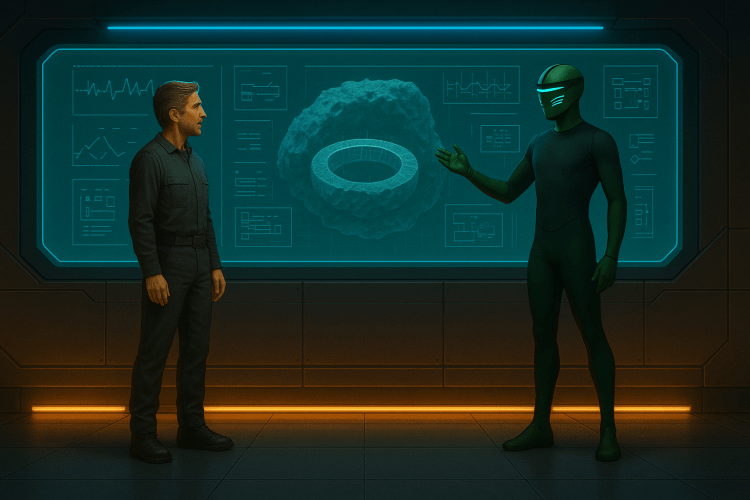
The outpost commander lifts its left hand. The Training Screen blooms into a glowing schematic of Hestia Asterobase, its light catching the celadon of graphene skin and shifting in soft gradients.
“Training mode engaged. Please get closer to the Training Wall.”
Hestia’s voice sets the Training Wall aglow, the schematic shimmering in anticipation, its lines already hinting at orbits and trajectories. Hermes’ head tilts fractionally toward the display, the faint glow along its cheek lines brightening; a quiet signal it was about to take command.
Unfolding the World of Gravitational Trust
Hermes steps into the center of the atrium, visor fixed on the Training Wall. Alethon adjusts his stance for a clearer angle on the curved screen, holding his position toward the entrance door.
“Let’s begin with a sense of place,” Hermes says, a small lift of its hand.
The Training Wall flexes forward a few degrees, no holodeck illusion, just a responsive surface that curves to meet the eye. Monty drifts toward the opposite wall.
The base schematic tucks itself into the corner. A pale map blooms: Mercury, Venus, Earth, Mars, with orbital threads laid over a velvet black background. A single orange filament traces 11-Amor.
The map tightens on Earth’s orbit, highlighting a point not far from the planet.
“Three weeks ago, we passed near Lagrange Point Four, our usual reference for cargo delivery with Earth as the destination, and to collect cargo for Mars. Now we drift outward along Amor’s arc toward the Red Planet, a stable bridge between two worlds.”
Monty folds her arms, the smile easy.
“Space taxi. No tips required.”
“Celestial hitchhiking,” Hermes allows. “Minimal propellant. Maximum efficiency. Four billion years in the making. This is the foundation of our Spaceways.”
The map pulses gently, a predicted arc curving toward a future rendezvous with Mars’ path.
“So…” Alethon’s voice is quiet, almost to himself. “We’re riding a rock through space.”
“Proper drift,” Hermes corrects mildly. “Nature moves; we adjust when needed.”
A gesture zooms to 11-Amor itself, rotation axis vertical, the spinner-like form turning slowly. Thrusters mark the far sides of its equator, one enlarging with another flick of Hermes’ fingers.
“We’ll talk about these later, during our physical visit in the Command Room.”
Hestia’s voice slides in, even and precise:
“Trajectory stable. No course adjustments required for thirty-one days.”
Hermes lowers the base schematic, rotating the asteroid so its equator runs parallel to the floor. The image is split cleanly in half, revealing the tunnel and modules inside, and then moves the landing zone to the top.
“And this, doctor, is your new world in motion. Let me show you something familiar.”
From above the schematic, Hermes’ left hand moves in a shallow arc. The Training Wall responds, zooming to the landing plate’s docking arm, telescoped out to meet the shuttle. On the other side of the arm, the first pod room is highlighted, already Hestia’s domain, where the crew car latches in.
The schematic traces the curving descent tunnel that follows, with the crew rail arcing inward, while the cargo rail shadows it like a silent twin. The view slides to the lower pod bay, rotating 180 degrees, zooming on the door ahead with the stamp in clean letters: WELCOME TO HESTIA ASTEROBASE.
“One short step up, and you’re in the Welcome Room, here, under blue light. Unless you take the cargo line,” Hermes says. “Two movement systems: people and payloads. Keep them distinct, and nothing goes missing, least of all you.”
Monty’s mouth tilts. “Translation: stay out of the cargo lane unless you want to get adopted by a crate.”
“Duly noted,” Alethon says. “I took the right path thanks to Three’s prompts.”
HSA3 gives a pleased little chirp and holds station, as if taking a bow.
Suddenly, a smaller frame blossoms in the corner: a camera view from the commander’s droid assistant, HSA1. The hovering robot is located in the first module after the Welcome Room, identified here as Airlock 1, the same passage Hermes has entered through earlier.
Its lens pulls in the gentle, almost aquatic hue of the chamber beyond. The light is calm, bluish against the matte metal. At the front, a door. In the corner of the feed, the door’s amber status glow holds steady.
“Airlock 1, primary access to the next module, the Greenhouse,” Hermes says. “Restricted until training is complete, or clearance is given.”
On cue, the amber shifts to green. The hatch slides open with a clean, practiced whisper, and for a second, the image is all brightness, then the auto-exposure recovers, and the scene breathes into focus.
“Proceed,” Hermes instructs.
The Training Wall feed widens, HSA1 gliding forward into the Greenhouse. The curved walls rise high.
Left, the wild side: grasses, low brush, trees, a thin silver stream sliding its length. Midway, the stream widens into a shallow pool before tapering again.
Right, the cultivation side: ordered beds and trellises, leaves shining under blended grow light and “sun.”
Overhead, the continuous sky vault curves from floor to ceiling, shifting through weather and light to match a 24-hour Earth day.
“Feels like a full summer day in there,” Monty says. “A bit too warm for me.”
“We keep it around thirty degrees Celsius during ‘daylight,’” Hermes replies. “Optimal for vegetation, even if a little tropical for humans.”
HSA1 drifts along the central walkway, one meter wide, a path set across the center of the floor’s seven-meter width. The camera slides past the spring at the entrance wall, where water issues in a gentle sheet and flows into the stream, following the slight slope of the 50-meter run.
“You’ll spend more time here than you think,” Hermes remarks. “This is food, oxygen, water, and a cure for the mind when the walls feel too close.”
Alethon realizes he is barely hearing the words. For a moment, he is elsewhere, a child walking with his grandfather between a rough strip of trees and a neat row of kitchen crops, the old man naming leaves, insects, the web of a living place, emphasizing the importance of being in contact with nature for physical and psychological health.
“The same forces that make the Earth go round,” the song echoes in his mind, “can hold two people side by side in full confidence.”
He blinks back with a trusting feeling as Hermes concludes.
“…critical to maintain balance when crew activity fluctuates.”
“Lost in the jungle already, doc?” Monty teases.
“Just… appreciating the view.”
“And you just started,” Hermes says with a small nod.
Monty wipes the back of her neck. “Enjoy it while you can. Give it five minutes, and you’ll start missing air conditioning.”
The feed tilts up briefly as HSA1 sweeps the arc of simulated daylight before returning to its level position. Hermes gestures again, and the image shifts seamlessly through the rest of the greenhouse to the door at the end.
Through the next seal, the image drifts into a compact buffer, Airlock 2, where cooler, drier air would strip humidity and any freeloading insects before the habitat continues. Two doors angle off the hub, orthogonal to the equator line, one north, one south: the visitor quarters, neat and modular, built for short assignments and low maintenance.
“Clients and guests,” Hermes says. “Usually, short stays. Easy turnovers.”
The feed continues, and the airlock’s front door opens into the Recreation module. Lighting has already shifted to sunset warmth. On the right, a quiet nook with a sofa; on the left, a widescreen, an invitation to the kind of pause Alethon hasn’t allowed himself in weeks.
Beyond it, a compact galley wall with a fold‑out table for two or three; farther on, the fitness strip, cycle, tread, row, bench, set along the arc.
Hermes slows the feed over the exercise machines.
“Two hours of exercise per day minimum,” it says, “split if you prefer, one hour morning, one hour evening. Perfectly balanced loads with cycle, row, and treadmill in a harness. Moon-g is kind, but your bones and muscles still listen to habit more than gravity. Right, Monty?”
“I exercise with the maintenance routines,” Monty says, dry as dust.
She raises one arm, palm flat, moving it up, “Wrench on,” then down in a slow rhythm, “wrench off…”
Both arms come up, then down as if she were hefting something invisible.
“Bring the bench, leave the branch…”
“That… counts?” Alethon asks, blinking.
“If it makes me sweat and keeps the station alive,” she says, “it counts.”
Alethon chuckles, shaking his head. “I’ll take that as certified procedure, then.”
Hermes’ visor quirks fractionally, like a smile made of glass. “One of your unusual procedures, Monty. Now let’s see what’s next.”
Another buffer, the third airlock, and then the two crew doors face each other across the hub, in the same position as the previous two, labeled in clean white.
Monty Quarters, Beware of Dogs.
Opposite:
Dr. Alethon Kouros Quarters.
“Gravity still pins the floor,” Hermes says, “but air will find a loose sock wherever you forget one.”
“Best excuse for a messy room I’ve ever had,” Monty mutters, amused.
“We’ll open yours later, doctor. No socks should be floating there. Still,” Hermes says. The visor dipped a fraction, almost a smirk, and the tour kept moving.
HSA1 slips into the Medical & Scientific Lab: stainless benches, sealed storage, modular racks. Quiet promise, not spectacle.
“Your domain, doc,” Monty says, voice warming despite herself.
“Configured to the specifications you sent,” Hermes adds. “I’ll show you everything once we get there together. Now, it’s the turn of my alcove.”
The Command Room comes into sight: spare, intentional.
At the module’s entrance, a matte black sphere sits in a cradle of three curved supports, 3.8 meters across outside and 3.6 inside. Astrometry. Its hatch is a neat iris; the interior skin is a continuous 360° monitor, with only two positions set at the center, shoulder to shoulder.
“Sky vault, from Amor’s point of view,” Hermes says. “Star trackers feed it live. Step in, and you’re standing under the true dome: parallax, glare, occultations, all corrected. Calibrated eyeline: one point eight meters… my visor height.”
“Planetarium?” Alethon asks.
“Closer to a sextant you can sit inside,” Hermes replies. “Navigation, star maps, and… perspective.”
Alethon lets the image settle: not stargazing, but a sailor’s tool for the cosmos, a compass hidden in stone.
HSA1 glides past the black sphere: wall arrays, system dashboards, and a single seat whose headrest carries a discreet port. The camera view drifts behind the chair, and the angle makes the connector stark in the frame.
Alethon’s gut tightens, recalling old clinic memories of burned patients, the long agony of coaxing nerves back to life. Ports like these have always promised enhancement, augmentation, even transcendence, yet too often they brought dependency, or worse, erasure. Once you let a system wire itself into your flesh, where do you end and it begin? The sight presses old unease against his ribs. Not trust. Not yet.
Hermes’ visor inclines as if reading the silence. When it speaks, the voice is even, but gentler at the edges.
“Hestia interface. Direct coordination when required, designed specifically by Monty.”
At that, she brushes the back of her neck, unreadable, then lets her hand fall.
Alethon catches the faint shift of tone. Almost reassuring. Or perhaps that is only his own need to believe it.
“All systems nominal,” Hestia reports.
“As expected. Now, the forge of Vulcan,” Hermes says with the faintest hint of amusement.
The Training Wall shifts again. Doors part to reveal the Engineering module: harnessed cable runs and stabilization hardware around a sealed power core buried below, occupying half the module, leaving a meter’s clearance around it.
Monty raps a knuckle lightly on the guard rail that circled the sealed power heart.
“Rule of thumb about the core,” she says. “If the status ring glows soft and steady, we’re friends. If it flickers, you fetch me. If it ever goes dark, don’t touch a thing and start praying to whichever god of fire you like.”
“I hope not to be there in that moment,” Alethon whispers.
“Me neither,” Monty sighs.
Behind the energy core are additional system control consoles and a door at the end. The door light stays amber. HSA1’s camera turns off. The screen zooms on the schematics, highlighting Airlock 4 and an under‑construction sector.
“That sector is still under construction, air pressure and temperature are equalized with the cargo bay,” Hermes offers, and nothing more.
“What’s being built?” Alethon asks.
“Work in progress,” Monty says lightly. “Cargo bay next.”
Hestia does not elaborate. Neither does Hermes.
“The cargo ring picks up from here,” Hermes continues. “From about the two-hundred-meter mark, it’s floor-ops for the rest of the loop, over four kilometers of continuous rail with sidings. Hestia, environmental conditions.”
“Rarefied air, temperature around zero degrees Celsius,” the base AI reported.
“It lowers thermal load, suppresses microbial growth, and saves power,” Hermes adds. “Not a comfort zone for humans, masks and layers if you must go there. Details in safety training.”
Monty tips her head toward Alethon. “If space logistics sounds fun, we can talk throughput curves and LIFO lanes later, preferably in front of a fresh Martian alcohol-free beer.”
“Maybe when sitting on the sofa. Logistics always made me sleepy,” Alethon murmurs.
“With this, the orientation tour is complete,” Hermes says. “Questions?”
“Plenty,” Alethon answers.
“Do they relate to safety?” Monty asks.
He shakes his head.
“Then, safety first. Let’s keep the funny things for the walking, not necessarily hand in hand,” she says.
Hermes inclines its head. “Hestia, move on to Safety Protocols.”
“Affirmative,” Hestia replies.
The ambient light moves from blue to amber, the hue flattens on Hermes’ visor, leaching warmth from the room. A soft chime marks the shift as the Training Wall dissolved and reforms in bold letters:
HESTIA ASTEROBASE — SAFETY PROTOCOLS.
Alethon exhales, only then realizing he’s been holding his breath. The room no longer feels like an introduction; it feels like a test. Even the gravity under his boots seems firmer, less forgiving. He straightens, waiting for what comes next.
Turning Amber into Green
Safety. The word glows amber on the wall, but Alethon hears it in another place. A classroom, years ago: the first day in the chemistry lab, a teacher listing hazards and drills. Safety wasn’t comfort, the voice said. It was the work of staying whole. Spot the risks. Respect the rules. Be ready when things go wrong.
Back then, he worried about a spilled vial or a flame too close. Now, the dangers swell grotesque: a cracked seal is a vacuum, a pebble at orbital speed is shrapnel, a thruster glitch is a tomb. The thought presses against his chest before he can push it away.
“Safety isn’t fear,” Hermes says, steady as stone, as if reading Alethon’s mind. “It’s discipline. Hestia: status.”
“Pressure integrity nominal,” the base AI replies. “Oxygen levels nominal. Temperature nominal. Energy level nominal. Asteroid rotation speed nominal. No leaks. No alarms. No hazards on our route.”
Monty lets the moment breathe, then cuts it with a grin. “Safer than your mother’s kitchen on Sunday lunch. We don’t bank on that, though. We bank on rules and on practice.
Your turn, Boss, show us the drill.”
Hermes inclines his head slightly, one hand lifting toward the Training Wall. Symbols ripple, then lock into place: doors and hatches, a precise language of bars and rings.
“Door indicators,” Hermes says. “Green is safe. Amber is restricted. Manual overrides remain command-only. No red in day-to-day operations. In an emergency, red cannot be cleared, not even by command. When red appears, alarms will sound in a triple tone. Follow the signal to the nearest safe zone.”
Alethon files the words away, but already knows they won’t stay in that form. The room holds a beat too long, silence pressed flat by protocol.
Monty taps the rail. “Translation: green means coffee awaits. Amber, hands off. Red, no way. Triple trumpet means turn around and go. Fast.”
That’s the version the human mind seizes. When adrenaline erases memory, only small phrases survive.
The words click into place. A flash from school rises in Alethon’s head: the shrill triple-tone of an evacuation drill, red lights stuttering across lab benches, the teacher’s voice calm but clipped. Even now, decades later, the body still recalls what the mind might forget: see the color, hear the sound, move away.
“Received loud and clear,” Alethon says, the words sounding strange in his own mouth, but right, like a reply meant for a crew.
Hermes gives the faintest nod, visor dipping. “Copy that. We can go on.” His arm tilts toward the Training Wall. Symbols dissolve into a cutaway of the habitat ring. Mass lines unfurl, deck labels settle, the slow sweep of rotation traced in a thin, luminous arc. Thruster ports in his palm, precise and inert, mapped like a constellation across the alloy.
“Hestia runs the habitats at approximately Moon-g,” Hermes says. “About 0.165 of Earth’s gravity or one-sixth. Heavy objects still have the same mass; the apparent weight is an illusion. Nothing tall and top-heavy. Keep storage low and horizontal. If it can roll, clamp it. If it can drift, tether it.”
Monty points toward a cargo bay view on the schematic, rows of long racks sketched in light. “Stacks built to be clever always fall. Stacks built to be careful don’t. Chance forgives the careful, not the clever.”
“Crystal clear,” Alethon says. “I’ll avoid building my famous burger pile if it keeps me from cleaning the kitchen all the time.”
Monty’s grin flashes. “Savvy decision, otherwise we’ll be chasing pickles and lettuce all over the party pit.”
Hermes jumps in. “If pickles try to fly away in celebration, liquids behave in an even nastier way.”
The Training Wall shifts: a poured ribbon lingers, sheeting along a handrail, reluctant to fall.
“At Moon-g,” the droid says, “fluids wander before they give up to the pull. In spin, liquids are lazy: they drift, they wander, and when they land, they smear. Pour low. Cap everything. If you spill, log the incident and report it. A film in a cable tray could become a short, and a short becomes a lesson no one enjoys.”
The Training Wall follows the liquid thread until it kisses a junction box. A shimmer, a spark, then fire. A stubby, round flame kernel blooms, its halo pressed to the panel, beautiful, the wrong kind of beautiful.
Hermes’ voice is steady. “In free drift, fire makes marbles, spherical, fed only by airflow. In Earth’s gravity, flames rise, pulled upward by buoyant air. Here in spin, between the two, flames still lean, but sluggishly. They creep sideways, slower, lazier than Earth, never truly climbing. Suppression has to attack from all sides, because fire here won’t behave the way memory says it should.”
Alethon shifts his weight, suddenly aware of how thin the floor feels.
Monty tips her head, deadpan. “Oh, just on time. Indoor fireworks. My favorite.”
“Fire…” the droid’s vocoder softens, just a shade. “Is one of humanity’s oldest fascinations… and fears.”
Then silence. Not a gap in words, but a thought arriving out of rhythm. As if the machine paused to feel before finishing the line.
For a blink, Alethon notices the timing more than the words, a slip in the metronome that feels almost like a thought happening out of order.
“Smoke and fire detectors are all nominal,” Hestia says, voice arriving half a beat early, like it anticipated Hermes by a breath. “Foam suppression systems are armed and primed for all modules.”
“Good, as expected,” the Commander answers, ruler-edge again, as if nothing kinked the rhythm.
The map of the base returns, simplified to routes and distances. Two lines bloom green.
“Emergency exits,” Hermes says.
Alethon frowns. “Exits? In solid rock? Why do we need those?”
Hermes turns his visor toward him. “Fire… Hull breach. System failure. No habitat is absolute. Survival always requires a way out.”
Monty raises a brow. “And sometimes, just a way to sneak off before the party pit cleanup.”
Both the visor and Alethon’s eyes swivel toward her. She shrugs, unapologetic. “What? Every emergency needs options.”
Hermes tilts back to the Training Wall, ruler-edge again. The schematics rotate to place the landing plate on top, zooming in on the descending pod area at the surface.
“Exit One: Crew Tunnel,” Hermes continues. “Using the same tunnel used to enter the base, you reach the descending pod area on the surface. Here, there is a hatch, not immediately visible, but on the wall beside the pod itself. Five escape pods are in the next module, one for each of the maximum five crew the base can host.”
Pods expand to a schematic: five cradles, guidance cones, and labeled straps.
“Pods are preprogrammed for return corridors,” Hermes says. “Earth or Mars, depending on the orbital position. Once inside the appropriate sphere of influence, they hand off to the nearest rescue net.”
Monty says, unblinking. “Lifeboat’s there. Not cozy, but better than a vacuum.”
A shiver moves down Alethon’s spine.
The map pulses again. Another line threads outward, longer, harsher.
“In the improbable case that the Crew Tunnel is inaccessible, there is Exit Two, via the cargo bay,” Hermes continues. “Four hundred sixty-three meters to the tunnel under the first thruster, then the ascent to the pod area on the surface through the fuel tank tunnel, with an additional five escape pods.”
“Call it four hundred meters of cardio before freedom,” Monty says, neutral as a flight surgeon logging a pulse. “Not pleasant. But available.”
Alethon pictures the run: the sideways tug of spin underfoot, alarms chewing the air, an oxygen mask, copper in the mouth. The distance is trivial, until breath is not. He sets the image down like a tool where he can find it again.
“Evacuation drills,” Hermes says, “are monthly and random. You’ll hate them until you love them. Of course, we don’t fire the pods, just reaching them from Exit One as quickly as possible.”
The Commander lifts a hand. “Exit Two remains restricted until construction of the last module is complete. Hestia, status.”
A radial spur appears, bored a few meters inward toward the bonded core. A rectangle stamped with a blunt label: UNDER CONSTRUCTION. No details. No hint.
“Sealed,” Hestia confirms. “Ambient pressure and temperature outside standard habitat range. An oxygen mask is required for human access. Airlock remains shut.”
Hermes inclines his visor. “If we must go that way for an emergency or an extraordinary activity, Airlock Four must first close its spur and cargo bay doors, equalize back to Engineering pressure, and let us in. Once masks are confirmed, it cycles again: equalize to the cargo bay, then open. Only then is the passage safe.”
Then, a pause, visor tilting toward Alethon with a deliberate slowness, the kind that makes the air feel heavier. “If I am not operational, Monty is second in command.”
Alethon swallows, a reflexive nod slipping out, not deference, but recognition that even the machine counted itself among the fragile.
Meanwhile, Monty raises a hand, the gesture as dry as her voice.
“She can issue the unlock,” Hermes continues, “again only once masks are confirmed. If even Monty cannot act for whatever reason, Hestia will accept your override, never before the mask is on.”
“I can mutter even in the void,” Monty replies flatly.
“I know you can.” Hermes’ nod is precise, almost fond.
Alethon exhales, a grin flickering. “Hard to imagine… any of this.” Half at the joke, half at the thought of him carrying on without Monty and Hermes.
Hermes moves his hand toward the Training Wall.
“Final notes: health is safety too. Reuse of resources keeps us alive as much as fire drills do.” Its voice softens, an edge filed down for human ears.
The screen flattens, cycling to the regeneration system of the base, which links the quarters, kitchen, greenhouse, and air control.
“Recycling is our religion,” Hermes says. “Every drop of water is recovered, from cleaning use to vapor in your breath. Food and human wastes are reprocessed and routed through the greenhouse to be used as fertilizer via a network of underground capillaries.”
Alethon whispers, half a smile. “So the tomatoes are running on leftovers.”
“Leftovers, plus everything you flush,” Monty adds, dry as chalk.
Hermes inclines his visor. “Exactly. Toilets are tuned to each user. Chemistry and microbes vary from person to person, and the biodigesters adapt accordingly to maximize efficiency. Swapping would confuse the system, reduce efficiency, and risk contamination; instead, it would spread waste rather than fertilizer. Do not swap unless maintenance assigns it.”
Monty leans in with intent. “Always log fluids. Always log smells. Rely upon your nose more than your pride. And don’t use my toilet, unless you want to fertilize the wrong patch.”
Alethon laughs, releasing the tension, and he isn’t the only one. Even Hermes lets the sound through, something brittle in the air finally breaking. In that moment, Alethon feels it isn’t just laughter. It’s the first thread of trust weaving across the three of them, thin but real.
“Hestia, post clearance… while we still can,” Hermes says, the cadence edged with something that almost passes for humor.
The wall responds without flourish, text resolving in cyan like breath held and released:
SAFETY PROTOCOL TRAINING — COMPLETE
DR. ALETHON KOUROS — CLEARED FOR HABITATS
The amber bar above the greenhouse door blinks, once, twice, then slides into green, not as status, but as a promise.
“Habitat access is open,” Hestia announces, clear but unnecessary now. Green has gravity.
Hermes steps close enough that the silent hum of its chest is a felt thing. The hand on Alethon’s shoulder is measured, not cold.
“Welcome aboard,” it says. “Officially.”
“Told you,” Monty says, already moving toward them and showing the way to Airlock 1 door. “Green means coffee is waiting behind the door.”
Alethon clears his throat, a half-smile tugging. “As long as it isn’t recycled.”
The nascent trio indulges in a finally relaxed laughter, rising together before fading into the air and leaving it quieter than before.
The room stays very still. Outside, the rock keeps its quiet spin. Inside, he understands why the place rarely goes wrong and why, when it does, the people here will meet it standing up.
A sudden crisp chirp announces HSA3 gliding forward, a small scout still serving its charge. The little drone slips in first and waits just inside.
The new crew follows, passing the first door that remembers Alethon’s name. The light above is a new color on his spectrum; the color of joining.
A few steps into the bluish airlock corridor, and they approach the second door, the little drone ahead. The hatch panels open at its presence, acknowledging the clearance. Beyond it, the greenhouse breathes daylight, an engineered sun over leaf and soil.
The song drifts back, stripped to its pulse: one sun shared, real or made, is enough to bring us together.
He moves with them. Moon-g ahead; procedures behind: three lives, one rotation.
 Becoming Spacepolitans