Looking from the Outside to Fix What’s Inside
Listen to Blade Runner End Titles by Vangelis to fully enjoy reading this post.
Observing Earth from the Outside
To take care of a system, one must first understand it. And to understand a system as complex as Earth, proximity is often a limitation rather than an advantage. Immersed in its dynamics, scales, and feedback loops, we struggle to perceive the whole. Distance, paradoxically, becomes a tool for clarity.
One of the most lucid intuitions on this point came from George I. Gurdjieff, who observed that meaningful understanding requires stepping outside the system one seeks to comprehend. From within, distortions are inevitable. From outside, patterns emerge. Applied to our planet, this insight becomes almost literal: the only place from which Earth can truly be observed as a whole is space.
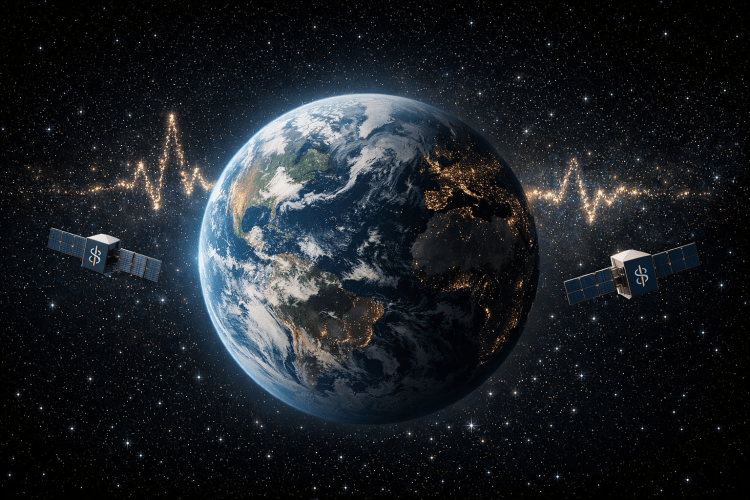
Seen from orbit, borders disappear, cycles become visible, and connections reveal themselves. Oceans, atmosphere, ice, forests, cities, and deserts form a single, continuous system. Phenomena that appear local from the ground reveal their global nature when observed from above. Human activity, too, leaves signatures that can no longer be ignored.
Observing Earth from space is not an act of detachment. It is an act of responsibility. Distance does not weaken our bond with the planet; it strengthens it. By stepping back, we gain the perspective needed to act with intention, coordination, and care.
The Rise of Planetary Awareness
The moment humanity first escaped Earth’s gravity was not driven by a desire to observe the planet. It was driven by curiosity, rivalry, and technological ambition. Yet, unintentionally, that moment opened a new way of understanding our home.
In 1957, Sputnik became the first human-made object to orbit Earth. It was a simple sphere by today’s standards, with limited instrumentation and a short operational life. But its significance went far beyond its technical capabilities. For the first time, Earth was no longer only the place from which we looked out into space. It became an object that could be looked back at.
Very soon, satellites began to carry instruments not just to survive orbit, but to observe what lay below. Cameras, radiometers, radars, and spectrometers gradually transformed orbit into a vantage point. From there, Earth revealed patterns impossible to grasp from the ground: atmospheric circulation, ocean currents, seasonal vegetation cycles, ice dynamics, and the subtle fingerprints of human activity.
This was the quiet birth of planetary awareness. Spaceflight ceased to be only about reaching elsewhere. It became a means to understand here. By stepping away from home, humanity gained the ability to see Earth as a system, fragile, finite, and interconnected.
When Space Changed Earth
Observing Earth from space did more than expand scientific knowledge. It altered global behavior.
In the 1970s, scientists began to suspect that chlorofluorocarbons, widely used in industrial and consumer products, were damaging the ozone layer. The hypothesis was serious, but the scale of the phenomenon remained uncertain. Ground-based measurements were sparse and fragmented. What was missing was a global, continuous view.
That view arrived from orbit. Data collected by instruments such as the Total Ozone Mapping Spectrometer, operated by NASA, revealed something unexpected. Over Antarctica, the ozone layer was thinning dramatically, forming a hole far larger and more persistent than anticipated. Space-based observations did not just confirm the problem. They made it undeniable.
Faced with clear, global evidence, nations acted. In 1987, the international community adopted the Montreal Protocol, committing to the phase-out of ozone-depleting substances. It remains one of the most successful environmental agreements ever implemented. Crucially, satellites did not disappear once the decision was made. They continued to monitor the atmosphere, providing long-term feedback on the effectiveness of the measures taken.
After decades of monitoring, the result became visible. In 2018, the United Nations released a scientific assessment confirming that the ozone layer was recovering, a direct consequence of the measures adopted under the Montreal Protocol. Once again, the evidence came from space. Orbiting instruments such as NASA SAM, SAGE, and HALOE, and ESA ERS-2 confirmed that a planetary intervention, guided and verified from orbit, had worked.
Humanity had identified a planetary-scale problem, agreed on its cause, coordinated a response, and verified the outcome, all enabled by observations from space. It was a precedent. Not only of environmental recovery, but of what becomes possible when Earth is seen, measured, and understood as a shared system. This was not just a scientific success. It was proof that observing Earth from space can lead to informed action, collective responsibility, and measurable recovery. A rare global win, seen from above.
Earth’s Nervous System in Orbit
What began as isolated observations has evolved into something far more powerful. Today, Earth is continuously sensed by a distributed network of satellites that function together as a planetary monitoring network. Orbit after orbit, day after day, they collect data that allows us to track change, detect anomalies, and understand long-term trends across the entire globe.
One of the most ambitious examples of this approach is the Copernicus Programme, developed by the European Union and implemented in partnership with the European Space Agency. Through its Sentinel satellite fleet, Copernicus provides systematic, repeatable observations of land, oceans, atmosphere, and ice. The emphasis is not on single images, but on continuity. Only by observing the same parameters over years and decades can real change be distinguished from short-term variability.
On the other side of the Atlantic, NASA operates a complementary portfolio under its Earth Science program. These missions focus on climate processes, natural hazards, water cycles, air quality, agriculture, and energy balance. Together with international partners, they contribute to a shared pool of data that is openly accessible and scientifically validated.
Seen as a whole, these systems resemble a nervous system in orbit. Satellites act as sensory organs, detecting subtle signals that would otherwise remain invisible. Temperature shifts, atmospheric composition, soil moisture, ocean color, ice thickness, and human activity patterns are continuously translated into data. This global awareness does not replace local knowledge. It completes it. By giving Earth a way to be observed as a single, interconnected system, space has become an essential extension of planetary care.
Earth Observation and Global Responsibility
Collecting data is only the first step. Its real value emerges when observation is translated into informed decisions. Over time, Earth observation has progressively moved from a scientific support role to a strategic one, shaping policies, guiding interventions, and enabling coordination at a global scale.
This connection between space-based data and action is clearly reflected in the United Nations Sustainable Development Goals. Across multiple domains, satellite observations provide a shared factual baseline that governments, institutions, and humanitarian organizations can rely on: forecasting natural disasters, managing water resources, improving agricultural productivity, monitoring air quality, and protecting ecosystems all depend on accurate, timely, and globally consistent information.
Climate action stands at the center of this transformation. Rising temperatures, melting ice, sea level change, and extreme weather events do not respect borders. Satellites are uniquely positioned to observe these phenomena as interconnected processes rather than isolated events. By tracking the same indicators year after year, Earth observation allows decision makers to distinguish long-term trends from short-term fluctuations, enabling responses based on evidence rather than perception.
This role has become increasingly visible in international climate governance. At conferences such as COP26, satellite data underpin discussions on emissions, adaptation, and mitigation, providing the long-term records needed to assess causes, impacts, and responsibilities. Earth observation has become anindispensable means of monitoring the causes and effects of climate change. In this context, it does not dictate policy, but it defines the factual ground on which policy must stand.
What makes this approach powerful is not only precision, but trust. Space-based data offer a common reference point, accessible to all and independent of national interests. In a world where responsibility is shared but impacts are uneven, this shared view from above becomes a foundation for cooperation. From data to decisions, Earth observation turns awareness into accountability and knowledge into collective action.
Whether this shared perspective is used to its full potential remains a human choice.
Earth as Home, Space as Perspective
Seen from space, Earth stops being a backdrop and becomes a fragile, finite, and profoundly interconnected whole. Atmosphere, oceans, ice, land, and life appear not as separate domains, but as expressions of a single reality.
Observing Earth from orbit has taught us something essential. Our planet does not suffer from a lack of data, nor from a lack of technology. What is revealed from above is not only environmental change, but the scale at which responsibility must operate. Problems that unfold globally cannot be fully understood, nor addressed, from within borders alone.
Space does not offer an escape from Earth. It offers perspective. A vantage point from which consequences become visible, patterns become undeniable, and long-term thinking becomes possible. Humanity can choose to use this perspective for the better, or consciously avoid it.
Becoming Spacepolitans means embracing this unique opportunity, recognizing Earth as a shared home, and space as the place from which welearn how to care for it. Not through distance as detachment, but through distance as understanding.
 Becoming Spacepolitans