Human life beyond Earth: from the first steps to the next homes in space.
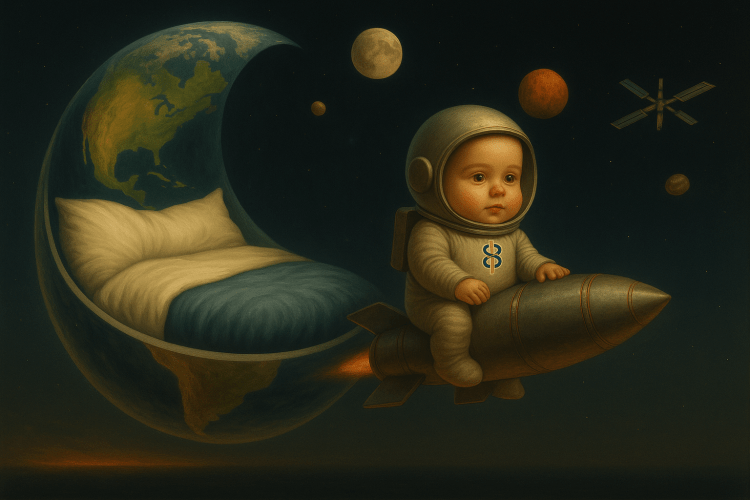
To enjoy reading this page, listen to Spacelab by Kraftwerk and I.S.S. (Is Somebody Singing) by Chris Hadfield.
From Fiction to Visionaries
A space colony is a large, self-contained, artificial environment in space that is self-sufficient and permanently inhabited. This concept has appeared in science fiction since Edward Hale’s The Brick Moon (1869) (you read that right, more than 130 years ago, imagining a sphere of bricks orbiting Earth!).
The leap from fiction to theory was surprisingly short. At the dawn of the twentieth century, visionaries like Konstantin Tsiolkovsky, one of the founding fathers of rocketry and astronautics, began turning dreams into equations. His Exploration of Outer Space by Means of Rocket Devices (1903) laid down the theoretical path that, within just fifty years, would see a human pushed into space by a rocket.
A few decades later came another bold thinker: Dandridge MacFarlan Cole. In the 1960s, Cole envisioned the macrolife: vast, self-sustaining habitats where humanity could thrive beyond Earth. His pioneering idea of hollowing out asteroids and spinning them to generate gravity directly foreshadowed many of today’s concepts, from NASA studies to modern visions of space settlement. Cole carried forward the line from sci-fi imagination to technical blueprint, showing that what once sounded like fantasy could be engineered into reality.
The first human outposts in space
April 12, 1961: one of the most significant dates in human history, the day Yuri Alekseyevich Gagarin reached outer space, laying the foundation stone for human expansion beyond Earth.
In the years that followed, the Space Race (see the Space Travel page for more details) saw the USSR and the USA send a growing number of crewed missions, gradually extending flight durations and testing humanity’s ability to live away from Earth. The first significant step toward permanence came with the development of orbital stations. The Soviet Union launched Salyut-1 in 1971, followed by the American Skylab in 1973. Each new station stretched endurance: Salyut-1 remained in orbit for 175 days, while Salyut-7 pushed to an impressive 3,216 days.
The leap forward arrived with MIR, launched in February 1986. It remained aloft for 5,511 days until March 2001, hosting astronauts for 4,594 of them, a total of more than 125 humans. MIR was more than a record-breaker: it was the first international station. Scientists and astronauts from around the world collaborated on missions, and costs were shared across international borders.
In 1992, Presidents George H. W. Bush and Boris Yeltsin formalized U.S.–Russian cooperation through the Shuttle-Mir Program, building on the earlier Apollo-Soyuz handshake of 1975. Seeing an American Space Shuttle docked to a Russian station was profoundly inspiring: former rivals united in pursuit of something larger than national pride, the future of humanity in space. MIR became the bridge from national efforts to global collaboration, paving the way for the International Space Station.
The eighth marvel in orbit: the International Space Station
On December 6, 1998, the Russian module Zarya and the American Unity were joined in orbit by the crew of STS-88. That historic docking marked the beginning of the assembly of the most complex human-made structure ever attempted in space: the International Space Station (ISS).
Built on the legacy of the Shuttle–MIR program, the ISS brought together Russia and the United States in a partnership soon joined by Canada, Japan, and the European Union. From the beginning, it showed that the challenges of space can unite people across the globe, transcending national rivalries.
Over the years, the ISS has grown module by module. By June 2011, it counted 15 pressurized modules, a number that remained stable for a decade. On July 29, 2021, the station expanded again with Russia’s Multipurpose Laboratory Module Nauka (meaning science in Russian).
The first long-term residents arrived on November 2, 2000, marking the start of Expedition 1. Since then, the station has been continuously inhabited, a milestone unmatched in human history. As of 2025, nearly 290 individuals from 26 countries have visited or lived aboard the ISS. The station is currently in Expedition 73, which began on April 19, 2025, and runs through December 2025.
The station’s future is now firmly set toward retirement around 2030. NASA has already tasked SpaceX with building a dedicated U.S. Deorbit Vehicle that will guide the ISS into a controlled reentry, targeting a remote ocean region. The deadline is not just about planning; it reflects the station’s advancing age. Some core modules are nearing or exceeding their original 30-year design life, and recent issues, such as a persistent air leak in the Russian segment, show that structural wear is no longer hypothetical. The ISS is aging in practice, not just on paper.
The next chapter after the ISS will not be about extending its lifespan, but about replacing it. NASA and its partners are preparing to shift operations to a new generation of commercial LEO stations. In this new era, the agency will no longer act as owner and operator, but as a customer, purchasing services from private providers. The ISS will therefore bow out with dignity, handing the torch to a fleet of commercial outposts designed to continue and expand humanity’s presence in orbit.
But beyond numbers and timelines, the ISS remains a technological jewel and a unique laboratory in microgravity. In low Earth orbit, astronauts test advanced technologies and conduct experiments that help us learn how to live and work away from Earth, knowledge vital for the Moon, Mars, and beyond. At the same time, its research has delivered benefits here on Earth, from medical advances to new materials (see the Space For Earth page for examples). In a few words, the ISS is a bridge between our planet and the cosmos.
Want to explore it yourself?
- Take the Grand Tour of the ISS with astronauts Luca Parmitano (Italian pride!) and Drew Morgan.
- Visit the ISS virtually through Google Earth’s Street View-like mode.
- Or, simply spot the real thing: the ISS is the third brightest object in the night sky, and NASA’s Spot The Station service shows when it passes overhead.
- If you’re curious to dive deeper into its layout and numbers, plenty of detailed infographics and official resources are just a click away, like this one from space.com.
The ISS remains a wonder, not just of engineering, but of cooperation. It is proof that when humanity looks up together, we can achieve the impossible.
Other national space habitats
Though not a stand-alone station, Spacelab (the realization of my childhood fantasies) was Europe’s reusable pressurized module and pallet system flown in the Space Shuttle bay. Configurable for different missions, it turned the Shuttle into a short-term orbital laboratory and returned intact after each flight. Across the program, 22 Spacelab missions flew before 1998, a milestone in international cooperation and modular science in orbit.
China’s path began with two small outposts: Tiangong-1 (2011–2018), which hosted Shenzhou-9 and Shenzhou-10 for about 24–25 days total aboard the lab, and Tiangong-2 (2016–2019), visited by Shenzhou-11 for 30 days.
The current three-module Tiangong station started with the Tianhe core module in April 2021 and was completed with the Wentian and Mengtian laboratory modules in 2022. Since late 2021, it has operated in six-month crew rotations (Shenzhou-13 onward). In 2025, the Shenzhou-20 crew took over operations, continuing the routine of overlapping handovers and regular EVAs. International collaboration primarily exists through selected experiments; Western crew visits are not currently on the table due to policy and mandate constraints.
India’s human spaceflight roadmap is outlined in Gaganyaan, followed by uncrewed tests in 2025–2026, and culminates in the first crewed mission in the mid-to-late 2020s, with a focus on establishing a national outpost, the Bharatiya Antariksha Station (BAS). Current plans aim to fly a first module around 2028 and evolve toward an operational Indian space station by ~2035, with capability growing as Gaganyaan milestones are achieved and new systems (life support, docking, cargo) mature.
Commercial stations: the future is now!
So far, only national space agencies have built or planned orbital outposts in LEO. However, the situation is changing fast: private operators are stepping in to carry humanity’s presence forward, especially with the ISS now set to retire around 2030.
The first in line is Axiom Space with its Axiom Station. Their approach is to connect new modules to the ISS, gain operational experience, and then separate into a free-flying station. “The assembly plan was revised so the Payload, Power, and Thermal Module docks first, targeted for 2027, enabling departure as early as 2028 to begin free-flying operations, with Hab-1, an airlock, and additional modules added afterward. Later modules will follow to form a standalone outpost by the end of the decade, designed to host crews, research, and manufacturing in orbit.
Another ambitious player is Vast Space with Haven-1, originally targeted for 2025 but now projected for launch in 2026. This compact station will host four astronauts for two-week missions using SpaceX’s Crew Dragon. Bigger plans are already outlined: Haven-2, a multi-module complex intended to operate through the 2030s and even test artificial gravity systems.
Blue Origin’s Orbital Reef once drew great attention, promising a “business park in space” in partnership with Sierra Space, Boeing, Redwire Space, Amazon Supply Chain, AWS, Genesis Engineering Solutions, and Arizona State University. The project’s timeline has slipped, and funding priorities appear to have shifted. Sierra Space’s Dream Chaser is real hardware but still delayed; after a contract modification, its first flight will be a free-flying demonstration targeted for late 2026 and will not dock with the ISS. Inflatable habitats and other modules remain in design, while Boeing’s Starliner is no longer a reliable option for crew transport. Orbital Reef is still on the drawing board, but its future is far less certain than once advertised.
One of the most concrete efforts is Starlab, led by Voyager Space with Airbus, Mitsubishi Corporation, and MDA Space, with Nanoracks as a key operating company in the program. Their design calls for a single launch in 2028 carrying the core habitat and service module, followed by early operations soon after. Supported by NASA under the Commercial LEO Destinations program, Starlab has recently passed key design reviews and remains firmly on the roadmap.
These commercial projects represent the next chapter after the ISS. Instead of one giant government-led laboratory, multiple private stations may orbit Earth, competing or collaborating to host science, manufacturing, and even tourism. The transition marks a new era: from one symbol of international cooperation to a marketplace of orbital opportunities.
Beyond Earth Orbit: Lunar Gateway
The Lunar Gateway is the outpost that will orbit the Moon, acting as a hub, laboratory, and stepping stone for deeper space exploration. It is part of the Artemis framework and, like the ISS, will be built through international cooperation, with NASA, ESA, JAXA, and CSA as its core partners.
Its purpose is to serve as a staging post for lunar landings, a platform for science and observation in lunar orbit, and a place to test new technologies before pushing on to Mars. From logistics and communications to refueling and crew transfer, the Gateway is meant to be the bridgehead in cislunar space.
The first two modules, the Power and Propulsion Element and the Habitation and Logistics Outpost, are scheduled to launch together on a Falcon Heavy ahead of Artemis IV, then spend about a year transiting to near-rectilinear halo orbit. That mission, currently targeted for no earlier than 2028, should see astronauts visiting Gateway for the first time and docking a third module, the European-built I-Hab. Later flights, such as Artemis V, will expand the station further with refueling and communications modules, aiming for a complete configuration in the early 2030s.
But Gateway’s future is not without uncertainty. Recent U.S. budget proposals have included ending Gateway and reshaping Artemis, and European partners publicly noted they were assessing the impact. Gateway has also been described as off the critical path for the first lunar landing. Gateway is no longer on the critical path to the first lunar landing, which means astronauts could return to the surface of the Moon without ever passing through it. Its modules are still in development and facing delays, and astronauts will not inhabit it until Artemis IV at the earliest.
Still, the idea is powerful: a permanent base in lunar orbit, shared by nations, orbiting between Earth and the Moon. If it survives political tides and technical challenges, the Gateway could become humanity’s first true outpost beyond Earth orbit, a lighthouse on the road to Mars.
Future Visions: From Projects to Prospects
Want to build a human future in space? You don’t have to wait for rockets or giant stations to be finished; you can start today. Organizations like the Moon Village Association and Nexus Aurora are open to anyone with passion and curiosity. Their volunteer teams work on projects ranging from lunar habitats to orbital designs, and joining them means contributing directly to ideas that may one day shape humanity’s expansion beyond Earth.
Beyond these present-day initiatives, some visions stretch much further. The Gateway Spaceport revives Wernher von Braun’s 1952 dream of a rotating spaceport in orbit, creating artificial gravity through centrifugal force. Stanley Kubrick’s 2001: A Space Odyssey gave us a strikingly realistic glimpse of such a station, long before the hardware existed.
Then there are the O’Neill Cylinders, vast self-sustaining habitats imagined by physicist Gerard K. O’Neill in his 1978 book The High Frontier. He proposed twin counter-rotating cylinders built with lunar and asteroid materials, providing gravity, atmosphere, and even landscapes inside. Cinema has already brought them to life. Think of the Cooper Station in Interstellar. These visions may still seem distant, but they continue to inspire engineers, scientists, and dreamers alike.
Yet, the Spacepolitan vision is already alive. Cole’s idea of Macrolife, that we might one day hollow asteroids, spin them for gravity, and carve habitats inside, is no longer just a theory. It has become part of our imagination made concrete. In this vision stands Hestia Asterobase, an asteroid turned into a living, breathing outpost, humanity’s upside-down village in space. More than fiction, it is a symbol of what becoming Spacepolitans means: carrying our ingenuity and cooperation into the cosmos, not for the few, but for all.
 Becoming Spacepolitans