A Planetary Time Machine Full of Questions and Answers!
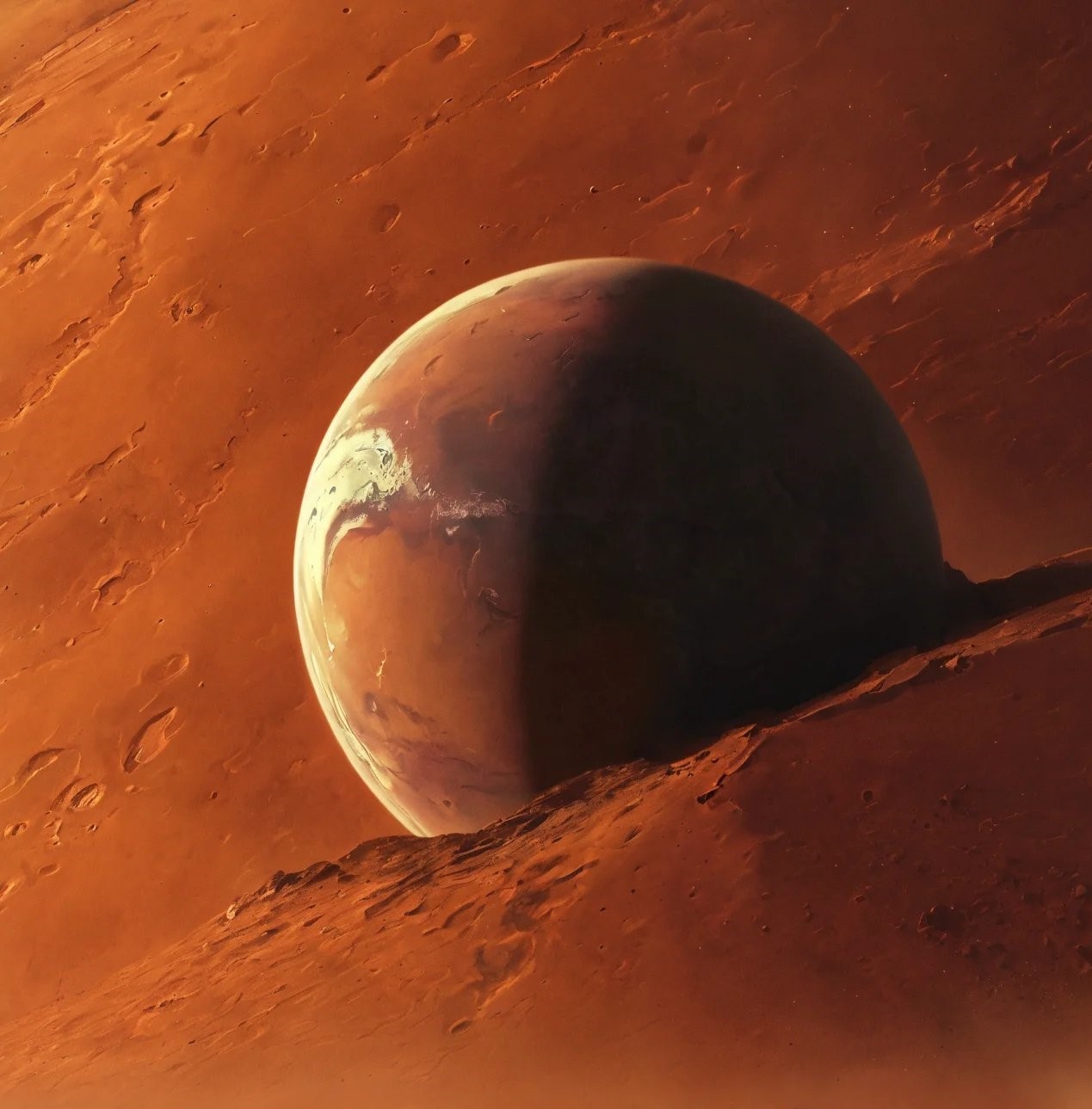
To fully enjoy reading this post, listen to Mars, the Bringer of War by Gustav Holst, There’s a Planet Here by Ozric Tentacles, and Life on Mars by David Bowie.
Mars in Myth and Mind
The red planet is the most Earth-like body in the Solar System, and perhaps the one most deeply rooted in the human imagination. Should we colonize it to become a multi-planetary species? Or preserve it as a pristine celestial fossil, touching it only with sterilized robotic fingers? That scientific, ethical, and existential question has its roots in centuries of fascination.
For millennia, Mars has appeared as a shimmering red dot in the night sky, named after the god of war across various cultures. However, the modern myth of Mars began in 1609, when Galileo Galilei turned his telescope toward it, launching a scientific curiosity that would only grow over time.
In 1877, Italian astronomer Giovanni Schiaparelli mapped the Martian surface and described observing canali, Italian for “channels.” But a mistranslation rendered the word as “canals” in English, sparking a wildfire of speculation: were these artificial structures? Was Mars inhabited? The timing made it irresistible. The Suez Canal had recently opened, showcasing human engineering triumphs. It was easy, almost poetic, to imagine intelligent Martians managing water on a drying world. The idea captivated not just the public but parts of the scientific community.
One of the most fervent believers was American astronomer Percival Lowell, who built entire theories (and an observatory) around the supposed canals. He believed Mars was home to an aging civilization, desperately redistributing water from its polar caps. His vivid maps and writings gave the myth a scientific veneer, influencing early science fiction.
Soon, the idea of Martians took hold. They appeared in books, art, and eventually movies, shaping a cultural narrative stronger than evidence. Scientific skepticism was drowned out by popular enthusiasm. By the early 20th century, many people believed Martians were real.
That belief reached a fever pitch in 1938, when Orson Welles aired a radio adaptation of H. G. Wells’ The War of the Worlds. The broadcast reportedly triggered panic among listeners who mistook it for a real invasion from Mars. Whether the panic was as widespread as claimed or exaggerated in retrospect, it revealed something essential: humanity was ready to believe. The red planet had become more than a place; it was a symbol of the unknown, the alien, the possible.
And then came Ray Bradbury’s The Martian Chronicles in 1950, a poetic, melancholic, and reflective work. Bradbury didn’t imagine green men or grand wars, but a quiet, decaying civilization, a mirror for our own. Long before the modern sustainability movement, Bradbury asked: “What if we bring ruin to other worlds as we have done to our own?”
Even as telescopes improved and later spacecraft revealed a lifeless surface, the myth endured. In 1976, NASA’s Viking orbiter snapped a blurry image of a rock formation in the Cydonia region that looked eerily like a human face. It was, of course, just a trick of lighting and resolution, but for many, it reignited the longing for proof of something… more.
Today, we know that there are no cities or canals on Mars, nor are there dying empires or lurking aliens. But the core question remains tantalizing: Was there life? Could there still be? Mars continues to be a mirror, reflecting our ambitions, hopes, fears, and our deepest questions about life beyond Earth.
The Martian Enigma
Behind the myths and legends, the real Mars may be even more fascinating. Its thin, rarefied atmosphere today hides a deeper truth: scientific evidence suggests that in its distant past, Mars was very different. What happened to its once-thicker atmosphere? Why did it lose almost its entire gaseous cover to the void of space?
Even its mass is a mystery. Based on its position in the Solar System and the distribution of matter in the early protoplanetary disk, Mars should have grown larger, comparable to Earth or Venus. But it didn’t. What interrupted its growth?
The Martian surface itself holds further enigmas. It is divided into three major geological eras: the ancient Noachian, the transitional Hesperian, and the relatively young Amazonian. Yet the evolution of its terrain wasn’t uniform. Why did its geological development stall or diverge in such complex ways?
One thing we’ve partially unraveled is the presence of water. The first probes confirmed the presence of water ice at the poles and in the soil, consistent with the presence of permafrost. More intriguingly, some regions appear to be shaped by long-gone rivers and ancient lakes, suggesting that Mars once had a denser atmosphere capable of sustaining liquid water on its surface.
But the plot thickens.
Mars once had a magnetic field, like Earth’s, which may have protected its atmosphere and surface from solar radiation. That magnetic field vanished, but the circumstances surrounding its disappearance remain uncertain.
Seasonal dark streaks called Recurring Slope Lineae (RSL) appear on steep slopes and then fade. Once thought to be signs of salty water trickling downslope, they remain controversial, but tantalizing.
Then there are the puzzling methane spikes in its atmosphere. Detected by both surface rovers and orbiters, these fluctuating levels of methane could point to geological processes or something more biological.
And beneath the South Polar ice cap, radar scans have revealed strange reflections, anomalies that may indicate briny subsurface lakes. If confirmed, they would open up new possibilities for microbial life surviving below the surface.
That brings us to the greatest and recurring mystery of all: Was there ever life on Mars? Could it still exist today, hidden beneath the surface, protected from harsh radiation and temperature extremes?
So far, we haven’t found definitive answers. But every one of these clues, and the insights that surround them, comes from the incredible fleet of robotic explorers we’ve sent to Mars. And their work is far from over.
Robots at Work: Exploring Mars Yesterday and Today
Humans haven’t yet walked on the red planet, but our robotic emissaries have been exploring it for decades, mapping its surface, scanning its skies, and digging into its secrets. These missions, often uncrewed but never unsung, have been essential to transforming Mars from a distant myth into a tangible world of science.
Mars exploration began with robotic pioneers conducting the first flybys. In 1965, Mariner 4 sent back the first close-up images, revealing a barren, cratered landscape, far from the Earth-like fantasy. Then came the bold Viking 1 and 2 missions in 1976, which deployed landers to the surface and ran biology experiments that continue to provoke debate.
In 1997, the Mars Pathfinder mission delivered the Sojourner rover, a small, brave trailblazer that proved surface mobility was indeed possible. In 2004, the twin rovers Spirit and Opportunity went far beyond expectations, driving for years across vast distances and uncovering compelling evidence of past water.
ISRO Mars Orbiter Mission (Mangalyaan-1) was India’s first interplanetary mission. Arrived at the red planet in 2014 and inactive since 2022, it was a major success in low-cost exploration and remains an iconic achievement.
Phoenix landed in the polar region in 2008, confirming the presence of water ice, while InSight, active from 2018 to 2022, deployed the first seismometer on Mars and measured marsquakes, unveiling secrets of the planet’s inner structure.
These historic missions laid the groundwork for everything we know, and we continue to learn from the missions currently in operation.
Mars is currently surrounded by a fleet of orbiters from around the world, each providing essential science and communication services:
- Mars Odyssey (NASA, 2001) is the longest-operating spacecraft at Mars. Originally tasked with mapping elemental distributions in the soil, it now plays a critical role as a relay satellite for surface missions.
- Mars Express (ESA, 2003) brought high-resolution imagery and groundbreaking radar data. It helped reveal possible underground salty water lakes. Its lander, Beagle 2, sadly failed to make contact, but the orbiter remains operational and valuable.
- Mars Reconnaissance Orbiter (NASA, 2006) has captured some of the sharpest images ever taken of another planet. From analyzing minerals to supporting lander communications, it remains a vital asset.
- MAVEN (NASA, 2014) investigates the upper atmosphere to understand how and why Mars lost its gases to space. Its variable orbit gives scientists a dynamic view of atmospheric escape.
- ExoMars Trace Gas Orbiter (TGO) (ESA/Roscosmos, 2016) monitors atmospheric gases, particularly methane, and maps subsurface hydrogen. Like Mars Express, its lander (Schiaparelli) failed, but the orbiter thrives.
- Emirates Mars Mission – Hope (UAE, 2021) marked the Arab world’s first interplanetary effort. It studies the Martian atmosphere, particularly its daily and seasonal cycles, adding vital data to global climate models.
- Tianwen-1 (CNSA, 2021) marked China’s ambitious entry into Martian exploration, becoming the first mission to successfully deploy an orbiter, lander, and rover in a single endeavor. The orbiter continues to operate, relaying data and conducting scientific observations. The Zhurong rover, which landed in Utopia Planitia, a vast plain in Mars’ northern hemisphere, has provided compelling evidence supporting the existence of an ancient ocean. Utilizing its ground-penetrating radar, Zhurong detected subsurface structures resembling Earth’s coastal sedimentary deposits, such as uniformly sloping layers indicative of shoreline processes. These findings suggest that around 3.6 billion years ago, Mars hosted a significant body of water that persisted for tens of millions of years before disappearing approximately 3.4 billion years ago.
Today, two rovers continue to unfold the Martian story from the surface:
- Curiosity (Mars Science Laboratory, 2012) is a veteran geologist on wheels. It explores Gale Crater and has discovered ancient clay-bearing sediments and mineral clues that point to long-gone habitable conditions. Now climbing Mount Sharp, it continues its search for chemical fingerprints of life-friendly environments.
- Perseverance (Mars 2020 Mission, 2021) landed in Jezero Crater, a once-flowing river delta rich in sediment, one of the most promising sites for fossilized microbial life. Its mission is to find biosignatures and collect rock samples for a future return to Earth.
Curiosity (Mars Science Laboratory, 2012) is a veteran geologist on wheels. It explores Gale Crater and has discovered ancient clay-bearing sediments and mineral clues that point to long-gone habitable conditions. Now climbing Mount Sharp, it continues its search for chemical fingerprints of life-friendly environments.
Nicknamed Percy by its team and fans, the Mars 2020 rover also carried two bold technology demonstrators:
- MOXIE, which has successfully produced oxygen from carbon dioxide in the Martian atmosphere, is a potential game-changer for future life support and fuel systems.
- Ingenuity, the first aircraft to fly on another planet. Initially expected to fly just five times, it soared through 72 flights, logged 129 minutes in the air, and covered 17 kilometers before retiring in January 2024.
Mars today is not silent. It hums with signals from orbiters, pings from rovers, and data relays to Earth. This robotic symphony is humanity’s eye, ear, and hand on another world, exploring, analyzing, and preparing us for what might come next. And maybe, just maybe, showing us that we don’t need to rush. The machines are doing fine.
What About the Future?
The red planet’s next chapter is already in the making. At least seven major robotic projects are currently in development, expanding the reach of science across Mars, its skies, and even its moons:
- EscaPADE (Escape and Plasma Acceleration and Dynamics Explorers) is a NASA mission involving two small spacecraft built on Rocket Lab’s Photon platform. Their goal is to study how the solar wind transfers energy and momentum across Mars’ unique hybrid magnetosphere, key to understanding how the planet lost its atmosphere. Originally targeting an earlier launch, EscaPADE is now scheduled to fly in the fourth quarter of fiscal year 2025, riding aboard the second launch of Blue Origin’s New Glenn rocket, following delays in the vehicle’s development.
- TEREX (Tera-hertz Explorer) is a JAXA mission developed by the National Institute of Information and Communications Technology (NICT) and the University of Tokyo. It comprises two components: a lander, TEREX-1, and an orbiter, TEREX-2. The mission aims to study the Martian atmosphere’s chemistry, particularly the processes that replenish carbon dioxide. TEREX-1 will carry a terahertz sensor to Mars’s surface to measure oxygen isotope ratios, while TEREX-2 will conduct a global survey focusing on water and oxygen levels. Initially planned for earlier launch windows, the mission has faced delays, and as of now, no official launch date has been confirmed. If successful, TEREX would mark Japan’s first successful Mars mission since the unsuccessful Nozomi mission in 2003.
- Mars Orbiter Mission 2, or Mangalyaan-2, will be India’s follow-up to its historic first Martian mission. Slated for a potential 2026 launch, the mission may include a lander and a rover, although final details are still under review. The goal is to deepen India’s scientific contribution to Mars exploration.
- Martian Moons Exploration (MMX) is a JAXA-led mission targeting Mars’ mysterious moons, Phobos and Deimos. The spacecraft will carry a small rover, Idefix, developed in collaboration with CNES, to explore the surface of Phobos. Its main goal is to collect and return samples to Earth, offering rare insights into the origins of Mars’ satellites and whether they’re captured asteroids or remnants from a giant impact. The mission is currently scheduled for launch in November 2026 aboard an H3 rocket, with arrival at Mars expected roughly one year later.
- ESA’s ExoMars Rover, Rosalind Franklin, is finally slated to launch in 2028, with a mission to drill up to two meters beneath the surface. Its goal is to search directly for preserved signs of life, potentially predating even Earth’s earliest organisms.
- Tianwen-3: China’s ambitious Mars sample-return mission, Tianwen-3, is slated for launch around 2028. Utilizing two Long March 5 rockets, the mission will deploy a lander/ascent vehicle and an orbiter/Earth-returner in separate launches. The lander aims to collect Martian soil and rock samples, which will be transferred to the orbiter for return to Earth by approximately 2031. The mission’s primary objective is to search for signs of life on Mars. China has opened the mission to international collaboration, allocating payload space for global partners.
- Mars Lander Mission (India): India’s ISRO is developing its third Mars mission, the Mars Lander Mission, targeting a launch in 2031. Building on the success of Mangalyaan, this mission plans to include an orbiter, a lander, a rover, and a helicopter, utilising advanced technologies such as a sky crane and a supersonic parachute for landing. The mission aims to enhance India’s capabilities in Martian exploration and contribute valuable scientific data to the field.
All these missions testify to a broader shift: Mars robotic exploration is becoming increasingly international, affordable, and diversified. And this trend is only just beginning.
According to NASA’s Mars Exploration Program 2024–2044 Plan, the next phase of Martian science will rely on lower-cost, more frequent missions, shared infrastructure like relays and imaging platforms, and targeted tech development in mobility, autonomy, and drilling. The strategy also emphasizes inclusive partnerships with new space nations, commercial players, and the global scientific community. NASA sees a narrow window to study Mars in its pristine state before human boots arrive, possibly by the late 2030s. So, upcoming missions must reach the planet’s most scientifically rich and challenging regions: subsurface ice, lava tubes, and ancient highlands. However, with recent budget cuts and growing uncertainty around flagship programs, it’s unclear how much of this roadmap will truly be realized, including boots on the ground by the thirties.
Nevertheless, this whole scenario is incredible, isn’t it? These robotic probes are the highest expressions of human intellect and cooperation, combining science, engineering, and planetary ethics into one interplanetary mission. The machines are paving the road ahead. What remains uncertain is whether we’ll choose to walk it or rush it.
A Fossil World or a Future Home? The Spacepolitan Vision for Mars
All robotic probes are assembled in clean rooms and kept always aAll this effort, decades of orbiters, rovers, drills, and data, has been aimed at unraveling the story of Mars and, through it, the story of life itself. Mars offers a frozen record of planetary evolution, a unique window into a time when Earth and Mars may have shared similar conditions. The halted geological processes preserve a landscape that hasn’t just aged, it has paused. That makes it a scientific Pompeii: a place where catastrophe became preservation.
Digging into this world means digging into time. The Martian crust may still hold chemical traces of ancient life, or even remnants of something that once breathed beneath its soil. If ever, what we find will not just answer our questions. It may redefine our place in the cosmos.
But there’s a risk. A quiet, irreversible risk.
Unlike sterilized robotic explorers, humans carry clouds of microbial life. And the moment we place a boot on Martian soil, the possibility of contamination begins, not as a science fiction plot, but as a biological certainty. If Earth life reaches Mars before we uncover its history, we might never know what was truly native to the red planet.
This is why the Spacepolitan vision urges restraint. Not abandonment, just a wiser pace.
Let’s start by building an orbital station. From above, astronauts could teleoperate rovers and drones with real-time precision, exploring Mars more thoroughly than ever before, without touching it. Let’s use Phobos and Deimos, lifeless moons with no biosphere to disturb, as testbeds for long-term human presence. Let’s sharpen our tools, deepen our understanding, and wait until the benefits of setting foot on Mars outweigh the risks of erasing it.
Yes, some want to go now. To conquer, to colonize, to plant flags and declare a new age. SpaceX’s vision is bold, magnetic, even mythic. But myths can be dangerous when they override wisdom.
So, back to the beginning: should we colonize Mars to become a multi-planetary species?
Or preserve it, at least for now, as a fossil world, untouched, unspoiled, and perhaps still whispering the story of another kind of life?
The Spacepolitan advice is to continue the robotic quest and wait to mark our footprint on the red sand. Let’s orbit, observe, and operate. Let’s become a multi-planetary species, not by claiming Mars, but by proving we’re ready for it. Let’s be explorers, not spoilers.
 Becoming Spacepolitans