Three “A” for the new
Era of the SPACEPOLITANS:
Awakening, the realization
Achievement, the vision
Awareness, the mission
To fully enjoy reading this page, listen to Dance of the Clairvoyants by Pearl Jam, Planet of Visions by Kraftwerk, and What’s Next to the Moon by AC/DC. Ideally, treat yourself and enjoy all, one after the other.
Awakening (Spacepolitan realization)
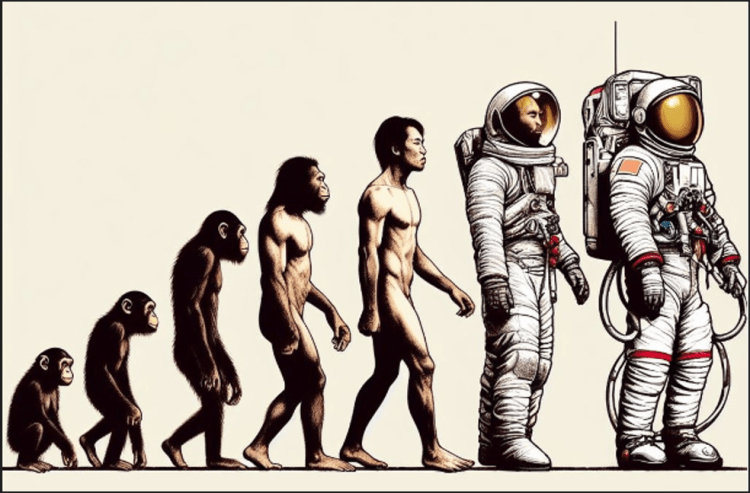
Humankind needs a new evolutionary leap
Humanity’s progress has come at a cost. And the bill is due. Our relentless hunger for growth has scarred the planet: poisoned air and water, rising temperatures, vanishing species, and ecosystems pushed to collapse. Scientists raise the alarm louder every year, revealing how profoundly human activity has disrupted the balance of nature. Yet we press forward, locked in a race we no longer control, driven by an instinct not to nurture but to exploit.
Even our economic, political, and cultural systems are beginning to show their limits. We struggle to cooperate globally. We fall short in addressing inequality, conflict, and technological risks. Our vision remains narrow, bound to short-term gains and outdated paradigms.
This might sound too alarming; it seems just another pessimistic take in classic Memento Mori style. But is it realistic? Let’s look at some facts. They may help us find common ground, whether to agree or disagree with these concerns.
Numbers, not just words
Let’s start with something simple. How many of us are there? As of April 22, 2025, humanity passed eight billion people (precisely 8.22 billion). By 2037, we will be over nine billion, and by 2060, more than ten billion (source Worldometer).
Now let’s compare that to the Earth’s Carrying Capacity. This is the number of humans our planet can support indefinitely while still regenerating its resources. A 2012 United Nations study reviewed several estimates. The most common figure? Eight billion.
Yes, we have already crossed that line. We live on a planet with boundaries, but our population keeps growing, as do our needs, pollution, and appetite for energy.
Pollution comes next. 2019 global plastic production exceeded 460 million tons (source: Our World In Data). Only a tiny share of that was ever recycled, with the exact percentage varying from country to country. Most of it still exists somewhere, buried, burned, or floating in the oceans.
Air pollution is just as lethal. In 2021 alone, toxic air in China and India caused over two million deaths. And that is just one example (source: Statista).
Then there is carbon dioxide, the most impactful greenhouse gas. Since 2003, human activity has released more than thirty billion tons of CO2 yearly. In 2024, we reached a peak of nearly thirty-eight billion tons (source: Statista).
Beyond pollution, there is life itself. A 2019 United Nations report estimated that out of the eight million species on Earth, at least one million are at risk of extinction in the coming decades, one out of every eight life forms.
And then there is Overshoot Day. This is the day when humanity has used up all the resources the planet can regenerate in a year. From that point onward, we are borrowing from the future. In the early 1970s, Overshoot Day was at the end of December. By 2024, it had crept up to August 1. That means we consume the equivalent of 1,6 Earths yearly.
In 2020, the COVID-19 pandemic forced human activity to slow down. Overshoot Day shifted to August 22, a slight delay caused by a massive global crisis. But even that was enough to show how quickly Earth recovers when pressure is reduced.
The facts speak for themselves. But knowing is not enough. What matters now is what we do with this knowledge. This is only the tip of the iceberg, an initial spark, a first glimpse into the more profound realization that must follow.
The AWAKENING exercise
Earth is the only known planet to host life, and humans are the only self-aware, technological species, at least as far as we know. As Spider-Man said, with great power comes great responsibility. A species like ours, capable of reshaping the world, should be the caretaker of this unique life sanctuary, not its destroyer.
This is the great dilemma.
Do we follow our selfish instincts and continue consuming the planet until nothing is left? Or do we try to stop, reject all contaminating activities, and return to an entirely natural way of life?
Neither path is viable.
The first leads to worsening environmental collapse. Eventually, nature will force a correction through scarcity, disease, disaster, or even extinction.
The second is pure utopia. We cannot simply abandon industry and technology. No one will willingly give up the comfort and progress we have achieved in exchange for the promise of an uncertain future.
So, Houston, we have a problem. We are caught in a conflict of interest. Living as we do now means harming the very world that supports us. But to stop would mean letting go of what defines our civilization.
We need another path that sustains human development while protecting the natural world and allowing it to evolve freely, without interference.
To move forward, we must change our perspective. We must go beyond borders and limits, beyond what we have always known.
We must include Outer Space, its energy, materials, and potential in the balance sheet of human survival.
Many thinkers have already made this mental leap. Gerard K. O’Neill, Stephen Hawking, Freeman Dyson, and others imagined how space could help heal the damage we have done to Earth. Despite their different views, they came to a shared conclusion: we must shift our most harmful activities away from this fragile planet. Space is not an escape. It is an extension, a solution, a new chapter.
Like the ancient gods Hestia and Hermes, we must balance the home and the journey. Earth is our hearth, the cradle of life. But the will to explore and expand beyond the horizon must now serve a new purpose: building a sustainable future for Earth beyond Earth. This is how we begin a new industrial revolution that happens out there, so we can restore what is here.
This is the new level of consciousness humanity needs to reach. The moment when we realize that…
…Humankind must become a spacepolitan species. A civilization that includes Outer Space in its cosmos.
Achievement (Spacepolitan Vision)
Garden of Eden back on Earth, Isengard out there
To find the path forward, we must reimagine Earth as a vast natural sanctuary, a protected ecosystem where all human activity is carefully measured, respectful, and clean. Every action, every system, every industry must be adapted to fit this new reality.
What follows is not a complete plan, but a starting point. A sketch of how we might restructure our civilization to bring the Garden of Eden back to Earth and move the heavy burden of Saruman’s Isengard far beyond it.
Production and Industry
Production on Earth must become clean, circular, and life-friendly. Anything that cannot meet these standards must be shifted off the planet.
Only industries capable of achieving zero pollution can continue operating on Earth. Every process must be redesigned to fit the circular economy principles, with full recyclability and no waste across the entire product life cycle. Existing factories must either transition to zero-emission models or be dismantled, returning their occupied land to nature. New industrial sites must be built only when strictly necessary, using sustainable materials, low-impact designs, and in zones dedicated to human infrastructure.
For industries that cannot comply, the solution is relocation. Outer Space offers the room and isolation needed for high-impact operations. Manufacturing, heavy processing, and energy-intensive production should occur on the Moon, asteroids, or artificial platforms in orbit. The products made in space and required on Earth must be delivered using clean transport solutions that do not add new harm. Likewise, goods produced on Earth should only be exported when essential for human presence beyond the planet.
Resource extraction follows the same logic. On Earth, non-biological resources must be harvested without polluting or endangering life. When this is impossible, the same materials must be sourced from space. Biological resources, like food, water, and organics, may be used when their extraction respects ecological balance. In the future, farms beyond Earth will support human colonies and may even supply Earth itself, reducing pressure on the biosphere.
Energy and Infrastructure
All energy used on Earth must come from clean, renewable sources. It must not pollute, disrupt ecosystems, or harm any form of life. This includes every cycle stage, from resource extraction and energy production to distribution and waste management. Energy must serve human activities without damaging nature and life.
In space, different rules apply. Energy systems for off-world habitats, transportation, or manufacturing can use any source necessary, as long as they pose no risk to life on Earth. Space-based power, including solar collectors in orbit, may eventually support energy needs on Earth, offering a clean supply without further exploiting the biosphere.
Infrastructure must follow the same principle of balance. On Earth, it must be minimal, efficient, and integrated into the natural environment. In space, it must be modular, expandable, and self-sustaining. Space infrastructures should be built using materials sourced in space to reduce Earth’s burden and enable genuine autonomy beyond the planet.
Mobility and Communication
On Earth, movement and connection must respect the rhythms of nature. Every mode of transport and communication must be designed to minimize disruption and preserve life.
Transport systems on Earth must be clean, quiet, and limited in scope. Only pollution-free vehicles should be allowed, and their use should be reduced to the essential. Travel routes and urban mobility must be confined to designated areas, keeping wilderness and ecosystems undisturbed. In space, transportation can follow different principles, as long as its impacts do not reach back to Earth. Space means of transport are allowed, but their use must be limited to specific launch zones and carried out during daylight, to minimize disruption to life and the environment.
Communication follows similar principles. On Earth, the default method must be cabled or low-power, to reduce electromagnetic interference with life forms and the natural environment. Wireless systems can be used in urban areas with power kept to a minimum. Radio transmissions should be restricted to emergencies or brief needs in natural environments.
Satellite networks will remain essential, especially in connecting Earth with space installations. Ground stations must be placed in carefully selected zones, minimizing physical and electromagnetic impact on ecosystems.
Science, Reseacrh and Experimentation
Scientific research must remain a pillar of human progress, but evolve with our new relationship to Earth. Studies and experiments on the planet must pose zero risk to any form of life or the environment. Their focus must shift toward preserving biodiversity, removing contaminants, developing clean technologies, and improving the quality of life, both on Earth and in space.
Experiments with uncertainty, danger, or unknown consequences must occur far from Earth. Space provides the necessary distance and isolation to explore the boundaries of science without compromising the safety of our planet. Research in orbit, on the Moon, or in deep space laboratories will allow humanity to keep pushing forward, with curiosity, care, and vision.
Life and Lifestyle
Life on Earth must return to balance with the biosphere. Every aspect of human living, from food and shelter to materials and habits, must be designed to regenerate, not deplete.
The new standard is a lifestyle based entirely on renewable resources and zero-impact choices. Food must be organic, grown without harming soil or water systems. Materials and technologies must be fully recyclable and compatible with nature’s cycles.
In the same way, existing buildings and structures should be converted into fully ecological homes and spaces. If that is not feasible, they may be rebuilt, but only when strictly necessary. Otherwise, cleared areas must be returned to their natural state and allowed to rewild.
New buildings are permitted only in designated urban areas. Their design must avoid disturbing any form of life and must rely on sustainable construction methods and renewable materials. The human footprint must shrink in scale and grow in responsibility.
In the long term, this new lifestyle may also limit the number of humans living on Earth. It is not a restriction but a choice to respect the planet’s carrying capacity and reduce pressure on its ecosystems. A portion of humanity may relocate to the Moon, to asteroids, or space habitats such as O’Neill cylinders. There, new communities can flourish without adding strain to Earth, helping restore it as the sanctuary it was always meant to be.
In space, humanity can grow without limits. Earth will no longer be a ceiling, but a foundation. Once freed from the scarcity that has shaped our economies and politics, we can imagine a civilization defined not by what we lack, but by what we can create.
Awareness (Spacepolitan Mission)
Reaching the stars while healing our home
The vision of humankind as both space citizens and caretakers of Earth may sound like utopia, but each day brings it closer to reality. We are living through a historic shift, a moment that future historians might call the dawn of the Asterozoic Era, the age when humanity turned to space not to escape, but to evolve.
On one side, we see a rising wave of ecological consciousness. From climate tech solutions and regenerative agriculture to youth-led activism and global initiatives like Earth Day and Clean Up the World, more and more people are questioning how we live and how much the planet can take.
On the other hand, the New Space Economy is rapidly expanding. We now witness private spaceflights, the development of space farms, and the growth of commercial orbital infrastructure. These are not isolated breakthroughs, but early steps of a cosmic shift, where life on Earth and our expansion beyond it are no longer separate goals but one shared mission.
It is time to bring these forces together: planetary care and cosmic reach. If we act purposefully, the next step in human evolution is at hand. Not just homo sapiens, but homo cosmicus. Not just dreamers, but builders of a civilization that reaches the stars while healing its home.
What We Need to Build
How far are we on this evolutionary trajectory? Even if something is cooking in the space pot, we are still at the beginning. It may take decades, even centuries, before Earth becomes a fully protected sanctuary and Outer Space is filled with thriving human colonies.
But every long journey begins with the first meaningful steps. To become a space-faring civilization, we must start building the foundations today. That means developing the technologies, the tools of transformation, that will sustain the spacepolitan vision. They will allow us to move beyond the limits of Earth, while protecting everything we hold dear on its surface:
- Reusable and clean launch system
Access to space must become routine, reliable, and non-destructive. We need launch vehicles that are efficient, safe, and built for rapid reuse without harming the atmosphere or land. - Autonomous and semi-autonomous robots and platforms
Machines will be our first workers in space. We need robots to build, repair, explore, and assist independently from Earth. We also need autonomous platforms to carry out scientific experiments, biological research, and chemical processes without requiring human presence. - Space mining and refining
Asteroids and the Moon hold metals, water, and rare resources. Extracting and processing them in space will reduce our dependence on mining on Earth and limit the need to send heavy materials out of the gravity well. - In-space manufacturing
We must learn to build in orbit and beyond. Producing tools, structures, and everyday goods in space will reduce our dependence on Earth-based supply chains and allow space operations to scale sustainably. Today, in-space manufacturing begins with small steps, like crystal growth and fiber production in microgravity. But it must evolve into full industrial capability to support construction, maintenance, and life-support systems far from Earth. - Orbital habitats and farms
Living in space requires new kinds of homes and food systems. We need modular, expandable habitats and agricultural ecosystems to support long-duration life in orbit, on the Moon, or deep space.
What if we fail to act?
If we do nothing, humanity will face extinction or, at best, be forced to return to a primitive, entirely natural existence. Nature will push us back into balance.
We already saw a glimpse of this in 2020. A single virus crossed into our world, killing millions, locking down entire nations, and halting countless human activities. Yet while humanity suffered, nature began to breathe again. Wildlife reclaimed abandoned spaces. Pollution dropped. Unaware of our crisis, the wild started to recover in our absence.
This is the message: humans are powerful but fragile. Capable but reckless. The time has come to wake up, take the helm, and steer a different course.
Buying time for space
To expand into space and enjoy its benefits, we must slow the countdown here on Earth. We need to buy time for space by lowering our footprint, reducing pressure on ecosystems, and making life on Earth more sustainable:
- Pushing the Overshoot Day closer to the end of the year
- Increasing the Earth’s carrying capacity through smarter living
- Developing the space-enabling technologies that will one day lift us off the surface
It will not be easy.
Governments, investment funds, and financial institutions must shift resources toward the UN Sustainable Development Goals: green innovation, circular systems, environmental recovery, and the 18th goal: the emerging space economy. These are not expenses, but investments in survival. They are the scaffolding for a spacepolitan future.
At the same time, there is work for all of us. Personal action matters. Every step that reduces consumption, protects biodiversity, or spreads awareness is part of the transition. Movements like Earth Day offer tools and ideas to guide those steps. The rest depends on the will to change and the courage to begin.
To accelerate the development of space technologies, every spacepolitan of today must become an ancestor of tomorrow and help expand the AWARENESS: sharing the vision, talking about space not as science fiction but as a path forward, and helping others see the cosmos not as a dream but as a destination. The more people join the journey, the faster we build the future.
 Becoming Spacepolitans