And suddenly, the Awareness happened.
Listen to The Overview Effect by Hellhaven to enjoy reading this page.
“Once a photograph of the Earth, taken from the outside, is available, a new idea as powerful as any in history will be let loose.” — Fred Hoyle, 1948
When Fred Hoyle wrote those words, no one had yet seen our planet from space. It was a prediction, almost a prophecy, that a single image could change the way humanity understood itself. Two decades later, that prophecy came true.
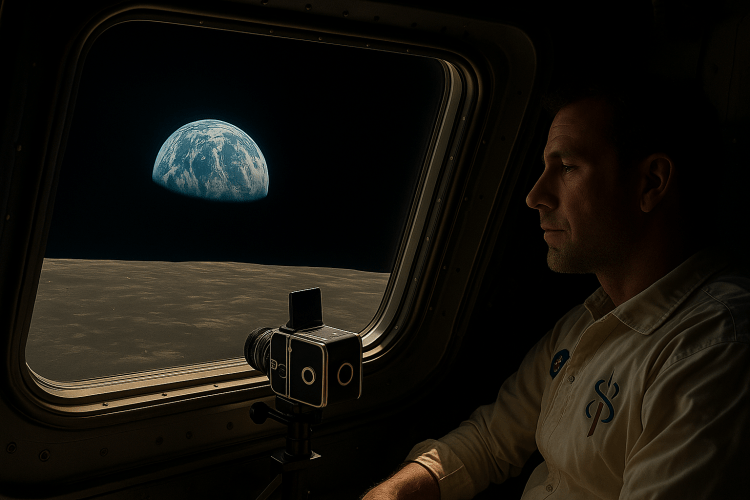
In December 1968, as Apollo 8 orbited the Moon, astronaut Bill Anders looked out of the window and saw something not listed in any flight plan: the blue and white of Earth rising above the grey lunar horizon. “Oh my God, look at that picture over there!” he said to his crewmates. “There’s the Earth coming up.” They scrambled for color film, and Anders captured the shot that would become known as Earthrise, the first true portrait of all of us. It was an unscheduled, spontaneous moment that changed the course of history. The photograph has been called “the most influential environmental image ever taken,” because it revealed, in a single frame, both our beauty and our vulnerability. In 2024, when Anders passed away, the world remembered not only an astronaut but the man who gave humanity its first self-portrait.
More than twenty years later, another distant observer turned back toward home. At Carl Sagan’s request, Voyager 1, already six billion kilometers away, was commanded to take one final look before leaving the Saturnian System. The result was a faint point of light, a speck of blue suspended in a sunbeam.
“That’s here. That’s home. That’s us,” Sagan wrote. “On it everyone you love, everyone you know, everyone you ever heard of, every human being who ever was, lived out their lives.”
The Pale Blue Dot did not change physics, but it changed perspective. It was a simple yet profound reflection, one that revealed how awareness itself can transform the way we see our world.
Yet what Sagan intuited through a lens, others would later live in person. The men and women who saw Earth from orbit spoke of the same realization, but with the immediacy of lived experience. Seeking to define this new state of awareness, writer Frank White called it the Overview Effect. In his book “The Overview Effect: Space Exploration and Human Evolution”, he described this feeling as a sudden cognitive realization of the planet’s wholeness, its fragility, and the interdependence of all life.
White first wrote about it in 1987, yet its essence had been echoing since Anders’ photograph, the sense that awareness itself might be our most precious resource. Astronauts speak of it as both revelation and responsibility. From orbit, borders disappear, conflicts shrink to the scale of clouds, and the atmosphere appears as a shimmering film, a single breath keeping life from the blackness beyond. “You develop an instant global consciousness,” said Edgar Mitchell of Apollo 14. “From out there on the Moon, international politics look so petty.”
Half a century later, that same awakening has begun to extend beyond professional astronauts. In September 2021, Inspiration4 lifted off from Florida and spent three days orbiting Earth at an altitude of approximately 585 kilometers, surpassing both the ISS and Hubble. It was the first all-civilian orbital mission, a milestone that connected personal wonder with collective purpose: raising over $200 million for St. Jude Children’s Research Hospital, including a $50 million pledge from Elon Musk. Watching their blue planet through a wide-domed window, the crew described the experience in familiar terms: awe, gratitude, and perspective, as if each of them had touched the same invisible thread that bound Apollo to Voyager.
That feeling also reached an unexpected witness when, on October 13, 2021, actor William Shatner, the first Captain Kirk of Star Trek, at 90 years old, flew to the gates of space with Blue Origin on its New Shepard. When he returned, his voice trembled. “Everybody in the world needs to do this,” he said. “The covering of blue is this sheet, this blanket, this comforter of blue that we have around us, and then suddenly you shoot through it, and you’re looking into blackness, into the unfathomable blackness.” And then, after a long pause: “I hope I never recover from this.” His words reminded everyone that the Overview Effect is not a luxury or an adventure; it is a confrontation with the truth that life is rare and delicate.
In 2024, Polaris Dawn climbed even higher, to a record 1,408 kilometers, the highest Earth orbit since Apollo. Crew Dragon Resilience, specially modified for the mission with a dedicated EVA hatch, suit interfaces, and the Skywalker stabilization tool, was fully depressurized for the first commercial spacewalk. Jared Isaacman and Sarah Gillis moved partly outside at the forward hatch, while Anna Menon and Scott Poteet monitored systems from inside. For the first time, a privately led mission opened its door directly to the vacuum, a symbolic as well as technical frontier, and the name of its guiding tool seemed to fit the moment: a Skywalker, bridging courage and sky. As Isaacman looked down at Earth during the spacewalk, with nothing between him and the planet but his visor, he spoke the words that would mark the mission: “Back at home, we all have a lot of work to do, but from here, Earth sure looks like a perfect world.” The Overview Effect is slowly ceasing to be a privilege of astronauts; it is becoming a human experience.
Most of us will never cross the Kármán line, yet technology and imagination are finding ways to bring that revelation closer. Projects like SpaceBuzz, Space for Humanity, and the Overview Institute work to spread the feeling through education and immersive storytelling. Children can now stand in virtual reality and watch the Earth slowly rise beneath them; for a moment, their heartbeat slows, their language softens, and they describe what astronauts describe: a sense of belonging to something larger. It is the same realization that spacefarers had when they saw our planet hanging in the void, a fragile marble shielded by a paper-thin atmosphere, carrying us all through the Universe as one crew aboard a single, natural vessel. The futurist Buckminster Fuller once called it Spaceship Earth, and the name still fits.
Each of these moments, the first photograph, the far-off dot, the words of those who looked back, forms part of the same unfolding idea that Fred Hoyle foresaw. Earthrise taught us to see our home. The Pale Blue Dot taught us to see ourselves. The Overview Effect (beautifully captured in this short video) continues that lesson, reminding us that when the camera steps back far enough, our differences shrink to the size of weather, and what truly expands is everything we hold in common.
One day, the Overview Effect will not be a privilege of astronauts or dreamers but a lesson every child receives, the first step toward understanding that we already share a single home. And when that awareness becomes universal, when every new generation grows up knowing they are crew members of Spaceship Earth, the next chapter will begin: the Spacepolitan Era, when humanity finally learns to live as one species among the stars.
And beyond seeing, there lies the thought that our journey into space might be less about what we take and more about what we become, a notion framed in Frank White’s Cosma Hypothesis, the idea that humanity’s gaze outward is also the universe’s gaze inward. When we look up, we aren’t just exploring space; we’re witnessing ourselves unfold.
 Becoming Spacepolitans