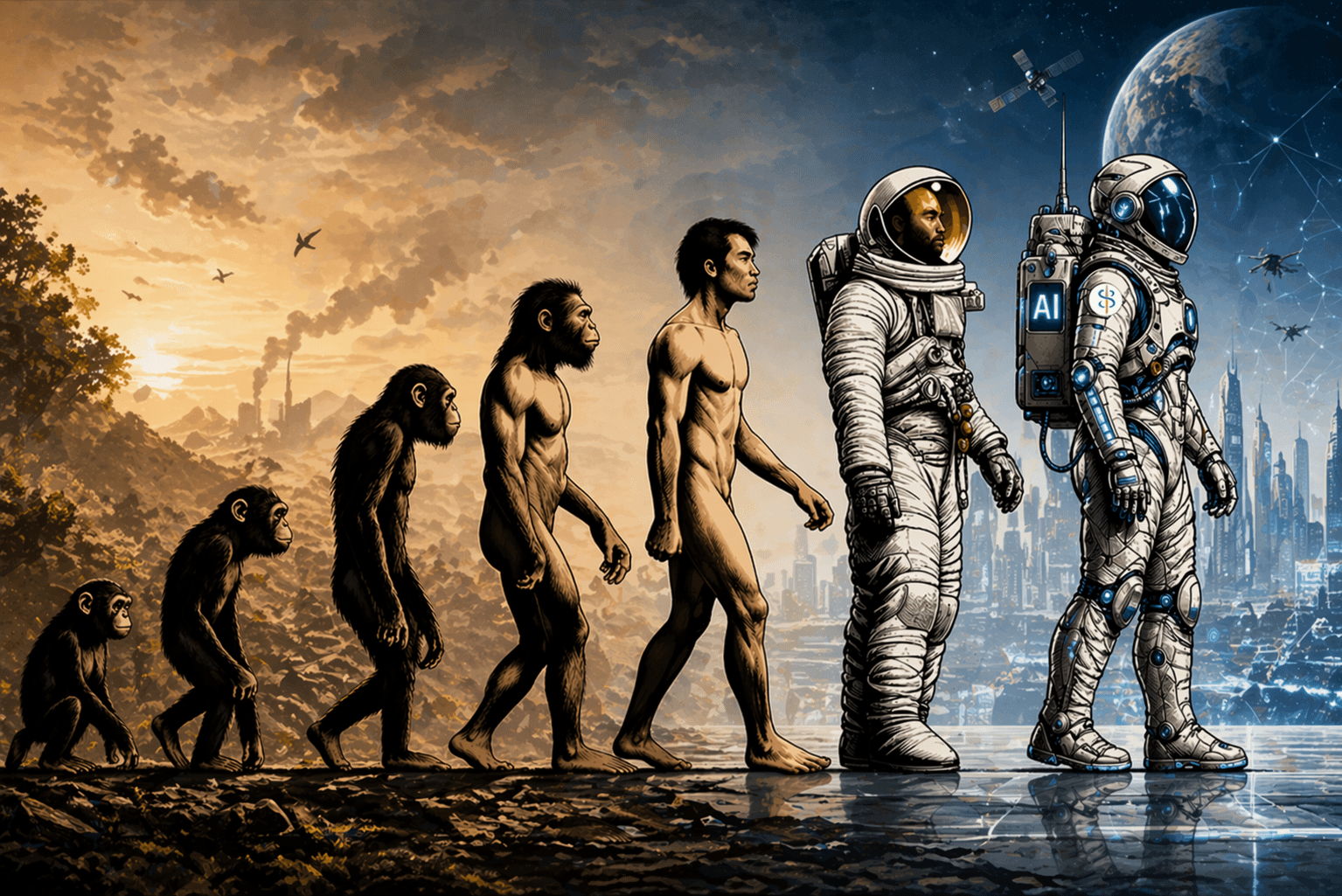
Space is the cornerstone of human evolution. Credits: created with Assistance from OpenAI’s DALL·E
Six years later, the urgency remains. Space expands our reach, AI accelerates our power. What matters now is direction.
Listen to Equation by Camille and Hans Zimmer to enjoy reading this post.
Six years ago, Becoming Spacepolitans started from a simple realization: the urgency was already there, in the growing mismatch between humanity’s ambitions, needs, and the finite limits of one planet.
Earth Day was not a celebration. It was a reminder. In 2020, its 50th anniversary triggered the first publication of Becoming Spacepolitans, together with the first version of the Manifesto, an attempt to give voice to the signal that something in our trajectory was no longer sustainable. The problems were visible, but the direction was not.
Back then, the equation was clear: Earth alone could not sustain humanity’s long-term development, and space was the missing structural element needed to avoid dystopian futures. Space was not just a dream, but a necessity; not a route away from Earth, but a way to expand the horizon of human possibility.
Six years later, the urgency has not changed. The world around it has.
In these years, we have seen acceleration everywhere: technological breakthroughs, shifting balances, growing awareness, and growing tensions. Progress and instability have moved together. The equation has not disappeared. It has become more complex.
Because today, there is a new variable in the system: Artificial Intelligence.
AI is not just another tool. It is an accelerator of understanding, execution, and coordination. It allows us to read the Earth with unprecedented clarity. It enables systems to operate at scales that were previously unmanageable. It connects data, decisions, and actions in ways that redefine what is possible.
In six years, the equation has evolved. The urgency has remained, but the context has changed. Space remains the structural element to embrace if we want to move beyond the limits of a single planet. What has entered the equation now is AI. And with it comes a decisive question: will it be a plus or a minus? Will it deepen the urgency, adding new risks and new pressure, or will it help resolve it by accelerating our expansion into space?
AI amplifies capability, but it also amplifies risk. Ethical questions are no longer abstract. They are embedded in systems. Environmental impact is no longer marginal. It becomes part of the infrastructure. Speed increases faster than alignment, and the gap between what we can do and what we should do widens.
This is where direction matters. In a world that is changing faster than ever, the Spacepolitans Vision is not a ready-made answer, but a reference point, a polestar. It does not remove complexity or solve the equation on its own. It helps us recognize and choose the solutions worth pursuing.
Not conquest, but continuity.
Not confinement, but expansion.
Not escape, but evolution.
Six years ago, space was the missing piece.
Today, AI has entered the equation.
That does not make the equation simpler. It makes it more powerful and more demanding. AI may become one of the most promising developments of human intelligence, especially if it helps us extend our reach, our understanding, and our operational capacity beyond Earth. This is also the perspective explored in the page AI and the Space Puzzle. In space, where autonomy, resilience, and real-time decision making are not luxuries but necessities, that potential becomes especially clear.
The world is still not enough. But we are no longer limited by possibility. We are limited by the direction we choose to give to possibility itself.
And that is why today is not just another Earth Day.
It is a checkpoint in how we choose to move forward.
Space for All, all for Space!
 Becoming Spacepolitans