Mother(Earth)’s Day 2021 – Blog Update

For Mother’s Day, a blog update about how Space helps us recovering Mother Earth.

To fully enjoy reading this post, listen to Space for the Earth by Ozric Tentacles (again and again!).

A good way to celebrate Mother’s Day? Publishing an important update about the blog’s section dedicated to the direct benefits space can offer towards achieving the UN Sustainable Development Goals, the global agenda to save our planet and ourselves. The content of Space foe Earth page has been improved with new information and it has been finally tranlsated into Italian!
Go and check the English version (Space For Earth) and the Italian one (Lo Spazio Per La Terra)!

On this special day, I take the opportunity to dedicate this very meaningful and special section of the blog to the memory of a person I have known for a few months, Dr. Shivani Johri, a very special Indian scientist. She flew prematurely among the stars on May 7, 2021. We will continue to love space for her too!

Space For All, All For Space!

Earth Day 2021 – Blog Update

A year ago, Becoming Spacepolitans Blog went live…

To fully enjoy reading this post, listen to Dance of the Clairvoyants by Pearl Jam

Today is Earth Day (22nd of April), the biggest annual event in support of environmental protection.
Today, the Becoming Spacepolitans blog turns one!
What better way to celebrate its first birthday than with a blog update with some big news?

Becoming Spacepolitans is about to be translated into Italian! Many friends asked for it and finally here it is! Today the first section is out, the same one published a year ago in the first post, the Spacepolitans Manifesto. This section is also updated in the English version and new insights are added in the “Awareness” paragraph. They provide a better understanding of the current plight of our beloved planet by exploring topics like population growth, “Earth Carrying Capacity” and “Overshoot Day”.

Fancy reading it? Now you have two choices: “Spacepolitans Manifesto”, the English version, and “Manifesto dei Cittadini dello Spazio”, the new one in Italian, choose the one which suits you best!

Looking back, we have already considered a lot of information about the importance of space for our planet, from many different points of view. We highlighted how and why space is the new fundamental element for the next step in human evolution. We went through topics like the benefits of outer space to the UN Sustainable Development Goals, the contribution of Earth observation technologies, sixty years of human spaceflight, Moon colonization, the potential of asteroid mining and many more. In the coming weeks, all these pages will be updated and translated into Italian, allowing the Spacepolitans message to reach more and more people.

So, should we shout the Spacepolitans motto? Yes, of course! But this time let’s do it in its Italian form: Lo Spazio per Tutti, Tutti per Lo Spazio!

Space Technology Transfer

Made for Space, Made for All

To fully enjoy reading this post, listen to Technologic by Daft Punk.

Space technologies are directly beneficial to our daily life in several ways, we came across their multiple benefits on many pages of this blog. However, there are also indirect positive effects which are less known to the public but equally important. Continue to read if you want to know more…

“Space is a hard”, this is the most common sentence echoed when something doesn’t go as planned in a space related activity. It means that reaching space and working there is tough, hence failure is sometimes inevitable. However, scientists and engineers are putting a lot of knowledge, effort and creativity to overcome the countless problems they encounter for every space mission. They invent new solutions and technologies to break though the barriers and push the boundaries and this results in a rapid and unusual development that could be impossible without such cosmic dares. On the other hand, the public is spending a lot of tax money to allow this magic to occur.

What happens to all the intellectual property generated so far? Are those scientific and technological advancements confined to the space arena and the tax money lost in space? Luckily for all of us the answer is no, they are not limited to space exploration. They are shared constantly with the “non-space” industries, enabling them to generate new wealth out of that initial investment.
In order to do that, space agencies like NASA and ESA launched specific technology transfer programs, aimed to bring indirect benefits from space to the ground (see NASA Technology Transfer Program, ESA Technology Transfer).
The mechanism of these programs is pretty easy. First of all, there is the discovery of a new technology, developed to overcome a limit imposed by the harsh space environment while trying to perform a specific activity. Once the technology is functioning as expected, the related intellectual property is disclosed to the public, usually through dedicated web sites or communication channels. If companies and entrepreneurs find an interesting technology to enhance one of their products or to make a new one, they could sign an agreement with the space agency to license its use.
In addition, space agencies manage also special business incubators, specialized in supporting new start-up enterprises aiming to bring space technology to the “standard” economy. Examples are the NASA Kennedy Space Center Innovation Incubator and ESA Business Incubation.

Let’s have a look at some specific cases, just to understand the wide scope of technology transfer.
Do you like your mobile phone cameras? Are you having fun creating HD videos with your Go-Pro? You need to know that they would not be performing so well without the CMOS image sensors and that this technology was developed at NASA Jet Propulsion Laboratory (NASA JPL) to equip spacecrafts with new high-resolution cameras.
In the last year or so, how many times did you measure your temperature with an infrared thermometer? In the early Nineties, the company Diatek Corporation partnered with NASA JPL to produce this new kind of thermometers, adapting infrared sensors developed to measure the temperature of stars. So, not only you are made of stars, but also your temperature is measured like the stars’.
What about something more spacepolitan? For more than twenty years, the ESA-led Micro-Ecological Life Support System Alternative programme, better known as MELiSSA, has been studying how to sustain astronauts during long missions in space. Its objective is to develop a closed life-support system, processing waste to deliver oxygen, water and food. One of the most promising technologies developed so far is a special filtering system for water, capable to remove many pollutants, including nitrates. Thanks to its partnership with MELiSSA, the French company Firmus was able to built a water purification station and test it for a school in Morocco, for the village of Sidi Taïbi, close to Rabat. The population of this town was growing rapidly and providing fresh water for everyone was a big issue, since the groundwater was rich in nitrates, not suitable for human consumption. Thanks to this test station, the school was able to use the filtered groundwater to provide fresh water to students and teachers, and the company gained valuable experience whilst developing the product. Which UN Sustainable Development Goal is supported by this technology transfer? Of course, SDG 6 Clean Water and Sanitation!
These are plenty more “spin-off” initiatives, some of them not so striking but equally important, and others in development which will land on the ground in the near future.

As Dr Geoffrey Nicholson (3M chemist, inventor of the Post-It Notes) said, “research is the transformation of money into knowledge; innovation (technology transfer) is the transformation of knowledge into money”. Hence, space exploration is not only offering direct benefits to Humanity, but it has also a positive cross impact on the normal economy, helping it to be more efficient, to consume less resources, and finally to improve our daily life. Investing in space is investing in our future. So, let’s shout even louder our spacepolitans motto: space for all, all for space!

Space 4 Earth

No more lost in blog… again!

To fully enjoy reading this post, listen to Space for the Earth by Ozric Tentacles (again!).

Quick blog update! Space4Earth is the website section containing all the information shared in the last months in previous posts, which are relevant to understand why space is so important to rescue our planet.

The main page is still about the direct benefits space can offer towards achieving the UN Sustainable Development Goals. The new additions are in its sub-menu and they include topics shared more recently:

  • Asteroids: Cross And Delight, space rocks could be the enablers of the human expansion or the bearers of the end of the story, this page is all about them;
  • Outer Space Tax, an intriguing proposal about how to share the resources contained in our beloved space rocks amongst all mankind;
  • Mysteries on Mars, everybody talks about Mars in these days, but could it help us in our way to become Spacepolitans?

What about the Spacepolitans Playlist? Don’t worry, it is updated with the most recent entries, together with the YouTube one, for lazy clickers.

So, what’s next on the blog? Very soon we will explore another important aspect of how space is already supporting a better world: technology transfer, the program actively pushing the inventions made for space to the non-space industries.

Don’t hold your breath as you are waiting for it since it may be a while, in the meanwhile have a look at the Space4Earth page to see if you missed any topics. If you are already up to speed, there is only one thing to do, join me shouting out the Spacepolitans Motto: Space for All, All for Space!!!

Mysteries on Mars

A Planetary Time Machine Full of Questions… and Answers!

To fully enjoy reading this post, listen to Mars, the Bringer of War by Gustav Holst.

The red planet is the body of the Solar System most similar to the Earth. Should we colonize and exploit it to make humans a multi-planetary species? Or should we preserve its status of pristine celestial fossil, barely sampling it by robotic probes? Let’s try to find a possible answer to this new intriguing conundrum.

Humans have always been fascinated by Mars, this shining red dot in the night sky, a symbol of the gods of war for many ancient civilizations. Thanks to the very first telescopic observations by Galileo Galilei in 1610, the scientific interest on Mars started to raise. In 1877, the first detailed map of the Italian astronomer Giovanni Schiaparelli ended up strongly impacting not only the scientific community, but also the collective imagination. Indeed, thanks to an incorrect translation of the Italian word “canali”, Schiaparelli’s work was interpreted abroad as if he had observed artificial “canals” on Mars’s surface, instead of natural “channels”. The incredible Suez Canal had been completed just a few years earlier and it was rather easy to guess that there were intelligent inhabitants of Mars, capable of engineering works like the ones just made by the Earthlings. Then, even if the following observations disavowed the canals interpretation, the Martians myth was already becoming so popular that first tales, then movies were dedicated to it, celebrating the various forms of our cosmic neighbours. The idea of having company in the solar system was so bewitching that scientific discoveries against it were initially just ignored by the general public. In the following decades, the existence of Martians was widely accepted and, in 1938, the historical radio transposition of the novel The War of the Worlds by the great H. G. Wells allegedly caused public panic among listeners who believed that aliens from the red planet had invaded the Earth. It is impossible to establish whether the cause of such mass hysteria was the masterful direction and interpretation by Orson Welles or the tension that preceded World War II, or the widespread Martian myth. Nevertheless, that broadcasting showed how the public was willing to accept such an eventuality.

Today we know that there are no green humanoid conquerors living on Mars’s surface, nevertheless, the Bowiean question “is there life on Mars” (or at least was) is far to be definitively answered, it remains a great scientific question mark. And it is not the only one, Mars is indeed full of mysteries!
Its atmosphere is actually very thin and scientific evidence has demonstrated that it was not like this in the very past. How did Mars loose almost its entire gaseous cover?
In addition, Mars’ mass is less than it should be considering its actual position and assuming it formed from the primordial planetary cloud of our Solar System. Why didn’t it grow like the other planets did?
And again, its surface is clearly divided into three different zones, each of them formed in the three main Martian ages: Noachian, Hesperian and Amazonian. Why didn’t the surface change homogeneously and at the same pace?

In order to find the most likeable answers to these and other intriguing questions, many robotic exploration missions were launched and they brought back invaluable insights to explain what could have been the history of the planet. For example, we solved the mystery about the presence of water, since the first probes found water ice in its pole caps and even in the terrain, in the form of permafrost. It had been found that in its ancient past the conditions of the Martian atmosphere were allowing liquid water presence, allowing the possible development and growth of life forms. And so on…

However, all the experiments run so far were not conclusive about the presence of life and some other enigmas. So, more and more national space agencies are operating probes and sending new spacecrafts toward the red planet, with the common intent of finding answers and clues about the origin of life in our solar system and so on. This is why we are witnessing a record breaking number of active Martian missions these days.
Let’s take a deeper look to understand what they specifically aim for.

[Detailed section alert: jump to the end if not interested in technical stuff]

In orbit there are already six spacecrafts:

  • Mars Odyssey, the most long-lived, in orbit since 2001; this NASA orbiter main objective was to produce the first global map of the amount and distribution of many chemical elements and minerals that make up the Martian surface; nowadays, it is still active and providing relay communication services between the Earth and NASA probes on the surface.
  • Mars Express, a veteran ESA spacecraft, in orbit since 2003; its primary mission objectives were to take high resolution pictures of the surface combined with altitude data and spectroscopic information of the atmosphere; thanks to its radar instrument, it allowed the discovery of salty liquid water lakes under the surface. Unfortunately, its lander, Beagle 2, never answered back after its tentative to survive the landing phase. Still taking great pictures, today the orbiter is playing an important role in communication services for other missions.
  • Mars Reconnaissance Orbiter, another NASA old friend orbiting since 2006; its main objective was to get insights on water history on the surface, taking very high resolution close-up (it can get to the dimension of a table); as other orbiters, it is now working as a communication bridge between the Earth ground systems and other robotic probes on the surface.
  • Mars Orbiter Mission, or Mangalyaan-1 (“Mars-Craft”), arrived in 2014, it was the first mission from ISRO, the Indian space agency; its primary objective is to look for methane traces in the atmosphere, an important possible footprint for the presence of life; there is even a movie about it, due to the daring development of this amazing enterprise (Mission Mangal).
  • MAVEN, NASA mission in orbit since 2014, with the main tasks to study the upper atmosphere and to understand why Mars did lose and is still losing gas molecules towards outer space; the spacecraft changed orbits over time to provide different insights; as all other orbiters, it is involved in the Martian communication relay framework for ground missions.
  • ExoMars Trace Gas Orbiter, a joint mission with ESA and Roscosmos, orbiting Mars since 2016, its main goals are to monitor seasonal changes on the surface looking for methane presence and to search for hydrogen concentrations, indicating the presence of water under the surface. Unfortunately, as for the Mars Express mission, its lander Schiaparelli didn’t touch the surface as expected, crashing quite fiercely; part of the ground mission communication relay, it will play a major role in supporting the next ESA mission to the red planet, ExoMars 2022, aiming finally to a successful landing of a European probe on the surface, this time a rover named Rosalind Franklin.

In addition to these six technological jewels, two orbiters have just been added to the Martian fleet in the first days of February 2021:

  • Emirates Mars Mission – Al-Amal (Hope) Probe, the very first United Arab Emirates mission to the red planet; it will help put together many pieces of the atmospheric puzzle, adding more insights on the lower part of Mars’ volatile shell and looking for additional data about oxygen and hydrogen escape into outer space.
  • Tianwen-1 (“Heavenly Questions-1”) , again a a very first mission to Mars, this time operated by the China National Space Agency; it is made of two devices, an orbiter and a small rover, which will try to land later in May 2021. In addition to many technological first demonstrations (reaching Mars and entering its orbit as the very firsts), its main scientific goal is to find the additional water presence under the surface, thanks to a special ground-penetrating radar, mounted on the rover.

On the ground there are two active missions arrived in the past years, both from NASA:

  • Mars Science Laboratory, better known as Curiosity Rover. It is an incredible six wheel robotic vehicle, the size of a big car, full of instruments,capable of drilling little holes, collecting material and analysing it with a real onboard laboratory; the main goal was to find evidence about Mars habitability for microbes somewhere in its past. Wandering the Gale Crates since August 2012, it collected a huge amount of precious information, enabling scientists to find chemical and mineral evidence of past habitable environments on the surface; after more than three thousand sols (Martian days) of operations, it is now heading to Mount Sharp, looking for more and more clues of the planet’s history.
  • Insight Mars Lander, successfully landed in 2019, it plays two main roles, providing information about Mars’ interior thanks to a special seismograph and acting as a complete weather station, to register every variation of temperature, atmospheric pressure, wind speed and so on. Unfortunately, its heat probe, which was supposed to provide information about the inner soil temperature, didn’t work out due to the unexpected poor consistency of the terrain, on which the probe landed.

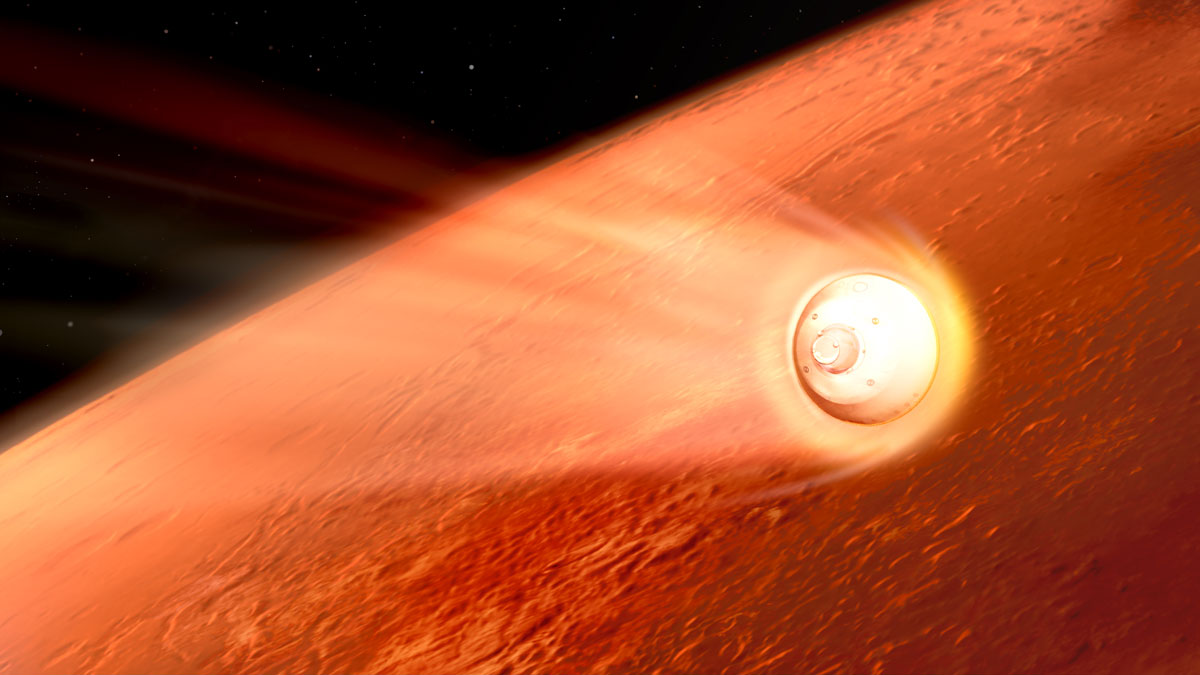
Another American mission is set to land in the next days, precisely the 18th of February 2021 (less then two days since the publication of this article, stay tuned to the news!): the Mars 2020 Mission and its rover Perseverance. Its main scientific goal is to directly search for ancient microbial life, landing on one of the most interesting places on Mars’ surface, Jezero Crater. Scientists are confident that it was an ancient river delta and, if there had been life on Mars, Jezero Crater would have been a very crowded place! So, it seems to be the ideal site even for a sample return mission, right? In fact, this is exactly one of the rover’s tasks: collect terrain samples and seal them in special containers for a future flight back to Earth. Perseverance will carry also a couple of very promising demonstration technologies: MOXIE, an experiment to produce oxygen out of the Martian atmosphere, almost made of carbon dioxide (could you guess why?), and Ingenuity, the first helicopter to fly over another world, introducing a new generation of probes for planetary exploration. What an amazing mission to follow!

What about the future? At least four projects are already in development phase:

  • ESA ExoMars 2022, will land the rover Rosalind Franklin, already cited above, on the surface. The clue is in the name, it should be launched in 2022.
  • Mars Therahertz Explorer, consisting of an orbiter and a lander, it should leave the Earth in 2022. If successful, it will be first Japanese mission to orbit around Mars, since another spacecraft, called Nozomi, did just a flyby due to a technical failure.
  • Martian Moons Exploration, or MMX, developed by JAXA, will be a first mission aimed to visit the moons of the red planet, Deimos and Phobos; the launch should happen in 2024.
  • Mars Orbiter Mission 2 (MOM 2), also called Mangalyaan-2, will be the second Indian mission to Mars and it will also bring a lander and/or a rover, details are still to be defined; the launch should occur in 2024, however it could easily be delayed until 2026, since it is still in the early stages.

[Detailed section alert end]

Incredible, isn’t it? All these robotic spacecrafts are the maximum expression of the human intellect, involving every aspect of our knowledge and capabilities. We are putting all these efforts in the hunt for evidence about the past of the Solar System and the development of life. This is something that only the exceptional Martian environment could allow to uncover, due to its blocked planetary evolution. Looking at a spot on Mars’ surface is like looking at a site like Pompeii: it shows the signs of what happened during the Martian age, in which it was formed, billions of years ago. Digging into the underground we could find the traces of past biological activity and, why not, we could even find still alive microbes! What a unique planetary time machine!
However, there is an eventual high risk to alter this pristine fossil world, the risk of introducing biological contamination from the Earth. Although all the robotic probes are assembled in clean rooms and kept always aseptic to avoid any kind of undesirable passenger, the presence of humans on the red planet surface would definitely raise the possibility that microbial life from Earth could be transferred unwillingly. Should this very unfortunate event happen, there would be a very high chance to bias the future scientific research, losing the chance to solve the most important scientific questions mentioned so far.
This is why we should consider very carefully any human presence on Mars’ surface. We could start building an orbiting station first, leveraging from the experience accumulated with the International Space Station and with the next Lunar Gateway. We could use this orbiting laboratory to pilot rovers and robots from above, in real time, being able to perform quicker and deeper research. Then we could establish bases on the surface of Phobos and on Deimos, the Martian moons, which are without atmosphere and couldn’t have hosted life in the past. Then, we could consider building a first little scientific base, like the ones in Antarctica, but only when the technology will allow us to live there with almost zero risk of contamination and when the benefits of human presence on the surface will be worth that minimum risk.

I know, this approach doesn’t seem to be that Spacepolitan, does it? Many people would like to conquer very soon the red planet, SpaceX’s plan to colonize Mars is so fascinating! Nevertheless, even if it could seem too cautious, the proposal above is exactly in line with the Spacepolitans’ mission of preserving life in its natural environment. It is not easy to apply it to our planet, however, it must be applied also to all the other worlds, not to repeat again and again the same fatal mistake we are making here! So, in answer to the initial dilemma of this post, we should continue with our excellent robotic missions, getting closer and closer to the red planet, without rushing there only for the sake of being the first humans to press the Martian soil. We could be a multi-planetary species also colonizing inanimate worlds, like moons or dwarf planets without any chance to host or have hosted life. We should become Spacepolitans without risking to compromise life on other worlds!

Outer Space Tax

Nothing serious, just an intriguing proposal

To fully enjoy reading this post, listen to Space Cowboy by Jamiroquai.

In the last two blog entries on asteroids, we went through many topics: past events, scientific discoveries, exploration missions. In the following we will see instead something hypothetical,an idea about how to share the resources contained in our beloved space rocks among all mankind.

This Blog’s Space for Earth section is about the contribution of Outer Space towards the achievement of each of the UN Sustainable Development Goals (SDGs). You can also find some of the possible future benefits to the SDGs, underlining further the strong link between space exploitation and Earth’s natural environment restoration. In the following, we will give a deeper look at one interesting potential contribution: how the wealth deriving from space resource mining activities could accelerate the achievement of goals like SDG 1 “No Poverty” and SDG 2 “Zero Hunger”.
Basically, how could this idea be implemented? We should start looking at what is already available about space resource utilization in terms of general principles. The widely accepted UN Outer Space Treaty introduces an important concept: “the use of outer space shall be carried out for the benefit and in the interests of all countries”. This is stated even more strongly in the UN Moon Agreement, affirming that space resources “are the common heritage of mankind”. In a sense, these two similar principles mean that the wealth generated by space exploitation should be shared between all countries, no one excluded.
This matter is not at all easy to handle, since only a part of the resources in the asteroid belt could be worth trillions of dollars and, as a consequence, they could generate serious issues in the world economy, even worsening the actual situation. A potential solution could be to introduce a tax system, following the way mining companies are paying the countries to exploit the natural resources. We could call it simply “Outer Space Tax”. This framework should include not only mining licenses, but also a set of royalties based on the kind and the quantity of the extracted materials.
Introducing such a tax mechanism would have two positive consequences. On the one hand, the price of resources mined in space could be controlled not to ruin the existing raw material market and the world economy. On the other hand, such taxes could generate a big chunk of money to sustain the SDGs mentioned above, finally sharing the wealth generated by space resources with all humanity.
Who or what should handle such a huge bureaucratic and economic power? As advocated by the Moon Agreement itself, it should be an “international regime”, acting in the name of all mankind and of all the nations. What could be better than the United Nations themselves? Instead of creating a new entity, an interesting choice could be to empower the UN Office of Outer Space Affairs (UNOOSA), which is already dealing with many space programs and related initiatives. It would be a matter of enhancing its structure, establishing its rights to collect taxes from entities engaged in space mining activities, and enabling it to monitor these activities in space.
Another important question is about the management of this huge amount of money which should not enrich the usual elites. It should enable the SDG Action Plan implementation instead. A possible way forward could be to channel all the proceeds directly towards the various UN programs and agencies, like UNICEF, feeding the SDGs initiatives without intermediaries. It would be important to avoid giving money directly to local governments, and elude possible difficulties related to benefits reaching the population and the natural environment’s restoration. Should politicians be involved at national level? Clearly it won’t be possible to take local actions without their involvement, however UN agencies should hold firmly the purse strings.
About timing, in the first stages the “Outer Space tax” mechanism could be used to track the activities, issuing licenses at little cost for a limited time, until the space mining business picks up. After that and according to its development, licenses and royalties should then be applied. In particular, royalties should relate first to space resources brought to the Earth, so that they can be easily classified and quantified, leaving free the in situ utilization of space resources. This will avoid adding costs to the first space constructions, already expensive as such. When the space construction business also becomes economically profitable, the Outer Space tax should then be applied to all mined space resources. At that stage, UNOOSA would have its own “space force”, a kind of cosmic Blue Helmets, to control space activities and apply the agreed rules.

This general concept could be extended from materials collected in space to all the possible resources available in space for commercial purposes. For example, a tax system could be applied to allow a spacecraft to occupy a specific orbit around the Earth. It could be similar to the one used to regulate the telecommunication frequencies (3G, 4G, 5G). The license could give the owner of the spacecraft the right to occupy an orbit and money earned from it could fuel the SDGs program. This mechanism could also have the possible interesting side effect to mitigate the space debris problem: if a company had to pay money to occupy an orbit for a spacecraft no longer operational, it would be really interested in its removal. Even more, if the spacecraft were to occupy an unauthorized orbit, a penalty could be applied and, once again, the company would have the right motivation to actively work for its displacement. In the end, it would help to regulate the use of Earth’s orbit, avoiding unpleasant overcrowding effects and mitigating the risk of collisions, which is actually not negligible at all.

Coming back to the main topic, nowadays space mining is hardly an engineering exercise, with many scientific studies, private and public initiatives underway, and it is obviously far from being an economic ecosystem. At this pioneering stage, it is more an investment, receiving public money through the national space agencies, than a wealth generator. However, the technology will develop quickly and soon spacecrafts will be wandering in space hither and thither to mine asteroids. This is why we should now start to think about the set of rules for the exploitation of space, starting from the general principles already agreed by the world nations. Leaving the field to the single nations or companies’ initiatives could definitely materialize the risk of transforming Outer Space in the new Far West, instead of providing benefits to all mankind.

Maybe this idea is too simple, or inapplicable. Maybe there are important aspects still to be taken into consideration, since these are just the thoughts of an average individual with no expertise in international law or in tax law. However, the need of set new rules for the new space world is there and it is increasingly important every day. In the end, we should become Spacepolitans, not space cowboys, shouldn’t we?

Space 4 Earth

No more lost in… this blog!

To fully enjoy reading this post, listen to Space for the Earth by Ozric Tentacles.

Let’s begin the 2021 with a blog update. In the last months, we shared a lot of information about how space can help solve many of the problems we have here on Earth, and how it can support the future development of humankind without harnessing our wonderful living planet.

Since different topics were covered in previous blog posts, a new section has been added to facilitate easy access, from a drop-down menu. This section is called “Space4Earth” and visitors can access it from any page of the blog, through the main menu on the top right.

By clicking directly on the word Space4Earth, it is possible to access the UN Sustainable Development Goals list, with all the considerations on the strong aid provided by space to reach these fundamental aims.

If you hover with the mouse over “Space4Earth”, a drop-down menu will appear with the different topics we already shared:

  • Observing Earth From Space, why looking at our planet from the outside is a key activity to understand what’s going on
  • Overview Effect, the quantum leap in the human awareness that occurs when looking back at our planet from space
  • Travel to Space, reflections on the first sixty years of human space travel
  • Humans in Space, what humans achieved so far in space and what they could do in the near and far future
  • A Moon of Opportunities, what has happened so far on our natural satellite and what to expect from this decade which future historians will surely call the Decade of the Moon…

What about asteroids? Don’t worry, you can still access the two articles published so far from both the Home Page and the Blog Page. (Spoiler Alert Start) They will join this section soon, after the third post about them is published… (Spoiler Alert End).

The About Page has been updated too. There are some basic information about myself and the well deserved thanks to my special proofreader. In addition, a new little video section has been added (I know I am not Brad Pitt, be gentle with me!) and the reference to the Spacepolitans Playlist has been included, containing all the songs recommended so far for your reading. Of course, the playlist will be continuously be updated every time a post is published.

That’s all for now, I hope the new “Space4Earth” overview will increase the reader awareness about the strategic role of space in our present and in our future, which is one of the compelling points of the Becoming Spacepolitans blog. So, stay tuned for the next posts and let’s shout loud the Spacepolitans Motto together: Space for All, All for Space!!!

Asteroids: Cross And Delight (2/2)

Should we love or hate space rocks?

To fully enjoy reading this post, listen to Space Rock by Trip Rexx and to Lucy in the Sky with Diamonds by The Beatles. Ideally treat yourself and enjoy both, one after the other…

Space rocks, how many there are in our Solar System. They could be the enablers of the human expansion or the bearers of the end of the story. For one reason or another, we have to face them and the sooner the better!

Since the discovery of Ceres, astronomers have become increasingly good at identifying asteroids and predicting their orbits, so much that, until 2020, they discovered over a million objects. All these information were and are currently catalogued by the Minor Planet Center (MPC), “the single worldwide location for receipt and distribution of positional measurements of minor planets, comets and outer irregular natural satellites of the major planets”. Basically, it is the official asteroidal registry office. One of its major tasks is to calculate the orbits of newly identified objects and to warn about the risk of their potential future impact with our planet. So, the MPC will be the first to wave the flag in case of a possible collision threat, real “dark side” of our space nuggets.

How can such adorable cosmic pebbles turn into deadly space bombs? The dinosaurs learnt it the hard way: the impact of a huge asteroid, some kilometre in diameter, blew away their habitat and their existence, scientists found great evidence of this event. In 2013, we were luckier, as we witnessed instead the explosion of a tiny twenty-meters large asteroid, thirty kilometres over the city of Chelyabinsk: no casualties, but more than one thousand people injured and seven thousand buildings damaged.
If the first example is an extremely rare event (one every hundred million years), the second one is more common and what happened in Chelyabinsk had not been predicted before. That event rang the bell and the UN itself decided to manage the question more seriously: it created the International Asteroid Warning Network. This international group was tasked with developing a well-defined strategy to assist Governments in the analysis of asteroid impact consequences and in the planning of mitigation responses.
After that decision, NASA reorganized its observation programs and established the Planetary Defense Coordination Office, whose mission is to lead the coordination of efforts to plan responses to these potential impact threats. Similarly, other organizations came to light or increased their activities, like the B612 Foundation, created with “the goal to protect the Earth from asteroid impacts”, and the Asteroid Day initiative, aimed at raising the awareness of the asteroid threat. Just for your info, the Asteroid Day was officially established by the UN at the end of 2016, and since then it is celebrated the 30th of June, anniversary of another historical impact. In 1908 over the Siberian forest of Tunguska, thousands of trees were flattened, a huge number of reindeers were killed and windows were blown hundreds of miles away.

Got it! Asteroid threat is serious business, not just stuff for science-fiction blockbusters like Armageddon or Deep Impact (more fiction than science, to be honest). So, is there anything that could be done? Is there any way to manage such menace?
As said, the first thing to do is to discover, measure and track the potentially hazardous objects (mainly Near Earth Asteroids or NEA) with multiple observations, in order to calculate their future orbits more and more accurately.
The second step is to assess the impact risk. For this purpose, scientists developed the so called Torino Scale (something like the Richter Scale for earthquakes), which allows to combine probability and damage on a scale from 0 to 10 (0 business as usual, 10 adieu world). The record so far is a level 4 on the Torino scale, obtained in December 2004 by 99942 Apophis, a 240-meter-wide stony NEA. Its first measurements led to predicting a possible quite devastating impact with the Earth in 2029, subsequently downgraded to level 0 for 2029 and level 1 for 2036 encounters, thanks to further observations.
Obviously, discovering, tracking and qualifying are not enough to deal with such threat. They are just the first part of the solution This is one of the reasons why many spacecrafts have been sent out to study asteroids, mainly the NEA family. They collected a great quantity of information, allowing scientists to know a lot more about them and to design different planetary defence strategies.
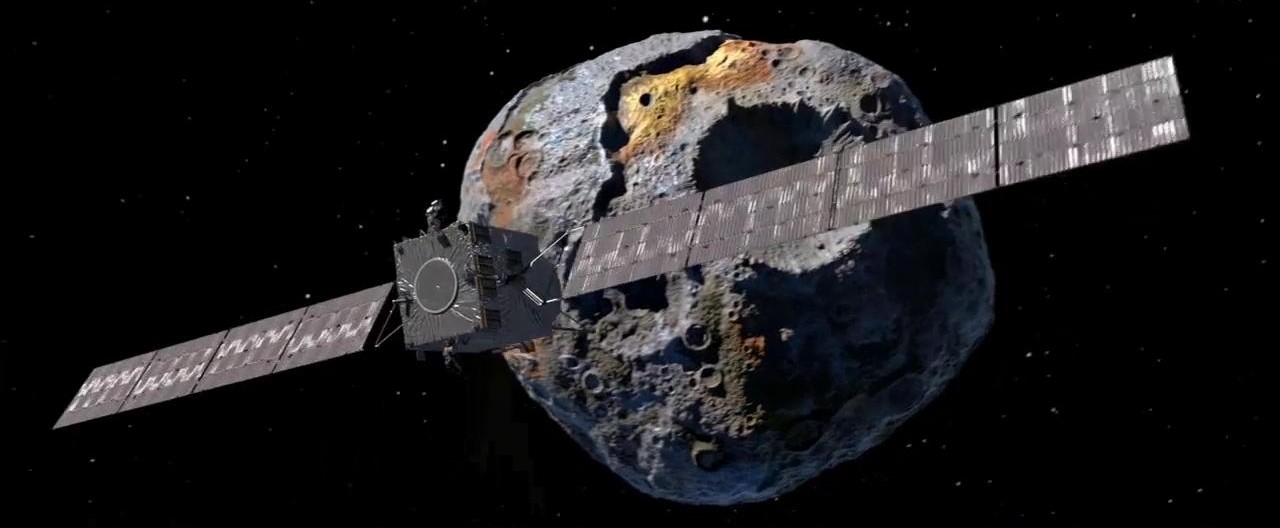
Many other missions are planned in the near future, like Lucy (are you listening to the song? Yes, its name is linked to it!), the first mission to Jupiter’s Trojan asteroids, or Psyche, aimed to study the possible remnant of the metal core of the planet not formed between Mars and Jupiter, the asteroid 16 Psyche (yes, same name of the mission, of course). But the very first missions designed on purpose to test a possible strategy are in their preparation stage: the American DART and the European HERA. The two spacecrafts have the common objective of figuring out if playing pool in space with asteroids works as a defence action, not only as a spectacular celestial game. DART spacecraft, the white cue ball, will be launched in July 2021 aboard a SpaceX Falcon 9 rocket, the stick, to reach asteroid 65803 Dydimos and its moon, Dimorphos, the coloured ball. After getting there, the spacecraft will deliberately crash into the one-hundred-and-sixty-meter large moon, to test if the method of the “kinetic impactor” can succeed in modifying the trajectory of Dymorphos, like the white cue ball does with the coloured ball. And HERA? To see if DART scored the point, placing Dymorphos in a different position, there is the need of a referee and HERA will play that role. Some year later, it will reach Dydimos system, observing all the changes produced by the impact. If everything goes as planned moving Dymorphos into a different position, we could have precious information to develop the first effective defence strategy: playing cosmic snooker!

Apropos of space games, there is a trendy virtual amusement played by many people around the world, which could be applied to space: its name is Minecraft. For those who have never heard of it, in the world of Minecraft the player must collect an incredible variety of resources, combine them together, and use them to build almost everything, limited only by the imagination. It’s a game of discovery and creativity, leading to incredible adventures, a true time stealer.
Having said that, how could we play Minecraft in space? Focusing on our darling rocks, it would be a matter of combining two very promising space technologies: asteroid mining and space manufacturing
As seen in my previous post, Asteroids: Cross and Delight 1/2, asteroids are made of many different kinds of material, from ice to carbon, from siliceous minerals to metal ores. Some of them could potentially be used to build structures in space, some others could provide the basic elements to produce propellants for spacecrafts or even support human life in space. It would be just a matter of collecting, processing and bringing the materials where needed. This is the basic concept of asteroid mining: extract resources from these space quarries to use them for any purpose.
How far are we from make this concept into a real thing? Several studies have already been undertaken on the matter and there are already companies building prototypes and proof of concepts. Trans Astronautica Corporation, or TransAstra in short, is one of them. They are working on a particular method, called Optical Mining. Thanks to the use of solar energy, very abundant in space, this technology allows to extract raw material by hitting a rock with a concentrated ray of light and fracturing it into tiny pieces. In their project, the optical mining device will be mounted on a special spacecraft called Honey Bee (what an explanatory name!). The idea is to fly to an asteroid, up to 40 meters in diameter, cover it with a big bag and hit it with the concentrated sun rays. All the little fragments, but also water and other volatiles, will then be collected in the wrapping bag. A small demo version of the first prototype of the mining spacecraft called Mini-Bee is in its development phase and will be launched for a test flight in space soon (no date released yet!).
There is another strategy that looks pretty promising: using microbes to modify rocks and extract materials or, in a single word, biomining. Even if this technique has been well known for decades, a new experiment called BioRock was recently installed on the International Space Station, providing important results on extracting rare earths from rocks in microgravity. In the future we could recruit armies of microbes, to obtain that raw materials useful for our expansion into space, not only to be used for asteroid mining, but also for In-Situ Resource Utilization (ISRU) on the Moon, on Mars and on all other rocky satellites.
Okay, it is clear, sooner or later plenty of raw material will be available in space, without depending on the very costly launches from the Earth. But how can we use them? Here comes the space manufacturing process. Basically, it involves the production of different goods in the space environment, from construction elements to specific tools and even electronic parts. There is an entire NASA program aimed to develop such capabilities, called In-Space Manufacturing. The private company Made In Space is collaborating to the program and its engineers are working hard to create the first working prototypes. They were able to print an object in space already in 2014, thanks to a special 3D printer installed on the ISS, and they developed also a machine to produce optical fibres in microgravity, resulting in much better quality than the ones made on the Earth’s surface. Very recently they placed on the ISS a module to print ceramic materials, the Ceramic Manufacturing Module, which performed successfully the first test in early December 2020. Made In Space is also working on a technology called Archinaut, that will enable to build structures in space environment, starting from the assembly of very large solar panels and their chassis. After several tests on Earth, the first demonstration flight should happen somewhere in 2022.
So, if we put together asteroid mining and space manufacturing, we could really start to realize in space the infrastructures we need to live there, without depending so much on the precious terrestrial materials. In a few words, we could become real space minecrafters!

Oh gosh, how time goes by talking about asteroids! We went through a lot of information related to our dear space nuggets: registry offices, frightening threats, cosmic snookers, space minecrafters… As you have just seen, they could really be our cross, in case of an impact with our planet. But they could be also our delight, thanks to their precious resources, which could be used to create the bricks for our new homes in space and the tiles to pave the road to become Spacepolitans. So, let’s stay tuned on the incoming exploration missions, the asteroids are waiting for us!

Asteroids: Cross And Delight (1/2)

Should we love or hate space rocks?

To fully enjoy reading this post, listen to The Golden Age by The Asteroids Galaxy Tour and to Space Rock by Rockets. Ideally, treat yourself and enjoy both, one after the other…

Resources, resources, we are always looking for resources to make any kind of things. However, resources are limited, especially in a limited environment like our planet. Recycling and circular economy are for sure terrific strategies to limit our insatiable hunger, but they are not enough. So, where could we find new resources before we run out of them? Simple, just looking up to the sky, there is plenty of material in space!

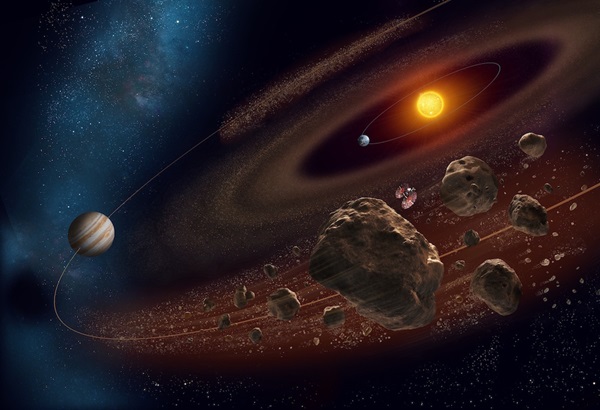
Asteroids are basically rocks spread over the Solar System, orbiting around the Sun, the big attractor. Why are they there? In a few words, planets were formed starting from a primordial cloud of gas and dust orbiting around our star, aggregating because of gravity. Not all material ended up forming large planets, but some of it remained scattered out there forming smaller items, like dwarf planets (such as lovely Pluto) and, of course, asteroids.
To give you an example, think about a LEGO construction, you built at least one in your life, didn’t you? Asteroids are like the left-over pieces once you finish the construction: you completed the project following the instructions (the planets), however, those pieces remained in your hands (the asteroids).
As well as those LEGO pieces, asteroids can be useful to build something else! This is the idea behind asteroid mining, a theoretical concept starting to become more and more concrete in the recent years.

Before rushing to it, let’s have a closer look at our space nuggets, to understand better why mining them could be a great opportunity. First of all, they are categorized according to their composition, in three major types:

  • C-Type or carbonaceous, the most common, they are very dark objects containing mainly carbon, clay, silicate rocks, even a good percentage of water in the form of hydrated minerals and ice, like a dirty chunk of stone coal;
  • S-Type or silicaceous, proper stones that are made up mainly of silicate materials based on iron and magnesium;
  • M-Type or metallic, the most rare and desirable nuggets, made mainly of nickel-iron minerals, very often accompanied by other precious metals, such as gold, platinum and rare earths.

In addition to these three main groups, there are also several subcategories, some even consisting of a single asteroid, somewhat different from all the others.

Another way to classify asteroid is based on their position in the Solar System. We have:

  • Near Earth Asteroids, or NEA, objects whose circles around the Sun sometimes bring them close to the Earth; they are divided, in turn, in subcategories depending on the shape of their orbit (Amor, Apollo, Aten);
  • Trojans, special objects, parked in particular points of a major planet orbit (Lagrange points), allowing them to follow or precede at the same distance from the planet itself during its trip around the Sun; the name “Trojans” was chosen because the first discovered asteroids in this group were identified with the names of heroes from Homer’s Iliad; the most numerous are Jupiter’s ones;
  • Main Belt Asteroids, located between the orbit of Mars and Jupiter, they form the largest group of this classification, and they are what remains of a planet that never formed or exploded in the very early stages of its formation (there is still no definitive theory about it, even if nowadays the “never formed planet” is the most accredited);
  • Centaurs, small group of objects which are spread out between Jupiter and Neptune, more similar in composition to comet nuclei (more ice than minerals);
  • Kuiper Belt Objects, or Trans-Neptunian Objects (TNO), large group over Neptune orbit, full of frozen stony objects but also dwarf planets like Pluto.

One could ask, what about the Oort Cloud? Isn’t there a group of asteroids in the great suburbs of our Solar System? The answer is “we don’t know”, the Oort Cloud is so far away that we are not sure what it is made of. Only occasionally we have been in contact with the “visitors” coming from there, the long period comets. This is why the Oort Cloud is also known as the House of Comets.
At this point another question could arise: is there a relationship between comets and asteroids? We could say that they are somewhat like cousins, belonging to the same kind of cosmic fragments. However, there are differences: comets are almost like dusty snowballs, whilst asteroids are like stones, as seen above. Comets are also characterized by having a coma and one (or more) trail, whilst asteroids do not exhibit such features. They could also differ in their orbit shape which is usually more eccentric and elongated for comets. On the other hand, sometimes the distinction between comets and asteroids can become very “subtle”, and there are objects that can even move from one group to the other, like Centaurs themselves.
Let’s keep comets aside for a moment, ready to pick them up again when we will explore mining, since they are very rich in what will be like oil for space economy: water.

How do we know all this about our beloved rocks? First of all, scientists have been observing them with telescopes of all kinds since the discovery of the first asteroid, Ceres, which took place on the 1st of January 1801 by the Italian astronomer Giovanni Piazzi. Since then, more than eight hundred thousand asteroids have been discovered, analyzed, and catalogued. Despite running for two centuries, the task of discovering asteroids is just at the beginning: it is estimated that in the Solar System there are zillions of asteroids larger than 100 meters!
Obviously, we didn’t just observe asteroids with telescopes, we also sent spacecrafts to visit them closely, and even touch them. The first fly-by was made by the famous American probe Galileo, whose main objective was to study Jupiter and its moons. During its trip to Jupiter in 1991, the spacecraft passed a few thousand miles from 951 Gaspra, a gorgeous stony asteroid in the Main Belt, taking the first incredible closeups of this new world. The first mission entirely dedicated to study an asteroid was NEAR Shoemaker, a spacecraft full of instruments that scanned 433 Eros, a huge stony NEA, king of records: first NEA discovered, first orbited and first even touched by a spacecraft. We then had other very enthralling missions like the European Rosetta, orbiting and touching Comet 67P/Churyumov-Gerasimenko (remember to bear comets in mind!), and the Japanese Hayabusa, able to return back to Earth a small sample of another stony NEA, 25143 Itokawa.
At this very moment, there are two spacecrafts in action, sent out to analyze, orbit around, touch and return a sample of two other NEAs. The first is the Japanese Hayabusa-2 and its objective is 162173 Ryugu. The other is NASA OSIRIS-REx, aimed to visit 101955 Bennu. OSIRIS-REx has already collected the sampling successfully and it will depart from Bennu in 2021, returning to Earth in September 2024, while Hayabusa-2 has returned the sample of Ryugu back to Earth just… today (this article is published the 6th of December 2020, Australian Time, just after sample’s touchdown)!

Let’s celebrate such an incredible success! We are living in very exciting times and every day we can witness the first signs of a new Golden Age, the age of the Spacepolitans! So, let’s take a break to party and shout loud the Spacepolitans motto: “Space for All, All for Space!”.
Oh, I almost forgot! We are not done here with asteroids! In the next entry we explore how they could be the potential incipit of our journey amongst the stars (asteroid mining), but also how they could prevent it (asteroid threat)… after all, they are our cosmic cross and delight!

Sustainable Development Goals vs Space – 2/2

How the Outer Space could help us to reach the World’s ambitious targets

To fully enjoy reading this post, listen to Final Countdown by Europe.

Outer Space, the transformative element that could push the UN Sustainable Development Goals, or SDGs, to the next level. Is it applicable to all SDGs or only to a few? For the first seven it is evident (see article Sustainable Development Goals vs Space 1/2). Let’s have a look at the remaining ones…

Poverty, hunger, good health, education, gender equality, water and energy: these issues are at the core of the first seven UN Sustainable Development Goals. What else? Here follow the other themes included in this important program aimed at saving the World.

SDG 8 – Decent Work and Economic Growth
This goal is obviously connected to SGD1 (Erase Poverty) and SDG2 (Zero Hunger), and space is a key contributor to it, offering the same benefits it brings to the other two. Furthermore, space is also influencing directly the growth of the global economy: the new space industry is ramping up year after year, Morgan Stanley expects it to hit US$ 1.1 trillion by 2040, while Bank of America estimates that it will grow eight times bigger in the next thirty years, reaching US$ 2.7 trillion in 2045.
Obviously, such a huge growth will bring a great contribution also to the overall employment levels, requiring a proportional increase of new and qualified jobs.
Looking even further in time, the exploitation of space resources instead of terrestrial ones will support our unstoppable economic expansion in a more sustainable way for our planet, and this is the basis of the Spacepolitan thought (see the Spacepolitans Manifesto).

SDG 9 – Industry, Innovation and Infrastructure
For decades space has provided the ideal infrastructure for telecommunications and geopositioning services. This is very likely the most known benefit, experienced by many of us in our daily activities, and it is headed to expand even more in future years, with the launch to LEO of the internet satellite constellations and the 5G cellular network extensions.
And what can be said about innovation? Space is innovation, space exploration means doing things never tried before, inventing solutions, developing new technologies. Is there a more powerful flywheel to accelerate innovation itself? If so, it is hard to find one, probably only high energy physics and quantum physics can play a similar role, but not as wide in its range of applications.
Lastly, according to the Spacepolitans tenet (see again the Spacepolitans Manifesto), when heavy industries move into Outer Space, we will finally be able to host only truly sustainable activities on the planet , removing the main source of pollution.

SDG 10 – Reduced Inequalities
This SDG aims at reducing inequality within and among countries in terms of income, age, sex, disability, race, ethnicity, religion, and so on.
Satellite data can support, plan and monitor mobility and migration of people, especially between different areas of the world, as well as assist in improving refugees’ conditions, disaster planning and emergency response.
Again, the next connectivity services based on satellites will also help to reduce the so called “digital divide”, bringing access to the internet and information all over the world, as already mentioned in SDG4 (Quality Education) paragraph.
However, space could also introduce some risk, that could be named the “space divide”, since exploiting space requires great initial investments and the most disadvantaged countries could be left out. However, risks can often be transformed into opportunities. This is the case of UNOOSA initiative Access to Space for All, which is helping developing countries to become emerging space nations, by facilitating satellite deployments and, in the near future, microgravity and exploration experiments.Kenya, the first country to participate, is now operating its first satellite in orbit. Mauritius‘satellite will be deployed in space in 2021, and more countries will follow suit in the near future.
Then, although it may seem repetitive, if implemented in the right way, the “good old” Space Tax should indeed reduce inequalities, sharing benefits also with SDG1 (erase poverty), SDG2 (zero hunger), and SDG8 (Decent Work and Econimic Growth).

SDG 11 – Sustainable Cities and Communities
GPS, 5G and IoT satellite communication, Earth Observation technologies are important contributions that space can make towards achieving this goal and in support of the realization of the so-called smart cities. This new concept of urbanization leverages on data connection between devices and vehicles, but also on new ways to monitor air pollution or the state of infrastructures. It is then easy to see that the above space technologies are the perfect enablers to realize the cities of the future.
Space can even contribute to save lives in our cities, by providing precious information to support rescue in case of any form of disaster. It can even help to prevent it, especially the kind that is not taken into consideration by most people: the issue of potentially hazardous objects, also known as the asteroid threat. Ever heard about Chelyabinsk? It’s a Russian city which became newsworthy in 2013, after a small meteor of just twenty meters of diameter exploded over the city, at an altitude of thirty kilometers, injuring more than one thousand people and damaging over seven thousand buildings. How can space help to address this kind of events? Nowadays there are a lot of initiatives aimed at mapping all Near Earth Ojbects, or NEOs, the most likely impactors. NASA itself received specific instructions by the American Congress to find and track them, in order to be able to predict such disgraceful impact events.
National space agencies sent already many spacecrafts to make rendezvous with asteroids and understand better their nature (i.e. NASA Dawn mission). Some of them took and are currently taking samples back to Earth (i.e. Jaxa Hayabusa2 mission), and others will soon be launched to test trajectory deflection strategies and technologies (i.e. NASA DART mission). So, investing in these space technologies could really help us not to end up like the dinosaurs! Interesting, isn’t it? However, it is a topic that deserves a dedicated post (mmm… good idea!).

SDG 12 – Responsible Consumption and Production
If you consider the benefits already identified for SDG6 (Clean Water) and SDG7 (Affordable Energy), you will realise that they apply also to this SDG, since they are strongly related.
Another important application of actual space technologies is the so called Smart Farming: satellite data are used in crop cultivation to cut or even get rid of the use of pesticides, whilst increasing land productivity. Then we have livestock grazing, images from space and herds geolocaliztion are helping the new “space cowboys” improving the yield of their work, just managing better the available resources.
Talking about technology transfer, in addition to what has been said for SDG6 and SD7, the development of In Situ Resource Utilization (ISRU) technologies could be transferred to terrestrial operations in order to use available resources in a more effective way. Need an example? Let’s take 3D printing construction capabilities. To develop future bases on the Moon or even on Mars, we could not bring a huge amount of construction materials from the Earth, since it would be too expensive. So, the basic idea is to take only construction tools and use any resource available there. NASA ran a competition about 3d printed buildings, and many startup companies participated, proving that this technology is already feasible. The winner, AI Space Factory, demonstrated the construction of a 3D printed habitat, named Marsha, a future Martian habitat. Furthermore, they developed a terrestrial habitat, Tera, built with the same technology, using a fraction of the resources commonly used in standard constructions. As we know, the construction industry is responsible of introducing a lot of CO2 in the atmosphere, so the positive side effects of this 3D printing construction technologies can again be beneficial to other SDGs (see below)…
Thinking about the distant future, as already said and restated for SDG8 and SDG9, if we don’t move population and production into Outer Space, and continue to consume our resources at the current rate, we will completely exhaust our beloved planet with no chance to recover.

SDG 13 – Climate Action
If we want to understand what climate change is, we need to consider scientific data, like air and water temperature, sea level, ice and snow coverage, extreme weather conditions, CO2 levels, and many more, gathering them from the entire planet.The only way to do so is to send special satellites to orbit, as already shared in “Observing the Earth From Space”, one of our previous posts. Monitoring and analyzing these data, year by year, will be the key to describe various climate dynamics and to unveil their possible causes, separating natural and artificial ones, and finally have a chance to mitigate the rapid changes we see today.
Focusing specifically on CO2 levels in the atmosphere, scientists all over the world have identified the increase in this measure as one of the most important accelerating factors of climate change, CO2 being a gas involved in the so called greenhouse effect which causes the average air temperature to increase over time.
Is there anything that space development could offer, besides helping with CO2 and temperature measurements? Of course there is and it is a mitigating factor. Let us talk about CO2 removal technologies. For years, devices have been used on space stations and crewed spacecrafts to remove CO2 from their artificial atmosphere. However, today they cannot be applied directly to the Earth’s atmosphere for various technical reasons which perhaps could be fixed in the future. But there is another new project that could help in the short run: a study led by the University of California and the Berkeley Lab aimed to develop a technology that will allow to capture the CO2 available in the Martian atmosphere, to help would-be settlers on Mars. This new machine, called Biohybrid, can capture the energy of sunlight to convert carbon dioxide and water into building blocks for organic molecules, to be used in the manufacturing of plastics, fuel and even drugs in situ on Mars. But the most interesting thing for this SDG is that the Biohybrid can also pull CO2 from the air on our planet, finally helping to mitigate issues related to climate change.

SDG 14 – Life Below Water
Here we are again with many benefits from Earth Observation:

  • mapping and monitoring of natural and protected areas,
  • assessment and monitoring of marine and coastal resources,
  • fishing vessel tracking and navigation to monitor illegal, unregulated and unreported fisheries,
  • water temperature monitoring (see also SDG13),
  • identification of algal blooms,

just to list “a few”.
However, satellite data are already helping to support another important issue about water: plastic litter. Many projects have already started to use data from satellites to localize, track and monitor plastic concentration. These data will help to take action not only about its removal, but also identifying its sources and stopping the increase of plastic waste pollution in the water.
Going a step further, actually submarine habitats are helping astronauts to prepare for their life in space. In the same way, lessons learned in the construction of space habitats like the ISS could improve the construction of submarine habitats, that could be used for monitoring and running advanced studies of marine life and for improving its preservation.

SDG 15 – Life On Land
Like SDG14, this goal is specifically about how humans could preserve other life forms than their own. Preserving biodiversity, fighting desertification, managing forests: all these activities are part of this incredibly important commitment. Space is a great ally. Satellite data support the monitoring of endangered species (GPS tracking for wildlife) and protected areas (Bio-geophysical Variable Mapping), as well as detecting and monitoring wildfires that destroy acres of forests every year all over the planet.
Nevertheless, we know that monitoring, tracking, detecting are not enough. We should leverage on space more, using it as an enabler to finally declare and treat the entire planet as a natural reserve, an immense sanctuary of life. This could be the most important achievement of the human race and we all should bear this in mind in every action we take, every day. Already heard about this? Correct! It was the second big “A” in our Spacepolitans Manifesto.

SDG 16 – Peace, Justice and Strong Institutions
Finally a goal that space cannot help us achieve. Or maybe it can. Wait a moment, has anyone said that space technologies are helping UN peacekeeping missions? Correct! Nowadays the UN peacekeeping missions are strongly supported by satellite data to monitor wars and conflicts.
And has anyone mentioned that the laws and regulations for a peaceful use of space are a powerful justice asset? Correct again! The Space Treaty, the Moon Treaty, and the other agreements of the international space law have been developed in the name of peace and justice and they cover:

  • non-appropriation of outer space by any one country,
  • arms control,
  • the freedom of exploration,
  • liability for damage caused by space objects,
  • the safety and rescue of spacecraft and astronauts,
  • the prevention of harmful interference with space activities and the environment,
  • the notification and registration of space activities and scientific investigations,
  • the exploitation of natural resources in outer space,
  • the settlement of disputes.

It is already a lot of stuff! And much more will be needed to support the exponential growth of the new space economy, as well as the development and strengthening of institutions like the Committee on the Peaceful Uses of Outer Space and the UNOOSA (UN Office for Outer Space Affairs) itself.

SDG 17 – Partnership for the Goals
A successful sustainable development agenda requires partnerships between governments, the private sector and civil society. Many space missions and projects are based on international collaboration, putting together efforts, funds and resources. The best example is obviously the International Space Station (ISS), which, for more than 20 years, has been the perfect result of the combined work of several countries.
However, space is not only a topic for partnership between countries, it also involves many different companies from the private sector. The various national space agencies, the UNOOSA and the new space economy itself are pushing further such collaborations. NASA Commercial Space Economy Program is a clear example, and so is the China Commercial Space Alliance, to highlight that public-private partnership is a worldwide key factor for space development and for the success of many projects supporting the SDGs.

We have reached the end, haven’t we? Well, to be honest, not yet! There is an initiative worth to be cited in this context, led by four international students, named SDG18 – Space for All. Their vision is about adding another SDG, focusing on space, and they want to bring it directly to the UN. Their objective is to increase the awareness about space as the great enabler to support the SDG agenda, as we have seen in these last entries.This potential new goal will be different from previous SDGs, although closer to SDG17, focusing on how to accelerate the Sustainable Development Agenda, instead of addressing a particular issue. They have already held a UN75 Dialogue on this matter and nowadays they are currently creating an organisation finalized to achieve their final goal!

Although probably unaware, but they are well on their way to Becoming Spacepolitans, like all of you who have reached the end of this long review. So, inspired by what we have learnt together and by SDG18, let us shout out the brand new Spacepolitans motto: Space for All, All for Space!