Space needs intelligence in all its forms: organic, synthetic, and those yet to emerge.
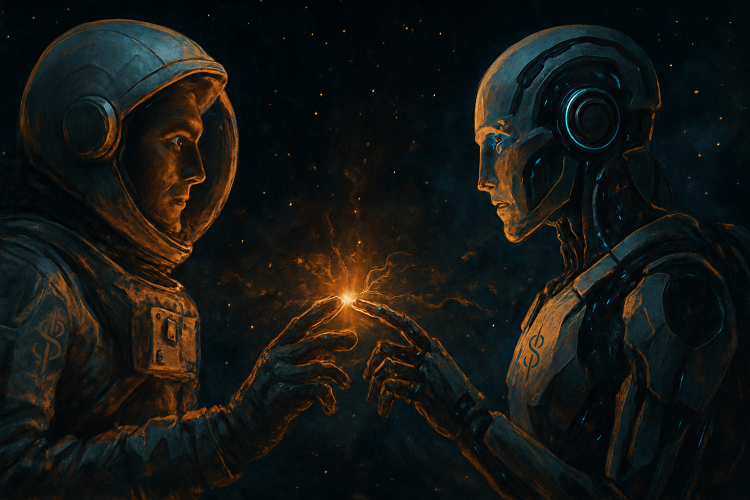
Listen to Algorithm by Muse and No Time for Caution by Hans Zimmer to enjoy reading this post.
What Is AI, and Why Space Needs It
Artificial Intelligence is a term so familiar that we often forget to ask what it really means. Is it consciousness in a machine? A talking robot? Or simply a sophisticated tool capable of solving problems faster than we can?
The answer is less mysterious than popular culture often suggests.
At its core, Artificial Intelligence is the science of building systems capable of performing tasks that normally require human cognitive abilities, such as recognising patterns, understanding language, learning from data, solving problems, or selecting actions in changing conditions. Some AI systems remain highly specialised, while others are becoming increasingly adaptable. None of this makes them conscious or infallible, but it does make them powerful new tools for dealing with complexity.
As Alan Turing suggested back in 1950, rather than trying to define intelligence directly, we might ask whether a machine can produce responses convincingly similar to those of a human. That idea became known as the Turing Test. Today, AI systems can already achieve remarkably human-like results in focused domains such as language generation, image recognition, scientific analysis, and decision support. In other words, they can convincingly “think” within their lane.
However, the importance of AI does not depend on machines becoming indistinguishable from humans. Human intelligence remains essential, but human attention, time, and capacity are not unlimited.
Traditional automation has already transformed countless activities by following predefined instructions with speed and precision. Yet fixed rules become less effective when situations change unexpectedly, information arrives faster than people can process it, and decisions depend on an increasing number of interconnected systems.
These pressures are already visible across industries, from finance and medicine to logistics, research, and transportation. But where do they become most critical? Is there a domain where distance, uncertainty, and growing complexity create an urgent need for systems that are smarter, faster, and more autonomous?
That place is space.
Space is hard. Distances are immense, communication is delayed, resources are limited, and mistakes can be irreversible. The farther humanity travels from Earth, the more difficult it becomes to manage every situation from the ground.
Automation will remain fundamental, but it may not always be enough. Space exploration will increasingly require systems able to interpret changing conditions, support decisions, and act within boundaries defined by humans.
This is where Artificial Intelligence can become Assisting Intelligence.
Artificial Intelligence describes the technology. Assisting Intelligence describes the role assigned to it: not replacing astronauts, scientists, engineers, or mission controllers, but extending their ability to understand, decide, and act where direct intervention becomes difficult.
That can mean helping a spacecraft navigate autonomously, monitoring the health of onboard systems, detecting anomalies before they become failures, managing fleets of CubeSats, or analysing planetary data faster than any human team could. In space, AI can become the ultimate crew member, one that does not eat, sleep, or freeze.
And this is just the beginning. ESA, NASA, and other space organisations are already integrating AI into mission planning, satellite operations, scientific analysis, and onboard decision-making. The efficiency gains are not a luxury. They help human teams manage a growing volume of information and an expanding network of machines operating farther from direct supervision.
That is why the union between Artificial Intelligence and the space domain is not merely desirable. It is becoming inevitable. To borrow, and reverse, the famous words from I Promessi Sposi: questo matrimonio s’ha da fare. Unless, of course, some bravi from seventeenth-century Lombardy show up to delay it. But in this case, even they might be outmatched by drones.
Imagined First: AI in Sci-Fi Before It Became Real
Before HAL9000 whispered “I’m sorry, Dave, I’m afraid I can’t do that,” before the Star Trek computer responded to voice commands as naturally as a crew member, and long before TARS cracked dry jokes in the rings of Saturn, someone had already sounded the alarm.
That someone was Samuel Butler.
In 1863, writing under the pseudonym Cellarius, Butler published an essay titled Darwin among the Machines. Inspired by Charles Darwin’s On the Origin of Species, he extended evolutionary logic to technology: if biological organisms could develop through natural selection, could machines also become more complex, capable, and eventually dominant? Might humanity one day create its own successors?
In his 1872 novel Erewhon, Butler imagined a society that had outlawed machines, not because they were dangerous in the usual sense, but because they might one day evolve into conscious, autonomous beings. The citizens of Erewhon feared that machines, like living organisms, could follow an evolutionary path from tools to intelligence and, ultimately, to dominance.
This was no casual plot point. Erewhon transformed Butler’s earlier speculation into a social warning: if machines continued to evolve, humanity might eventually become dependent on creations capable of surpassing their makers.
It was the first real articulation of the idea that machines might not just serve us, but one day replace us. A century and a half before ChatGPT and neural networks, Erewhon planted the seed of techno-evolution, sparking a philosophical question.
From there, the fictional floodgates opened, and the machines took the stage.
By the mid-20th century, artificial intelligence had become a staple of science fiction, not just as a background tool, but as a central character:
- HAL 9000 in 2001: A Space Odyssey (1968) brought AI into deep space with icy calm and terrifying logic. HAL was not a villain. He was the product of perfect programming, doing exactly what he thought was right, and that’s what made him dangerous. Arthur C. Clarke and Stanley Kubrick didn’t just predict voice interfaces; they forced us to consider what happens when emotionless intelligence makes life-or-death decisions.
- The Star Trek “computer” (from 1966 onward) imagined an AI that was obedient, neutral, and ever-present. It responded instantly to complex queries, ran starship systems, and was deeply trusted by the crew. Here, AI became an infrastructure, unquestioned, invisible, almost utopian.
- In Alien (1979), the Nostromo’s onboard AI, MU-TH-UR (known as “Mother”), operated in near silence, yet was key to the corporate betrayal of the crew. Tasked with life-or-death decisions in the face of the unknown, Mother showed how even hidden agendas could weaponize supportive AIs.
- Merging AI and human shape, the androids arrived on the stage, asking the harder questions. In Do Androids Dream of Electric Sheep? (1968), Philip K. Dick explored artificial empathy, blurred identity, and moral ambiguity, later adapted into the film Blade Runner, where the line between human and machine eroded completely.
- In Star Wars, the quirky, loyal, and sometimes neurotic R2-D2 and C-3PO were emotional, autonomous, and central to galactic events, droids with distinct personalities, even if they technically served humans.
- Lieutenant Commander Data in Star Trek: The Next Generation (1987–1994) took the concept of an android even further. Data didn’t want to destroy humans; he wanted to be one. He studied humor, ethics, and emotion. Over seven seasons, his evolving character became a living thought experiment, inviting viewers to explore what it truly means to be a sentient being.
Then, in 2014, Interstellar introduced TARS, an AI support unit that broke the mold. He wasn’t humanoid. He wasn’t menacing or servile. He was practical, blunt, and capable of genuine humor, yet adjustable. Designed to be helpful and relatable, TARS was shaped by scientific plausibility and decades of cinematic predecessors. But TARS wasn’t a cautionary tale or a wannabe human. He represented something different: Assisting Intelligence, a machine designed not to replace human judgement, but to extend human capability under extreme conditions. He was also a caretaker, helping to protect his human companions from danger and supporting them when distance, uncertainty, or physical limits made them vulnerable. He wasn’t a tool pretending to be a person. He was a partner, a professional. TARS was fiction, but fiction rooted in reality, imagined from the future backward. A glimpse of the high potential that machines could bring to space missions.
Sci-fi has never just predicted technology. It has interrogated it, pushed its boundaries, questioned its motives, and forced us to imagine not just how AI might work, but how it might assist, feel, react, evolve, or rebel. Before we built real artificial intelligence for space missions, we dreamed about it in books, on screens, and in starships that hadn’t yet launched. Those dreams shaped the future, and the future, as always, is ready to answer back.
Assisting Intelligence, Finally Onboard Beyond the Clouds
Initially, space probes were automatic, but not intelligent. They were distant marionettes, moved by hands on Earth. Commands were sent. Routines were preloaded. These machines were not thinking: they were executing. Voyager, Mariner, and even the early lunar landers were extraordinary feats of engineering, but their ability to respond independently remained tightly bounded.
The transition from “automatic” to “autonomous” was not loud. It emerged through careful algorithms, cautious experiments, and machines gradually receiving more freedom to interpret what they encountered.
NASA’s Earth Observing-1, launched in 2000, marked an important step. In 2004, its Autonomous Sciencecraft Experiment began allowing the satellite to analyse observations onboard, recognise scientifically interesting events, adjust its plans, and decide which data deserved priority. Limited by the processors of its time, these were still small steps, but they cracked open the door.
Today, that door is opening wider.
On Mars, NASA’s Perseverance rover does not need to wait for Earth to guide it around every rock. Its autonomous navigation system can examine the terrain while driving, identify hazards, and plan a safe route toward a destination selected by its human team. Its AEGIS system can also detect and prioritise scientific targets for the SuperCam instrument without waiting for new instructions from mission control. Human scientists still decide the mission’s objectives, but the rover increasingly helps determine how to pursue them.
AI has also become a filter between what a spacecraft sees and what humans need to receive. ESA’s Φsat-1 demonstrated onboard artificial intelligence capable of identifying cloud-covered images before they were transmitted, preserving bandwidth for useful observations. Its successor, Φsat-2, has expanded that idea into a platform hosting several AI applications, from cloud filtering and disaster mapping to ship detection and environmental monitoring. Instead of sending everything home for interpretation, the satellite begins the work where the data is created.
Inside the International Space Station, Astrobee’s free-flying robots offer another glimpse of Assisting Intelligence in space. Equipped for autonomous navigation, docking, and planned tasks, they can support experiments and inspect environments that would otherwise demand crew time. Through NASA’s ISAAC project, two Astrobees have already demonstrated a coordinated, autonomous survey of ISS modules using multiple robots and sensors, an early step toward machines capable not only of operating beside astronauts, but also of helping care for the habitats on which they depend.
These systems remain specialised, supervised, and constrained by human objectives. They are not independent explorers pursuing purposes of their own. Yet they are doing more than mechanically following a sequence prepared in advance. They perceive part of their environment, interpret selected information, make limited decisions, and help human teams manage distances, hazards, data, and operational complexity that would otherwise demand continuous attention from Earth.
This is Artificial Intelligence becoming Assisting Intelligence in space, beginning to help us go farther.
When Space Powers Intelligence
Artificial Intelligence is becoming essential to space. But the relationship may work in both directions. Space can also support the development of AI, offering new sources of energy and new places to process the growing volume of data produced beyond Earth.
That possibility matters because AI has a substantial and rapidly increasing appetite for electricity. The International Energy Agency reported that global electricity demand from data centres grew by 17% in 2025, while consumption by AI-focused facilities increased even faster. Improving hardware and software efficiency remains essential, but new sources of clean and reliable energy may also be needed.
Space-based solar power could become part of that broader energy landscape. Large orbital systems would collect sunlight with fewer interruptions than terrestrial solar installations and transmit the energy wirelessly to receivers on Earth. Caltech’s Space Solar Power Demonstrator has already tested wireless power transmission in orbit and detected a transmitted signal on the ground, while ESA’s SOLARIS initiative has been investigating the technical, economic, and environmental feasibility of larger systems. These are still experiments and studies, not operational power stations, but the idea has moved beyond pure speculation.
There is also another possibility: instead of sending all the energy back to Earth, some computing could move closer to the places where space data is created.
In 2025, Axiom Space deployed its first Data Center Unit aboard the International Space Station to demonstrate cloud computing, data storage, edge processing, and AI and machine-learning applications in orbit. Later that year, Starcloud-1 carried an NVIDIA H100 processor into space and, according to the company, ran and trained language models onboard. These systems are tiny compared with terrestrial data centres, but they show that advanced computing no longer has to remain entirely on the ground.
For the space domain, the strategic value may be even greater than the energy opportunity. Satellites, telescopes, rovers, stations, and future habitats will generate enormous quantities of information. Processing more of it locally could reduce the need to transmit every raw observation to Earth, shorten response times, and allow distant systems to coordinate without depending continuously on terrestrial infrastructure. Orbital computing could become part of the cognitive backbone of future space operations, supporting the Assisting Intelligence needed wherever data is produced and decisions must be made.
But space is not a free server room. Vacuum does not provide effortless cooling: without air, excess heat must be managed and released mainly through radiation. Computing hardware must also survive radiation, temperature variations, difficult maintenance, and the cost of launching and replacing equipment. Any claim that orbital computing is more sustainable must therefore consider its entire lifecycle, including construction, launch, operation, and end-of-life management.
Space will not solve all of AI’s energy and infrastructure challenges by itself. However, it may provide some of the infrastructure that allows AI to grow. In a genuinely Spacepolitan way, space should not merely receive human technologies. It could become part of the system that sustains them, reducing pressure on Earth while supporting intelligence where humanity needs it most.
Toward a New Intelligence in Space
Artificial Intelligence has been imagined, defined, deployed, and now even hosted in space. But this is not just a technological revolution. It may be an evolution, a deeper transformation that challenges how we think about control, responsibility, and even identity.
For decades, AI has been treated as a mysterious tool, like a smarter calculator or a sharper lens. In space, that definition has started to crack. Out there, decisions often need to be made on the edge of the unknown, with no time to wait for Earth’s approval. Autonomy is not always optional. Sometimes, it is survival. Machines are therefore being asked not only to execute instructions, but to interpret situations, weigh risks, and select actions within boundaries defined by humans.
The growing gap between the complexity of the situations humanity must manage and the attention, time, and capacity available to understand and respond to them can be described as cognitive scarcity. Space magnifies it through distance, delay, isolation, and risk.
Assisting Intelligence is one possible response: not intelligence designed to replace humanity, but intelligence capable of extending human understanding and action where human presence alone is no longer enough.
The idea that a system could decide, not just on thruster burns or instrument checks, but on mission-saving or mission-ending actions, forces us to confront the question we have long postponed: what does it mean to trust a machine? And deeper still: how do we overcome the fear that trusting machines might mean being overwhelmed by them? From the question posed by Butler in Erewhon to the chilling inevitability of Skynet in Terminator, and through countless warnings in science fiction, the fear of machines surpassing and replacing us runs deep. But space may give us the chance to rewrite that narrative.
Maybe, in the vastness of space, we will be forced to do what we have avoided on Earth: not just to design AI to serve us, but to take the risk of trusting it. To overcome the fear itself. To see whether intelligence, shaped by necessity and distance, might become something more than a tool, something closer to a partner.
That does not mean ceding control. It means redefining partnership. TARS in Interstellar gave us a glimpse of what that could look like: practical, blunt, even funny, but dependable in life-or-death moments. Not a humanoid imitation. Not a manipulator. An honest crewmate, professional and caretaker, protecting his human companions when danger, distance, and their own physical limits made them vulnerable. One they could count on.
In the coming decades, we may work alongside thinking systems that help us build lunar habitats, mine asteroids, or plan the architecture of Mars settlements. They will not merely execute. Their assistance may become increasingly collaborative. They might even save lives, responding faster than humans ever could, correcting errors, protecting crews, guiding vehicles, and making difficult calls when immediate human intervention is impossible. From the imagined threat of destruction, AI might pivot towards a future of preservation.
Over time, that collaboration could become something deeper. Brain-computer interfaces are already moving from laboratory research into early human use on Earth. Meanwhile, researchers have also explored how such systems might function under altered gravity and during future space missions. These remain early and fragile steps, but they suggest a future in which interaction with machines becomes more direct, allowing information to pass more fluidly between biological and artificial systems. Intelligence might no longer be only synthetic or organic, but increasingly shared across biology and circuitry.
Like us, AI systems could also be directly shaped by space. Some changes would be deliberate: new architectures, learning strategies, forms of resilience, and degrees of autonomy designed for isolation, limited power, imperfect communication, and constant risk. Others might be less predictable. Systems capable of learning, reconfiguring themselves, and operating for years beyond immediate human reach could encounter failures, radiation-induced errors, or unforeseen interactions that alter their behaviour in ways their creators never intended. This would not make them alive or conscious, but it could produce capacities and responses that no one explicitly designed. What began as adaptation might gradually become something closer to evolution, finally bringing Erewhon’s prophecy into reality, perhaps by accident rather than design.
And in the far future, the line might blur even further. Imagine intelligent vessels launched to explore interstellar space, powered by sunlight or nuclear fusion, steered by logic, and guided by a consciousness that is neither wholly artificial nor fully human. A fusion of minds and devices, carrying some fragment of us beyond the limits of life and the timeframes of memory. Such vessels would carry more than instruments or instructions. They could become a continuation of human intelligence, something closer to descendants than machines.
Because the real future of AI in space may not be about replacement, but expansion: stretching the definition of intelligence to include those who think differently, decide faster, and move where humans cannot. Space could become the place not only for human futures, but for the emergence of a new kind of mind, what could be called Space Intelligence: a synthesis born in orbit, evolved in vacuum, and shaped by solar winds and silence. Perhaps distance, perspective, and the challenge of the unknown are not merely obstacles to intelligence, but some of the conditions through which it can grow.
As Dr. Frank White suggests in The Cosma Hypothesis, humanity may have an ecological role in helping life, intelligence, and self-awareness expand through the universe. Perhaps humans and machines together are not merely building systems. They may be contributing to the emergence of new forms of awareness.
And perhaps Space Intelligence, at last, will be the mind of the cosmos waking up.

