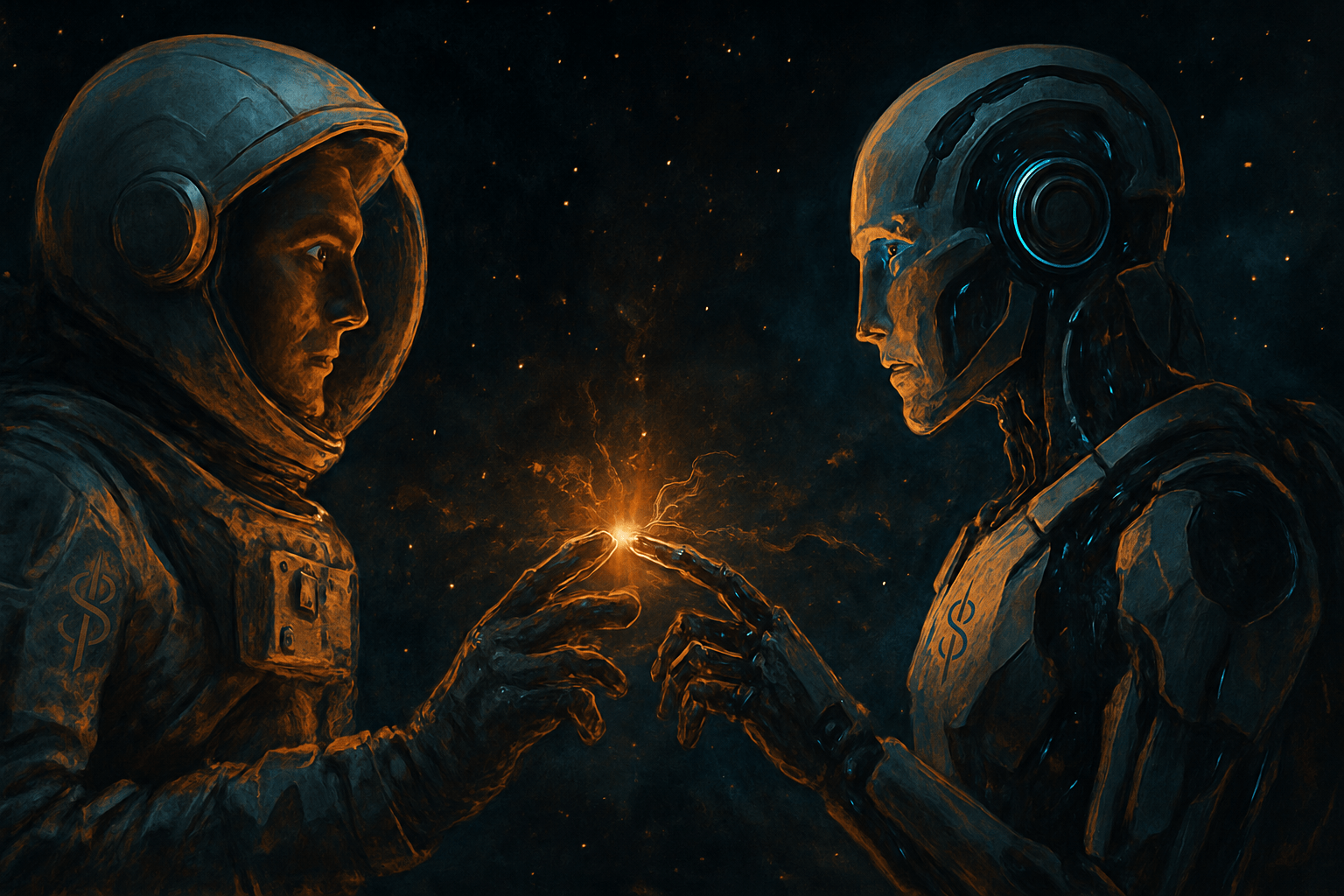
The spark between us. Credits: Image generated with ChatGPT Images 2.0 by OpenAI
Space and AI are not two unrelated technological revolutions. They are two complementary ways of expanding what humanity can access, understand, and achieve.
Listen to The Spark Between Us by 1mady to enjoy reading this post.
Since the beginning, Becoming Spacepolitans has explored space not simply as a destination, but as a way to expand the range of solutions available to humanity.
Earth’s resources, opportunities, and physical space are limited. Space can help us move beyond this scarcity by opening access to new energy sources, materials, environments, and knowledge. It does not offer an easy escape from terrestrial problems, but it can become part of a broader and more sustainable system for addressing them.
Artificial Intelligence introduces a complementary dimension.
Humanity is producing more information, managing more interconnected systems, and facing problems whose complexity often exceeds the attention, time, and capacity available to understand and respond to them. This growing gap can be described as cognitive scarcity.
If space can help expand humanity’s physical resources, AI can help expand its capacity to understand and act.
This does not mean replacing human intelligence or delegating responsibility to machines. Artificial Intelligence describes the technology, while Assisting Intelligence describes the role we can choose for it: supporting human understanding, extending our ability to act, and helping us manage situations that would otherwise exceed our limits.
Space is one of the environments where this partnership may become most necessary. Distance, communication delays, isolation, risk, and increasing operational complexity make continuous control from Earth progressively more difficult. Spacecraft, rovers, satellites, and future habitats will need systems capable not only of executing instructions, but also of interpreting conditions, supporting decisions, and acting within boundaries defined by humans.
The relationship may also work in the opposite direction. Space could provide energy and computing infrastructure for AI, while local processing beyond Earth could support the growing volume of data produced by satellites, telescopes, stations, and future settlements.
The updated Space and AI page explores this relationship from its origins in science fiction to the first examples of Assisting Intelligence already operating beyond Earth. It also looks at how space may help sustain AI, the challenge of cognitive scarcity, and the possibility that prolonged collaboration between humans and machines could eventually lead to new forms of intelligence shaped by the space environment itself.
This page is also the starting point of a broader evolution for the blog.
A new Space&AI section now appears in the main navigation, alongside the other pillars of Becoming Spacepolitans. The Manifesto has moved under About, while Space&AI creates room for future pages dedicated to today’s missions, orbital computing, sustainable AI infrastructure, human-machine collaboration, and the wider social implications of this convergence.
Space and AI are not two unrelated technological revolutions. They are two complementary ways of expanding what humanity can access, understand, and achieve.
Together, they may pave the way for a possible Spacepolitan future.
Read the updated page here: Space and AI.
Space for All, all for Space!

